
Alpacto › Couples & Chores › How to split chores
How to split chores fairly: a chore split calculator that counts minutes instead of tasks
“Five chores each” is not how to split chores fairly, because laundry is two hours a week and the bins are four minutes. This page is for anyone splitting chores with spouse, partner or roommate: this chore calculator takes the minutes each job really takes and who does it, and shows the honest total for each of you. The six steps below turn that number into a split you both signed.
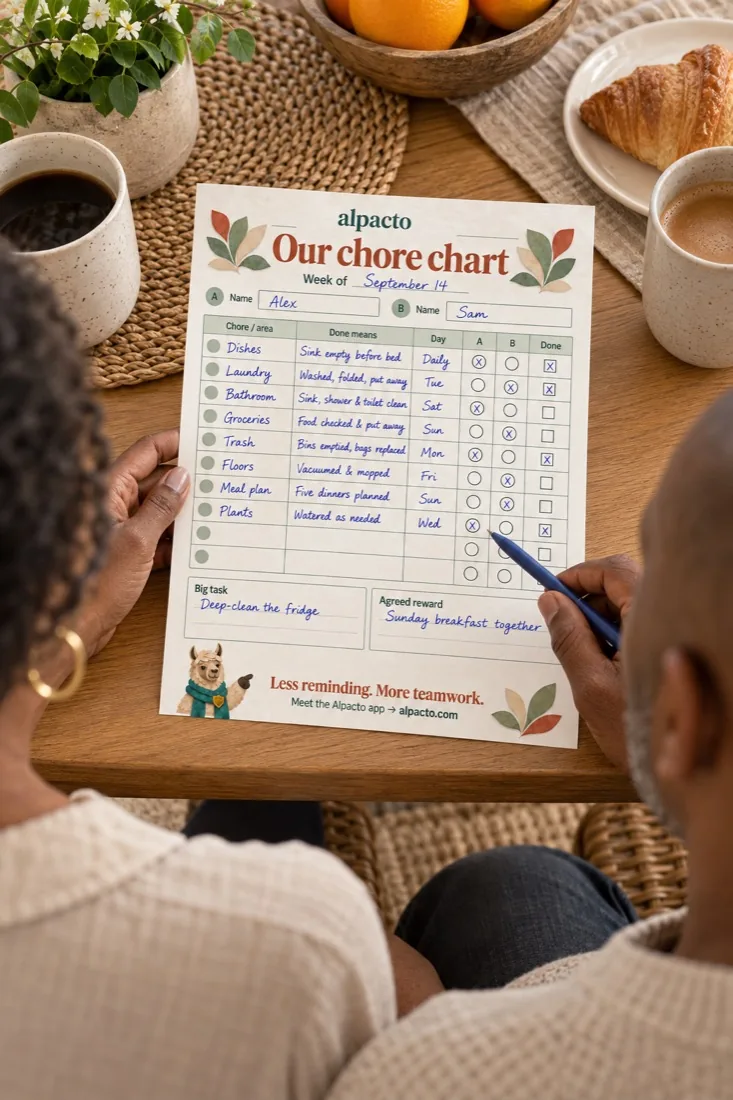
The split you both looked at is the one that holds.
In short
To split chores fairly with a spouse or partner, list every job in the home, including the planning nobody sees, and write the weekly minutes next to each one. Add up minutes per person, not lines, then decide together what to drop, what to outsource and who owns which area whole.
The result does not have to be 50/50. It has to be a number you both looked at and agreed to, written down with a day for each weekly job and a reward on the heavy rows.
The calculator on this page does the arithmetic. The chart and the app below keep the agreement alive after the first week.
Why counting tasks leaves one of you doing more
Counting tasks leaves one of you doing more because a line on a list is not a unit of work. Taking the bins out is four minutes, while laundry for two adults, from the basket to the wardrobe, is close to two hours a week. Counting minutes shows who really carries more.
Most couples split chores by lines on a list: you take the bins and the plants, I take the dishes and the laundry, four jobs each. It feels fair and it is not. Cooking and cleaning up after meals is the single largest block in the US time-use survey: 0.86 hours a day for women and 0.46 for men, before anyone has vacuumed anything.
The second problem is perception: each partner remembers their own jobs in detail and the other person’s jobs in outline, so both feel they carry more. Writing minutes next to each line replaces two memories with one number that neither of you has to argue about. If you both work full time, your paid hours are close: on days they worked, full-time men averaged 8.2 hours and full-time women 7.9 (BLS, 2024).
Hours a day on household activities, US, 2024
Chore calculator: split your week by the minute
How to split chores with spouse or partner: six steps
To split household chores fairly, list every job including the planning and put weekly minutes next to each. Drop or outsource what you can, give each person whole areas, agree what done means, and review weekly. The calculator gives you the minutes, and the six steps below turn them into an agreement.
The steps combine what time-use data shows, what a professor of organizational behavior recommends to dual-career couples, and what couples in the threads we read said finally worked.
Sit down together and write every job in the home: daily, weekly and monthly. Add the planning lines that never make a list: knowing when the dentist is due, noticing that the soap is running out, remembering the school form. Jennifer Petriglieri calls the first step “a joint inventory”, because each of you underestimates the other’s share until it is on paper.
Estimate a normal week rather than a good one. If you disagree on a number, time the job once next week and use that. Adding up the minutes per person is the only step the calculator does for you, and it is the step most couples skip.
Ask what you can simply stop doing: the ironing nobody notices, the weekly deep clean that could be monthly. Then ask what you can pay for during a hard season, a new baby, a promotion, a parent who needs care. Petriglieri’s advice to couples is to divide tasks “deliberately but not necessarily equally”, and dropping a job is a legitimate way to divide it.
“Bathroom” is a line on the chart; “scrub the tub when asked” is a request. Owning an area means noticing it needs doing, planning it and doing it. This is the idea behind Eve Rodsky’s Fair Play chore list of one hundred cards: each card is held by one person from start to finish, so nobody has to manage the other.
Look at the totals and decide the split out loud. Then write one plain sentence per line for what done means: “counters wiped, dishwasher running” is a standard, “kitchen” is not. The repeat arguments live in that gap.
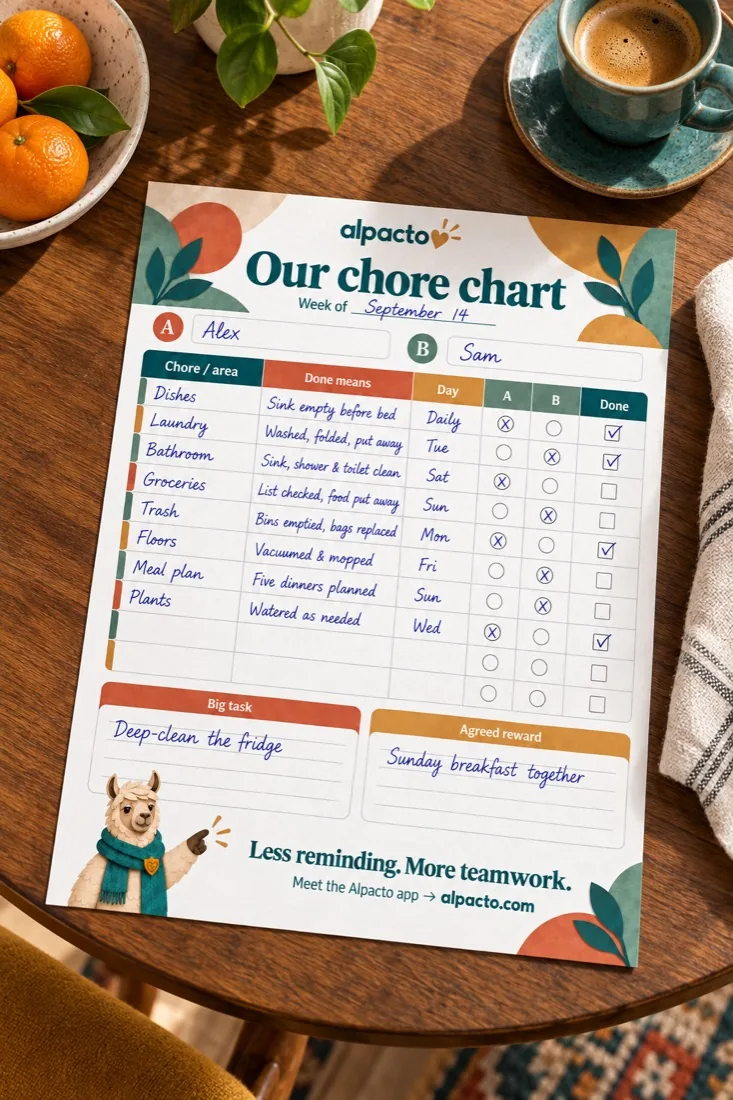
Put the split on a chore chart for couples with a day for each weekly job, or into the app. Then spend ten minutes on Sunday: what slipped, what moves, what the heavy row earned. The review is the part people skip, and the part that keeps the split honest.
When the split is unequal on purpose
An unequal chore split is fair when both of you chose it, there is a visible reason for it, and it has a review date. Research connects the division of housework, communication and relationship satisfaction, and the link runs through talking, not through arithmetic. A 60/40 split that both of you chose beats a 50/50 split that one of you resents.
Good reasons for an unequal split are visible and temporary: one of you works sixty hours this quarter, one of you is ill, one of you is up at night with a baby. Write the reason on the chart next to the date, so the split has an end and a review date instead of becoming a habit.
The bad reason is the one nobody wrote down. In marriages where both partners earn about the same, husbands still get roughly 3.5 more hours of leisure a week than wives, and most of those couples never agreed to that. If one person’s evening off is a reward on the chart, it gets earned, rather than happening to one of you by default.
And one thing that is not obvious
Dividing household chores fairly is easier when the two of you rank jobs by how much you hate them before you look at how long they take. Two hours of a job you find calming costs less than twenty minutes of one you dread. Trade the dreaded lines first, then balance the minutes.
How to split chores with roommates: rotate the shared areas
To divide household chores fairly with roommates, rotate shared areas by week and add a column for who checked. Nobody wants to own the kitchen forever, and “clean” means four different things to four people. The method works the same for three or four, though the calculator is built for two names.
Private areas stay private. Your room is your job, and the chart should say so, otherwise the tidy roommate ends up cleaning everyone’s. For a roommate home, split the shared minutes evenly unless someone is away for weeks, and put the exceptions on the chart with a date.
The weekly review matters more with roommates than with a partner, because there is no relationship goodwill to absorb a missed week. Ten minutes on the same evening every week, with the chart on the table, prevents the passive-aggressive note on the fridge.
Splitting chores with spouse who does not follow through
When a partner stops following through on a chore split, move the reminding out of the relationship and into a shared system: a chart on the fridge, pact cards or an app. All three use the same zones and the same standard of done, and differ only in who does the reminding.
Chore splits usually fail in week three rather than at the negotiation. One person keeps their lines, the other slips, and the person who kept theirs starts reminding. Reminding turns a partner into a manager, and the person being reminded hears a parent.
Paper on the fridge, ten minutes on Sunday
Tick the rows during the week, review on Sunday. The chart does the reminding by being visible. Download the couples chore chart, free, Letter and A4.
Pact cards, one per job
Write one job on a card and hand it over. It comes back signed when the job is done. Good for couples who hate a grid on the wall.
The app, when paper stops working
In Alpacto each row becomes a pact: a job, a standard of done, a reward in coins. The app counts the coins and sends the reminders, so neither of you has to be the one who asks.
Questions people ask about splitting chores
How do we split household chores fairly when we both work full time?
Split by minutes, not by tasks, and count the planning jobs nobody sees. Full-time work leaves both of you short on time, and on days they worked full-time men averaged 8.2 hours of paid work and full-time women 7.9 (BLS, 2024). So the minutes at home are what need an agreed split.
What is a fair way to split chores between two people?
A fair way is one where both of you looked at the minutes per person and agreed to the totals. Count minutes for a normal week rather than the number of tasks, and include the planning jobs that nobody sees. Fair can differ from equal, as long as it is written down and reviewed.
Should chores be split 50/50?
Not necessarily. Research connects satisfaction with communication about the split more than with the ratio itself. A 60/40 split you chose together, with a reason and a review date, works better than a 50/50 split one of you resents.
How to divide chores with husband or wife without a fight?
Start with the list and the minutes, not with who does more. When both of you see the same numbers, the argument about memory disappears and what is left is a decision. Then write down what done means for each line, because that gap causes most of the repeat fights.
What is the Fair Play chore list?
It is the set of one hundred task cards from Eve Rodsky’s book Fair Play. Each card covers a whole job from noticing to finishing, and one person holds each card. The idea behind this calculator is the same: own an area whole, count the time it really takes, and agree the split out loud.
Does the chore split calculator include the mental load?
Yes, as a line called planning and remembering. Give it real minutes. If one of you carries most of the planning, the totals will show it, and you can move whole areas rather than single tasks.
Is there a chore calculator?
Yes, the one on this page. You enter the minutes each job takes a week and who does it, and it shows the total for each person and the split as a bar. It works on a phone and needs no account.
How should a married couple divide chores?
Do the same six steps as any couple: list every job including the planning, put minutes next to each, drop or outsource what you can, and give each person whole areas. Then write the split on a chart with a review date. A chore chart for husband and wife has two blank name columns for exactly this.
How to split chores with roommates?
Rotate shared areas by week, keep private rooms private, and add a column for who checked. Split the shared minutes evenly unless someone is away for weeks. The calculator takes two names, so run it once per pair or use the roommate version of the cleaning schedule.
Is there a chore split calculator app?
The calculator on this page works on a phone and needs no account. For keeping the split alive after the first week, the Alpacto app turns each row into a pact with a reward in coins and does the reminding for you.
What if one of us works more hours than the other?
Count the minutes first, then decide on purpose. A heavy work season is a good reason for an unequal split if you both agree to it. Write the reason and a review date on the chart, and revisit the split when the season ends.
How to split household chores with partner or roommate when there are three of you?
Rotate shared areas by week, keep private areas private, add a column for who checked, and review on the same evening every week. The method is the same as for a couple; the rotation and the check column are the two additions.