
Alpacto › Agreements
Agreements between partners, roommates and families: which one to write, and how
Three guides and five printable sheets for putting a promise on paper: to yourself, a partner, your roommates or a teenager with a first phone. Find your situation in the table below. None of the sheets is a legal document.
In short
Start from who is on the other side of the promise: a promise to yourself becomes a self contract with a witness, a shared flat gets a roommate agreement. Whatever the paper, write each point as something you do, how you do it and what happens when it slips. End with both signatures and a date to read it again.
Why a written agreement holds better than a spoken one
A spoken agreement lives in two memories, and a month later they no longer match. Whoever remembers it more strictly becomes the one who reminds, and the other one hears nagging.
Research on goals points the same way. A 2016 review of 138 randomized studies found that tracking progress helped people reach a goal more when the results were physically recorded and when they were reported to someone else. A signed sheet on the fridge does both.
| Said out loud | Written and signed | |
|---|---|---|
| What was agreed | Two versions, one in each head | One version both of you can read |
| What happens after a slip | Decided in the heat of the moment | Written down before anything went wrong |
| When it changes | Quietly, when someone stops doing it | On the review date, by both signers |
Which of the agreements between partners, roommates and families you need
The sheets for two people or more have no head roommate and no partner in charge. Even the teen contract gives the parents rules of their own.
| Your situation | What to write | Page |
|---|---|---|
| You keep breaking a promise to yourself | A self contract a witness co-signs, with a plan for skipped days | Contract with yourself |
| You and a friend want to keep each other on track | Five lines you both fill in before day one | Accountability partner |
| A friendly bet with your partner | The bet, a deadline, a judge and a prize that is not money | Bets for couples |
| Sharing a flat | An agreement between roommates on money and the house, from chores to moving out | Roommate agreement |
| Two partners, the same argument every month | A relationship agreement on the home, money, time apart and how you make up | Relationship contract |
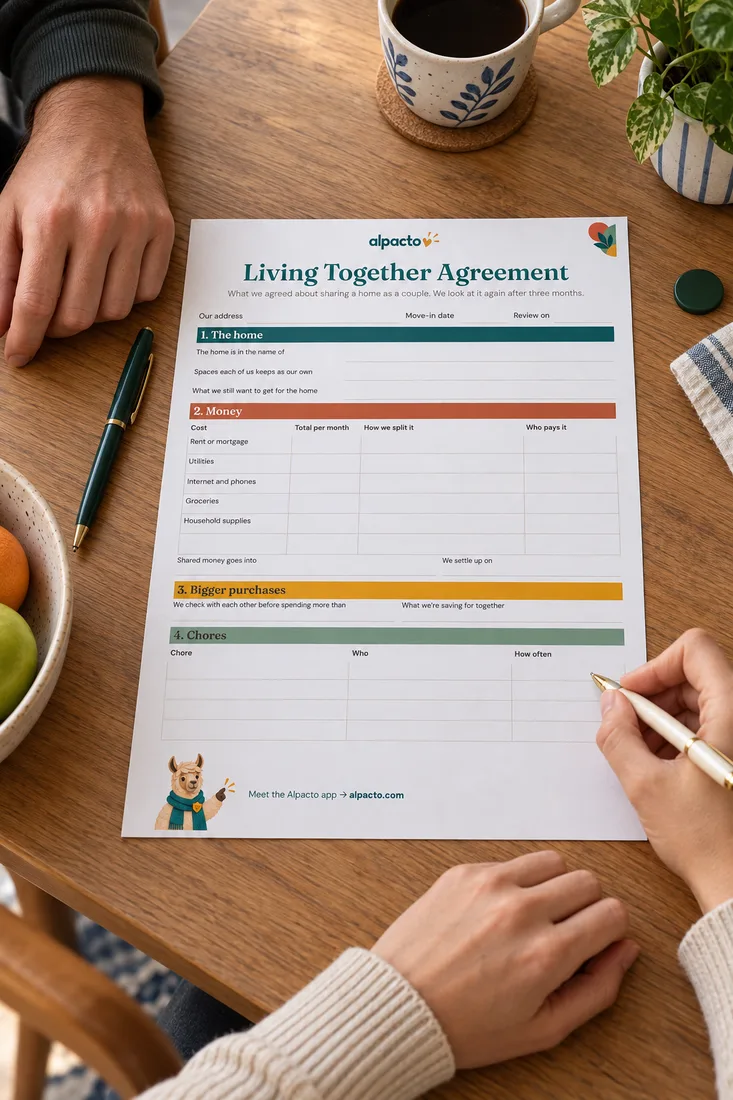
| Moving in together | Whose name is on the place, how rent splits, and a calm plan if you split up | Living together agreement |
| A teenager’s first phone | Phone rules for the teen and three rules the parents keep | Teen phone contract |
| A few rules for everyone at home | A blank sheet, each rule in three parts, signed by two adults | House rules |
The last five rows also sit side by side on one page: agreement templates.
Four guides on keeping an agreement going
Contract with yourself
Signed alone, a promise has one weak spot: only the person who broke it can notice. The guide adds a witness, a weekly check-in and two lines for skipped days. Write a contract with yourself
Accountability partner
What four studies found, including one where a partner added nothing, and why most partnerships fizzle out. It ends with a 30-day tracker for two. Set up an accountability partner
Bets for couples
Forty bets sorted by how long they run, with jobs for the loser in place of punishments. The Bet Contract names a deadline and a judge, with no money anywhere. Pick a bet
Rules for fighting fair
Twenty-five rules for before, during and after an argument, including a time-out word. Tick the ones you both accept, edit the wording and print a sheet you both sign. Write your fair fight rules
How to write any agreement: three parts, two signatures, one date
The house rules sheet prints the rule that works for any agreement: each point says what you do, how you do it and what happens when it slips. Write the thing you do, not the thing you avoid. Dishes done before bed can be checked tonight; stop being messy can be argued about forever.
- What you do. One action someone can see, with a day or a time: bins out on Tuesday night.
- How you do it. The standard of done, so nobody argues about what counts: both bins, lids shut, at the curb.
- What happens when it slips. Agreed while nothing has slipped yet: we swap weeks and talk it over on Sunday.
- Names, signatures and a review date. All five agreement sheets have a line for that date.
The review date does the most work: an agreement nobody rereads drifts back into one person’s version of events.
Is a family agreement legally binding? Ours are not
Several of our sheets say so in print: “Not a legal document. A shared agreement between people who trust each other.” Signing one changes nothing in your lease.
A paper that must hold up in court, such as a cohabitation agreement, is work for a lawyer, and the rules depend on your state. Our sheets cover what those forms leave out: who cleans the bathroom in odd weeks.
Questions people ask
Can a roommate agreement be legally binding?
Sometimes, depending on your state and on what it says, which is a question for a lawyer. Ours is not meant to be: the roommate agreement prints Not a legal document on page two. If rent shares must hold up in a dispute, put them in a legal form as well.
What about a family agreement on money or care for a relative?
That is a legal matter, and that kind is written with a lawyer. Our sheets are for how you live in the same home.
How do I write up a simple agreement?
Write each point in three parts: what you do, how you do it and what happens when it slips. Then add both names, both signatures, the date and a date to read it again.
Can I draft my own agreement?
Yes, for the household kind. For anything a court may need to enforce, have a lawyer read it first.
What are some examples of family agreements?
A phone contract with a teenager, a page of house rules, a living together agreement before a move, or a bet between partners with its own judge. Each one is linked in the table above.
The same agreement, on both phones
In Alpacto a written agreement becomes a pact: a task, a routine, a challenge or a bet, with the person, the deadline, the standard of done and a reward. Both sides see the same terms before anything starts, and coins stay inside Alpacto and are never money.