
Alpacto › Couples & Chores
Chore chart for husband and wife, and everything else about sharing a home as two adults
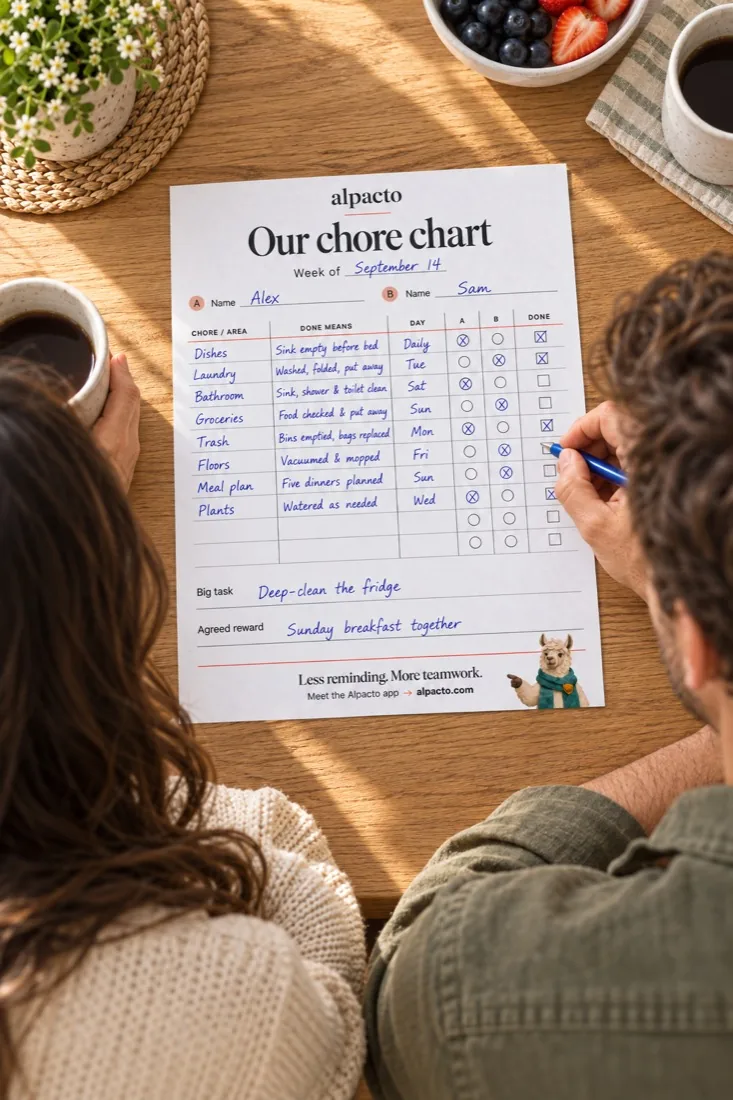
A chore chart for husband and wife, or for any married couple, has two blank names, a plain standard of done on every row and a weekly day for each job. This hub covers the part of living together that causes the most arguments: who does what, who remembers what, and who ends up reminding. It holds the shared chart, a calculator for how to divide household chores by minutes, the mental load list and the articles that go with them, each starting from what couples say in the threads.
In short
A married couple chore chart works when both names are blank until you write them in, when every row has a plain standard of done, and when you split minutes rather than lines. The invisible half of housework is the planning, so the chart has zones you own whole instead of tasks you do on request.
Paper on the fridge is the first step. If the chart dies in week three because one of you is doing the reminding, the same agreement can live in the app, which counts the coins and sends the reminders instead of a partner.
Guides and tools in Living together
Chore charts
Chore chart for couples: a free printable that treats you both as adults
A couples chore chart that lasts past week two: zones, a chore schedule for couples by day, a chore wheel, and a fair split of the minutes.
articleFair split
How to split chores fairly: the chore split calculator
A free chore calculator: enter the minutes each job takes, see the split for two, and learn how to split chores with a partner, spouse or roommate.
toolMental load
Weaponized incompetence: how to hand a job over instead of arguing about it
What weaponized incompetence is, whether it can be unintentional, examples both ways, and a card sheet that hands a job over in three accepted hand-ins.
articleThe mental load: hand over the noticing, not only the chores
The mental load is the noticing, planning and checking behind housework. Four steps from the research, a list by area, and a way to hand one area over whole.
articleFair Play cards: what is in the deck of 100, and how to deal it
What the 100 Fair Play cards hold, suit by suit, what the deck and the book cost, how a round works, where couples get stuck, and how to play without buying it.
articleThe FlyLady method, run by two people instead of one
What the FlyLady method is in the words of its own site, what is free and what costs money today, and four changes that let two people share the zones.
articleMoney
How to split bills in a relationship: three ways, and the page you both sign
Three ways couples split bills, the math for an income-based split, and a one-page money agreement to fill in together. Free printable, Letter and A4.
articleCouples conflict
What do couples argue about? Here is what 998 people asked a partner for
What do couples argue about? We counted 998 asks people made of a partner across 3,863 discussions and published the method. Sex, kids, and being asked at all.
articleCouples
Marriage advice for newlyweds: a first-year plan you can tick off and print
37 pieces of marriage advice for newlyweds as dated actions. Tick yours, enter the wedding date and print a 12-month timeline. Free.
articleDefault parent: what it means, and how to stop being one
What a default parent is, seven signs, and a free 30-task check that shows who carries what. Five steps to stop, a script, and a printable hand-off list.
articleHow to improve communication in a relationship: a sentence rewriter and 6 exercises for two
Rewrite a blaming sentence into a clear request, then try six two-person communication exercises with timers. Free, in your browser, nothing saved.
articleSigns of a healthy relationship: what they look like at home, and a private 20-statement check
Signs of a healthy relationship in plain terms, plus a private 20-statement self-check that shows strong areas and areas to talk about. Not a diagnosis.
articleWhat a chore chart for husband and wife (and any married couple) needs that a kids’ chart does not
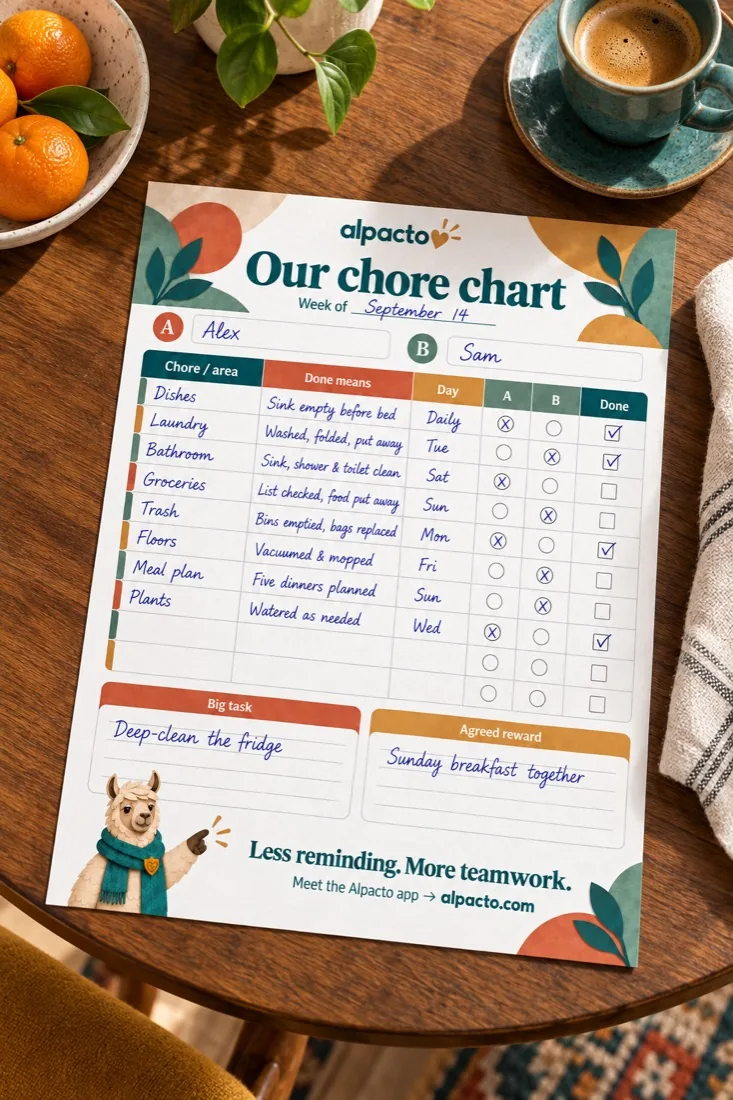
Most chore chart templates were drawn for children: a row of stars, a grown-up who checks, a prize at the end. Hand that to another adult and you have made one of you the parent. The couples in the threads we read are blunt about it: a chart one partner made for the other gets followed by one person and then thrown away.
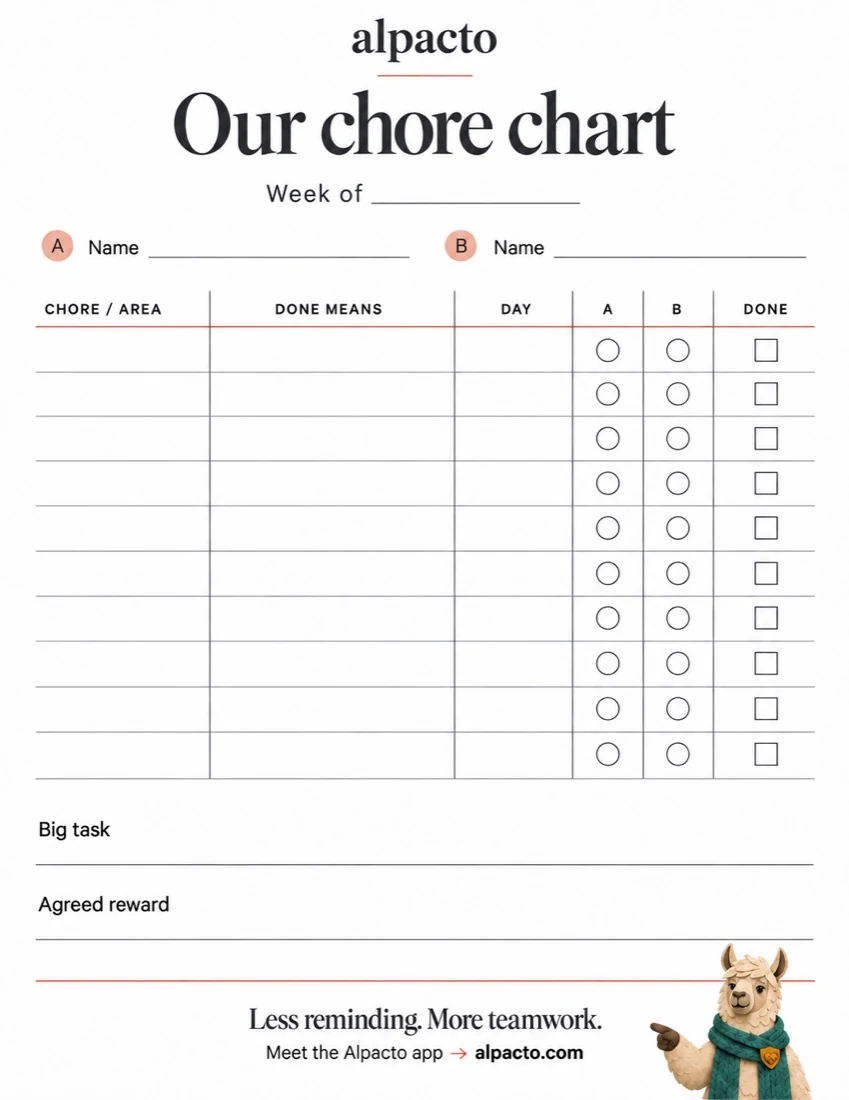
A chart for two adults needs three things a kids’ chart lacks. Two name columns that are blank until you write them in, so the sheet has not decided who does what, and zones of the home instead of one-off tasks, because a zone can be owned whole and a task cannot.
The third is a one-line standard of done per row, because “I did the dishes” and “the kitchen is clean” are different jobs.
For a day-by-day chore schedule for couples, a chore wheel or a chore list, the walkthrough is on its own page: chore chart for couples, with schedule, wheel and chore list. The sheet comes in three designs, US Letter and A4, and downloads with one click and no email. Every other chart on the site, for adults, roommates and kids, is in the chore chart list.
How to divide household chores: by minutes
“Five chores each” sounds fair and is not, because taking the bins out is four minutes and laundry for two adults is close to two hours a week. In the US time-use survey, cooking and cleaning up is 0.86 hours a day for women and 0.46 for men, before anyone has vacuumed anything.
The way out is to write minutes next to every line, add them up per person, and decide the split out loud. Research connects the division of housework with relationship satisfaction through communication rather than through the ratio: a split you both chose beats an equal split one of you resents.
The chore split calculator does the arithmetic on a phone, with a line for planning and remembering so the invisible work shows up in the totals. The page around it explains the six steps, from listing everything to the ten-minute Sunday review.
Hours a day on household activities, US, 2024
What is mental load, and what goes on a mental load list
What is mental load? It is the thinking part of running a home: noticing that the soap is nearly out, knowing when the dentist is due, deciding which summer camp, checking that the form went in. A 2019 study of 35 couples broke this cognitive work into four steps, anticipate, identify, decide and monitor, and found that anticipating and monitoring fell mostly to women even when the visible tasks were shared.
A mental load list makes that work visible: one line per area, with the noticing and the planning written out alongside the doing. Once it is on paper, the fix is not “help more”. It is handing over an area whole, so the person who owns the bathroom also owns knowing when the bathroom needs anything.
Handing an area across works the same way on paper: write the area, the standard of done and the name of whoever owns it next, so the noticing moves along with the doing. The cleaning schedule has a column for exactly that.
How to stop nagging: move the reminding out of the relationship
Nagging is not a character flaw. It is what happens when one person holds the plan in their head and the other person holds none of it, so the plan has to be transmitted out loud, repeatedly.
The person reminding feels like a manager. The person being reminded hears a parent and does less. If the two of you do better with a finish line, turn the habit into one of the couple challenges with a stake and a date.
The way out is a deal both of you signed, with the reminder built into the deal rather than into a person. On paper that is a chart on the fridge with a day for each weekly job and a ten-minute Sunday review. In the Alpacto app it is a pact: a job, a standard of done and a reward in coins, with the app counting and reminding so that neither of you has to.
Guides for couples: housework and money
The mental load
The noticing, planning and checking behind housework: the four steps from the research, a list by area, and how to hand one area over whole. Read about the mental load.
Weaponized incompetence
What it is, whether it can be unintentional, examples both ways, and a card sheet that hands a job over in three accepted hand-ins. Read about weaponized incompetence.
Fair Play cards
What is in the deck of 100, suit by suit, what the deck and the book cost, how a round works, and how to play without buying it. Read about the Fair Play method.
The FlyLady method for two
What the method is in the words of its own site, what is free today, and four changes that let two people share the zones. Read about the FlyLady method.
How to split bills
Three ways couples split bills, the math for an income-based split, and a one-page money agreement you both sign. Read how to split bills.
The default parent
Who the school calls first, a check of 30 kid tasks that shows the real split, and a hand-off list for the jobs you give away whole. Stop being the default parent.
Talking, arguing and the first year
What couples argue about
998 asks people made of a partner, counted across 3,863 discussions, with the method published. Read what couples argue about.
How to improve communication
Rewrite a blaming sentence into one that lands, a list of words that start fights, and six exercises for two with timers. Talk so it lands.
Signs of a healthy relationship
Twenty statements in six areas, a private check of what is strong and what to talk about, and where to turn if something feels unsafe. Take the check.
Marriage advice for newlyweds
37 things to settle in the first year, from the first money talk to the holiday rotation, turned into a dated plan from your wedding day. Plan the first year.
Printables for couples
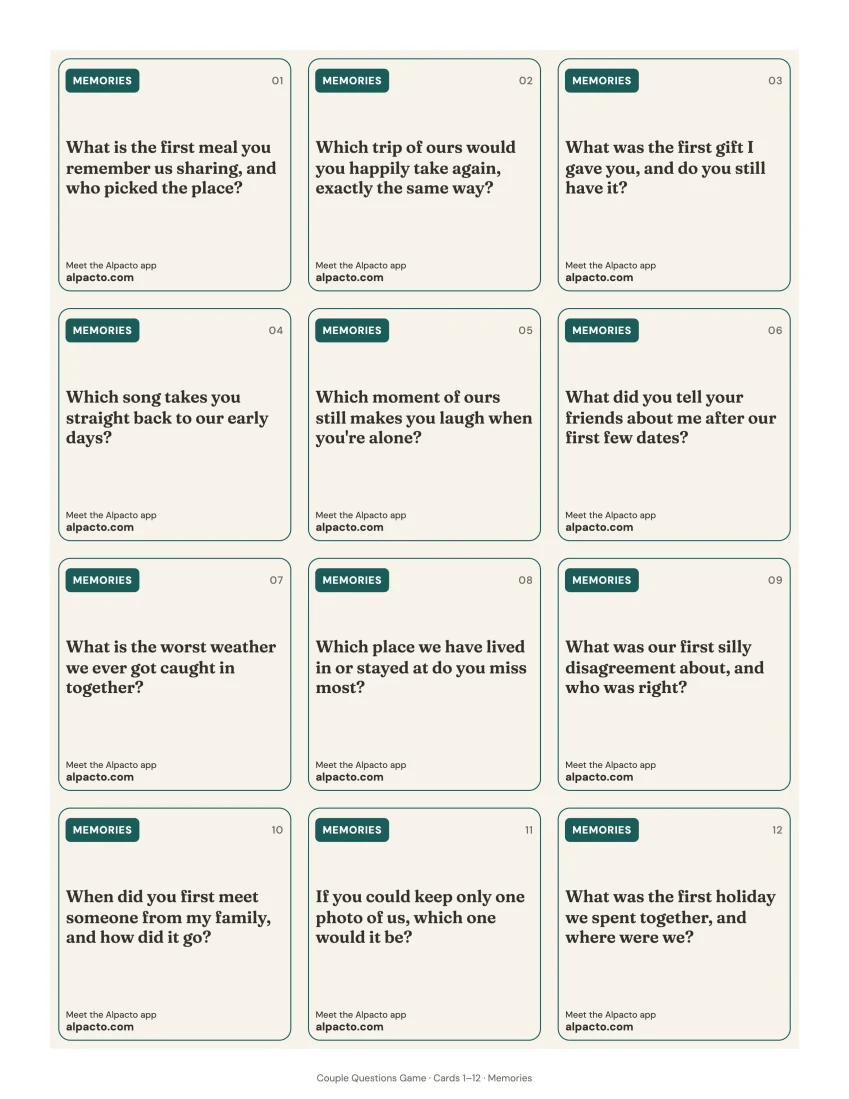
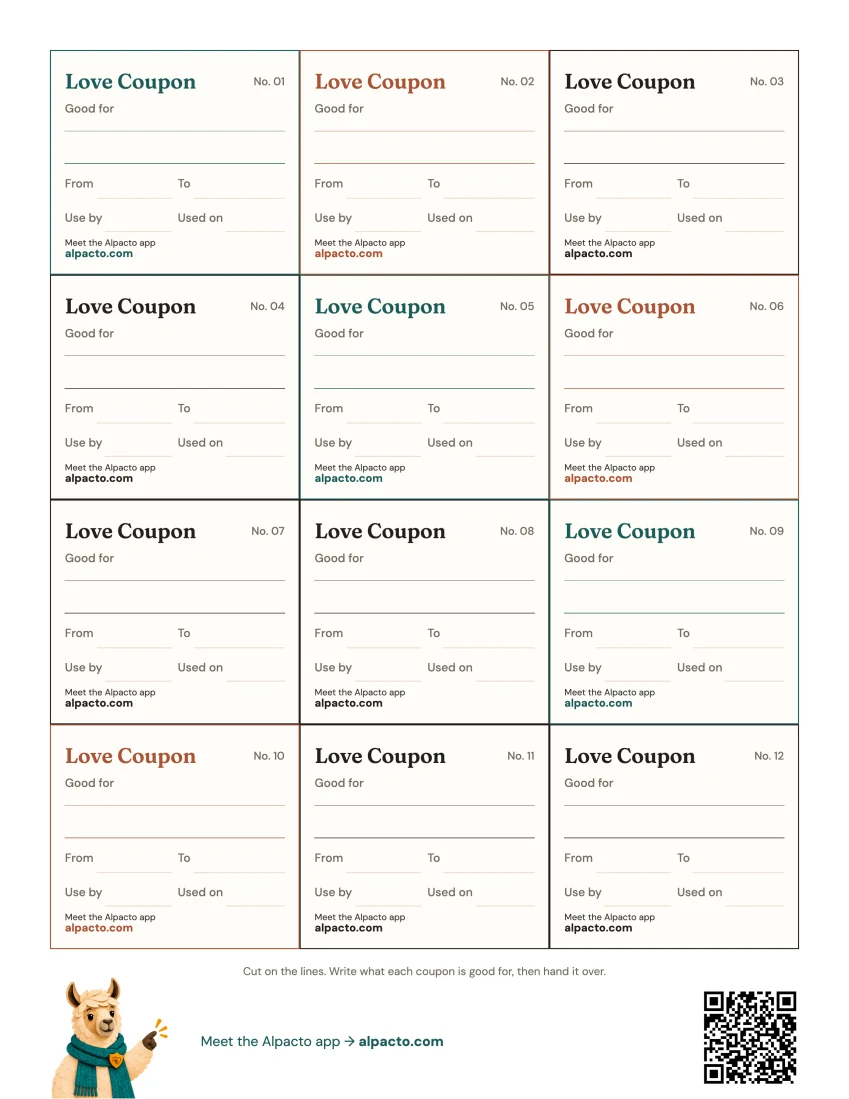
Blank and filled in, US Letter and A4, download without an email.
Questions couples ask
Is this chart different from a chore chart for adults who are roommates?
The sheet is the same: two blank names, zones, a standard of done. Roommates add a rotation for shared areas and a column for who checked, because there is no relationship goodwill to absorb a missed week. The roommate version of the cleaning schedule has both.
How do we divide household chores when one of us works much longer hours?
Count minutes for both paid and unpaid work, then agree an unequal split on purpose, with the reason and a review date written on the chart. An unequal split you both chose holds better than an equal one that ignores the hours.
What is the mental load in one sentence?
It is the anticipating, deciding and monitoring that keeps a home running, as opposed to the visible doing, and it is the part most likely to fall on one person without anyone agreeing to that.
Does a chart help if my partner does not care about the house as much as I do?
A chart cannot make someone care, but it can replace “you never help” with a written standard of done for each row and a reward on the heavy ones. In the threads we read, the arguments were about the standard far more often than about caring.
How should a married couple divide chores?
Write down every job with the weekly minutes next to it, add the minutes per person, and decide the split out loud. Then give each of you whole areas of the home instead of single tasks, and put the split on a chart with a review date. The chore split calculator does the adding.
Is there a household chores chart for husband and wife that I can print?
Yes. The chore chart for husband and wife is free, comes in three designs, US Letter and A4, and has two blank name columns, zones and a line for what done means. It downloads without an email.
Is there a chore calculator for couples?
Yes. The chore calculator takes the minutes each job takes and who does it, then shows the total for each of you. It works on a phone and needs no account.
Is there an app for sharing chores between two adults?
Yes. Alpacto turns each row of the chart into a pact between two people, with coins for what gets done and rewards you both wrote down. It is on the App Store and Google Play.
The same deals, without anyone doing the reminding
Every chart here has an app version: the same zones and rewards, coins counted automatically, reminders sent by the app rather than by a partner.