
Alpacto › Couples › Signs of a healthy relationship
Signs of a healthy relationship: what they look like at home, and a private 20-statement check
The signs of a healthy relationship are visible on an ordinary day: you are listened to, you trust what you are told, chores are shared fairly and fights end in repair. Below are those signs in plain terms and a private self-check that shows which areas are strong.
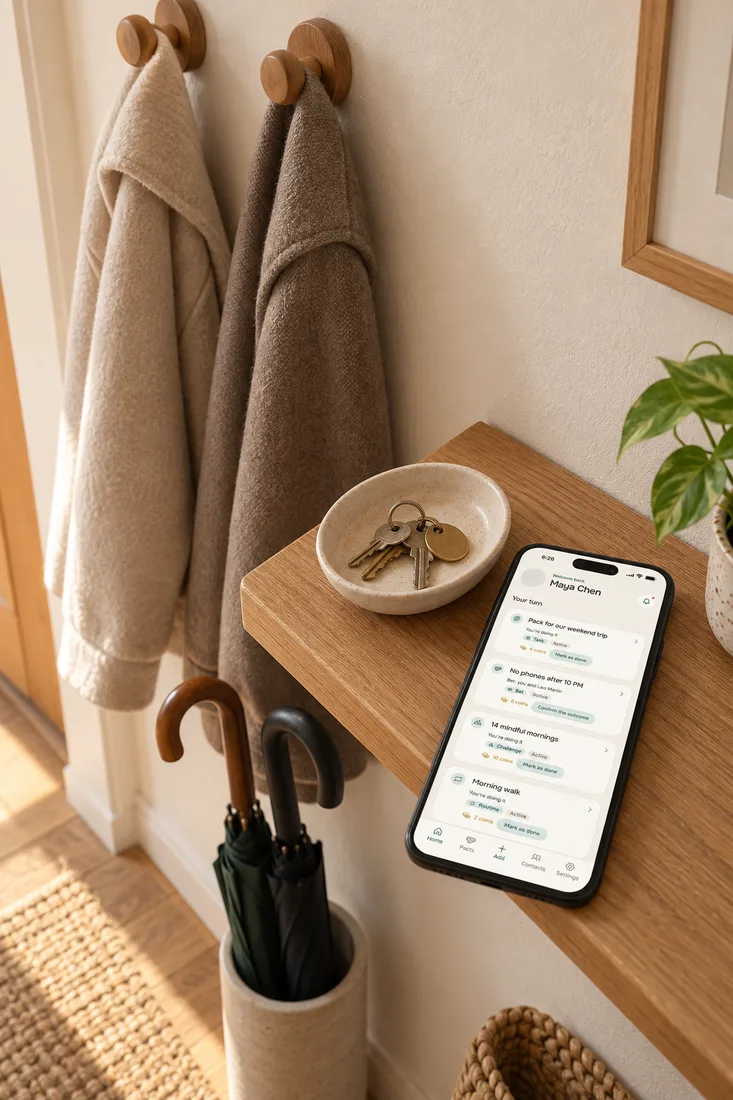
Healthy shows up in small, ordinary things.
In short
A healthy relationship is not one without arguments. It is one where both people feel respected and free, and where problems get talked through instead of buried.
The check below has 20 statements in six areas and takes about five minutes. It is not a diagnosis. If any statement about fear, control or harm is true for you, skip to the safety section, because that is not something better communication fixes.
Healthy relationship check: how often is each of these true?
Answer for the last few months, not your best or worst day. Nobody sees your answers, and closing the page erases them. Your partner can fill it in separately, and you compare areas, not scores.
Respect
- My partner takes my opinions seriously, even when we disagree.
- We talk to each other without sarcasm, mocking or name-calling.
- When I say no to something, my partner accepts it.
Trust and honesty
- I believe what my partner tells me.
- Neither of us checks the other’s phone or messages in secret.
- When one of us says “I will,” the other can count on it.
Fairness at home
- Big decisions about money and the home are made together.
- Chores and errands are shared in a way we would both call fair.
- We both know what accounts and bills exist and can use the money we need.
- Noticing what needs doing is not always the same person’s job.
Handling conflict
- I can bring up a problem without it turning into a fight about everything.
- When a fight gets heated, one of us can call a pause and we come back to it.
- After an argument, at least one of us says sorry for their own part.
- Most arguments end with something we agreed on.
Independence
- I can spend time with friends or family without being questioned or punished for it.
- Each of us has time or interests that are ours alone.
- I feel free to be myself around my partner.
Fun and warmth
- We laugh together several times a week.
- We spend time together that is not about chores or logistics.
- We still do small kind things for each other.
Five questions about safety
These are answered the other way round: Never is the good answer. They are not part of the six areas above. You can answer them even if you skip the rest.
- I feel afraid of how my partner will react when I disagree.
- My partner controls my money, my phone or who I see.
- My partner has hit, pushed or threatened me, or blocked me from leaving.
- My partner pressures me into sex or physical contact I do not want.
- I change what I say or do mainly to keep my partner calm.
- Fair fighting rules · Relationship check-in questions
- Questions to ask your partner · Relationship contract template
- How to split chores fairly · The mental load · Chore chart for couples
- Fair fighting rules · How to improve communication
- What couples argue about · Living together agreement
- At home date night ideas · Date night jar
Signs of a healthy relationship, and what each looks like at home
The National Domestic Violence Hotline describes a healthy relationship as one where both partners talk openly, respect each other, trust, stay honest, are equal and set boundaries. Cleveland Clinic adds empathy, reliability and teamwork. The table puts those ideas into things you could see in your kitchen.
| Sign | What you would see on an ordinary day |
|---|---|
| Respect | A disagreement about dinner ends with both opinions heard. Nobody mocks the other’s job, family or tastes. |
| Trust | Phones lie on the counter and nobody thinks twice. A late text is a late text, not a trial. |
| Honesty with privacy | You tell each other the facts that matter, and each of you can still keep a private thought. |
| Equality | Money, moves and big purchases are decided together, and both of you can see and use the accounts. |
| Fairness at home | Both of you know what needs doing this week. Reminders go both ways, or are not needed. |
| Healthy conflict | You can say “pause” and mean it, and the topic comes back the next day. |
| Independence | A night out with friends gets a “have fun,” not an interrogation. |
| Warmth and fun | You laugh, you touch, you still do small things for each other with no occasion. |
The characteristics of a healthy relationship are the same whether you are dating or married, and the signs of a healthy marriage add shared money and home. With the years, shared money and housework pile on top of them, so fairness at home matters more.
Healthy relationship signs that surprise people
Arguing is not a red flag
The Gottman Institute separates a complaint about a specific thing from criticism of your partner’s character, and says contempt such as mockery, name-calling and eye-rolling can predict the end of a relationship. A healthy couple argues about the first and avoids the second. Our fair fighting rules page lets you pick rules for it.
Hard work is normal
Cleveland Clinic quotes a psychotherapist who says every relationship has hard times and that how you deal with them matters. A rough month alone does not make a relationship unhealthy.
Familiar is not the same as healthy
The same article warns that a relationship can feel familiar or better than past ones without being healthy, especially if earlier relationships were problematic. That is a reason to check against behaviors, as the table and the check above do, rather than only against how it feels.
Healthy, unhealthy or abusive: where fear and control belong
The Hotline puts it this way: “All relationships exist on a spectrum from healthy to abusive, with unhealthy in between.” Its page lists abuse signs such as threats and insults, control over where you go and who you see, control of the money, and pressure for sex.
You do not have to be sure it counts as abuse before you reach out. If you worry about being monitored online, use a device your partner cannot see.
What to do with your result
- Pick one area worth a talk. One is enough for a week.
- Say what you noticed, not what your partner is: “I answered Sometimes to the one about chores. Can we look at that on Sunday?”
- Use a tool for that area, such as the links in your result. Each opens a page with something you can fill in together.
- Redo the check in a month. If an area is still low and you are stuck, a couples therapist can help.
Questions people ask
What are 5 signs of a good relationship?
Five that cover the most ground:
- You feel respected when you disagree.
- You believe each other.
- Jobs at home are shared fairly.
- Arguments end in repair.
- You each have a life outside the relationship.
What are 10 signs of a healthy relationship?
Add to the five above: you laugh together, you can say no, money is decided together, you can keep a private thought and you do small kind things unasked. The table on this page and the 20 statements in the check show what each looks like.
What are 12 signs that a relationship is healthy?
There is no official twelve. Cleveland Clinic lists twelve under its own headings, from respect and earned trust to being comfortable with each other when you are not on. Our check groups similar ideas into six areas.
What is the 3 6 9 month rule in relationships?
We could not open a source with a clear, research-based definition, so we do not repeat its numbers. Signs of health are about behavior, not the calendar, and the check works at any length of relationship.
Is it normal to fight in a healthy relationship?
Yes. What matters is how you fight: about the issue, without contempt, with a pause when it gets hot, and an agreement at the end. If you are afraid of your partner during a fight, that is not a normal disagreement.
Can a relationship be healthy and still need work?
Yes. A low area in the check is a place to work, not a verdict. Most couples have one or two.
Is this check a diagnosis?
No. It is 20 statements that help you start a conversation. It cannot judge your relationship, and it is not therapy or medical advice.
From a low area to a small agreement
When a low area turns into one specific job or promise, write it down. In Alpacto that kind of agreement becomes a pact between two people. One promises, the other accepts, and both see what was agreed and what is still owed.