
Alpacto › Challenges & games › Relationship check in questions
Relationship check in questions: 63 to choose from, and a builder for your weekly or monthly agenda
A relationship check-in is a short, regular talk where you both say what went well, what was hard and what you will do next. Below are 63 couples check in questions in nine sections and a builder that picks a balanced set for a 15-minute weekly or a 45-minute monthly check-in. It prints a one-page agenda.
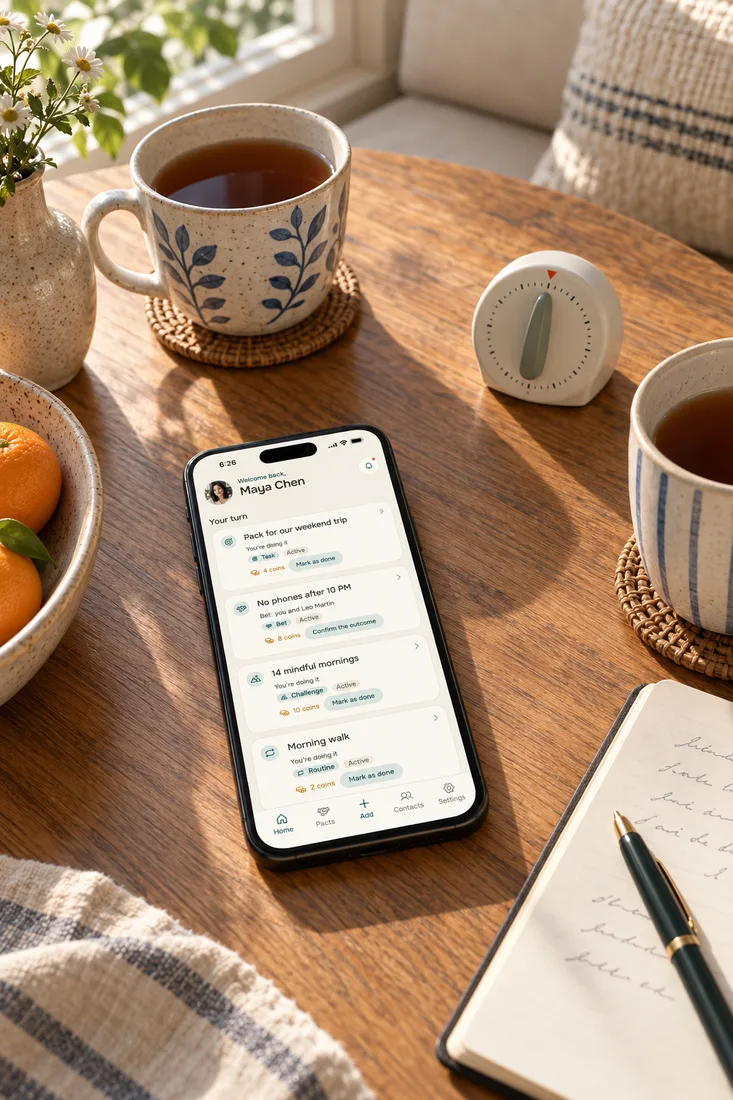
One page, fifteen minutes, one agreement at the bottom.
In short
Weekly is five questions in 15 minutes. Monthly is ten questions in 45. Every agenda starts with appreciation and ends with one agreement.
Keep it on a timer, bring no ambush topics, and stop when the time is up. If it turns into a fight, stop and book a second slot.
Relationship check in question builder: your agenda in one click
The builder takes one question from each section, opens with appreciation and closes with a plan. Swap or rewrite any question, add your names and print. Nothing you type leaves this page.
Print opens your browser’s print window. Choose “Save as PDF” there if you would rather keep a file.
63 relationship check in questions, by section
The builder draws from this list, so you can also read it straight through and pick your own. For getting-to-know-you questions, see 120 questions to ask your partner.
Appreciation
Start here: thanks first, so the rest is easier to hear.
- What did I do this week that you noticed and never thanked me for?
- Name one small thing I did that made your week easier.
- What did you like watching me do this week?
- When did you feel most on my side this week?
- What did I handle that you were glad you did not have to think about?
- Which moment from this week would you like us to repeat?
- What is one thing you are grateful for that I may not know about?
What went well
Look back at what worked, so you know what to keep.
- What worked this week that we should keep doing?
- Which day felt easiest between us, and what made it easy?
- What was the best ten minutes we had together?
- What did we handle better than last time?
- Which problem from a few weeks ago has quietly gone away?
- Which small habit of ours is paying off?
- What are you proud of us for?
The week ahead
Logistics: put the calendar on the table.
- Which evenings are already taken this week, and which are free?
- Which day will be the busiest, and what do you need from me on it?
- Which appointments, deadlines or visitors do we need on one shared calendar?
- Who is handling dinner on which nights?
- What do we keep forgetting that needs a date?
- What do we need to buy, book or return before the weekend?
- When is our next time alone, and what are we doing?
Chores and fairness
Who carries what, including the planning nobody sees.
- Which chore felt heaviest to you this week?
- Did you do something around the house that I probably did not notice?
- Which job would you hand over if you could?
- Who is carrying the planning, not just the doing, of something right now?
- Is there a job where we disagree about what done looks like?
- On a scale of 1 to 10, how fair does our split feel this week, and what would move it up one point?
- Is there a job that has sat undone long enough to need a decision?
Money
Short and factual. Big money talks get their own slot.
- Is there a purchase this week that we should have talked about first?
- Which bill or payment is coming that we both should expect?
- Does this month’s spending match what we said mattered most?
- Is there something you want to save for in the next three months?
- How do you feel about our money right now, in one word?
- Is anything about who pays for what bothering you?
- Which money decision have we been putting off?
Intimacy and connection
Closeness, touch and time together, asked plainly.
- When did you feel closest to me this week?
- When did you feel far away, even though we were in the same room?
- What kind of attention or touch would you like more of this week?
- How did our time together compare with our time on phones?
- What do you miss from earlier in our relationship?
- How are we doing on affection and sex, and does either of us want something different?
- What could I do this week that would make you feel wanted?
One thing to change
Phrase it as a request, not a verdict.
- What is one thing I do that makes your life harder, said as a request?
- What did I say or do this week that stung? Start with “I felt…”
- What do you want me to do less of next week?
- What is one habit of yours you want to change, and how can I help?
- Which topic have we been circling that needs its own time?
- Is there something you would like to have said in a different way this week?
- What have you been waiting to bring up?
Support and stress
What is going on outside the relationship that lands inside it.
- What is taking most of your energy outside our relationship right now?
- On a scale of 1 to 10, how full is your tank, and what would add a point?
- Which hour of your week is the hardest, and could I make it lighter?
- For the thing on your mind, do you want advice, help, or just me listening?
- When you are stressed, what do you wish I would do?
- What are you carrying alone that I could share?
- Who or what outside our home is draining you, and what would help?
One agreement
The ending: a plan both of you can repeat.
- What is our one agreement for next week, written as who does what by when?
- What is one thing I can do next week that would make you feel cared for?
- Which topic from today needs a follow-up, and exactly when is it?
- What will we each do so that we remember this agreement?
- What is one thing we will do just for fun next week?
- What is the date and time of our next check-in?
- Which one thing from today do you want me to remember on Wednesday?
What a relationship check-in is, and where the idea comes from
A check-in is a standing appointment for the relationship itself. It is not a date, and it is not the place to settle one big argument. It is a short routine with the same shape each time, so small things get said before they pile up.
The format comes from the “State of the Union” meeting, an idea from the Gottman Institute. Their article describes a weekly talk in four steps: appreciations, what went right, concerns, and one request for the coming week. It does not give a length.
Why a fixed slot helps is our reasoning, not a study. A concern with a day to land on does not have to come out over dinner or at 11 pm. A talk that opens with thanks and ends with a plan also feels different from one that opens with a complaint.
Five rules for a relationship check-in
- Set a timebox. Fifteen minutes for a weekly check-in, 45 for a monthly one. When the timer ends, the check-in ends, even mid-topic. Write the topic on the sheet and carry it to the next one.
- No ambush topics. A subject that needs more than five minutes, such as a move or a debt, gets named under “one thing to change” and booked as its own conversation. Do not spring it on your partner in the middle of the check-in.
- Take turns, and swap who goes first. One person answers while the other listens without fixing. Next week the other person opens.
- Pick a time and a place. Same day, same chair, phones face down. “When we have a moment” is how check-ins stop after two weeks.
- End with one agreement. One, not five. Write it as who does what by when, so that next week you can both say whether it happened.
Weekly relationship check in questions: a 15-minute script
This is the order the builder produces for a weekly check-in. Each step has a clock, so nobody has to watch it. Set a timer for 15 minutes and move on when each block ends.
| Minutes | Step | What you do |
|---|---|---|
| 0–2 | Appreciation | Each of you answers one appreciation question, one minute each. Say thanks, not “but”. |
| 2–5 | What went well | Together, name one or two things from this week to keep doing. |
| 5–8 | The week ahead | Calendars out: busy evenings, the hardest day, dinner. |
| 8–11 | Focus question | Chores and fairness by default, or money, intimacy, support. Each answers, the other only listens. |
| 11–15 | One agreement | Choose one thing for next week, write who does what by when, and fix the time of the next check-in. |
If the focus question opens something big, write it under “for later” on the sheet and stay on the clock. Rotating the focus question each week keeps one topic from taking over the same slot every week.
Monthly relationship check in: 45 minutes, ten questions
A monthly check-in has room for the topics a weekly one has to skip. The builder adds money, intimacy, support and one thing to change, and looks back twice. The shape stays the same: appreciation first, one agreement last.
Do it somewhere that is not the couch in front of the TV, such as a walk or a coffee shop. That is about four minutes a question, so the timer matters more here. You do not need both a weekly and a monthly one; pick the rhythm you will keep.
What to do when a check-in turns into a fight
- Agree on a pause word before you need it. When either of you says it, the talk stops, with no argument about whether it was needed.
- Take a break and set a time to return. Same evening or the next day. A pause with no return time feels like a dodge.
- Write the topic in one sentence under “for later”. It is now on paper instead of in the air, which is often enough to let the check-in finish.
- Come back with a softer start. The Gottman Institute’s article suggests the speaker use the form “I feel… about what… I need…”, with the need phrased as what you want to happen, not what you dislike.
- Shrink the check-in for a few weeks. Appreciation and one agreement only. If every check-in still ends in a fight, a couples therapist is a better next step than a better question list.
If you ever feel afraid of your partner, a check-in is the wrong tool. Talk to a professional or a domestic violence hotline instead.
Questions people ask
How do you do a weekly relationship check-in?
Pick the same time every week, set a 15-minute timer and cover five things in order: appreciation, what went well, the week ahead, one focus question, and one agreement. Take turns answering and write the agreement down. The builder above makes that exact agenda.
What are good weekly relationship check in questions?
Take one from each step of the script: appreciation, what went well, the week ahead, a chores or money question and a plan. For example, “What worked this week that we should keep doing?” or “What is our one agreement for next week?”. The lists above have seven for each step.
How long should a relationship check-in take?
Fifteen minutes for a weekly one and about 45 for a monthly one. The Gottman Institute’s article on the weekly meeting does not give a length, so these timeboxes are ours. Shorter is fine; a ten-minute version of appreciation plus one agreement still counts.
What is the 7-7-7 rule for couples?
It is a popular schedule, not a research finding: a date every week, a getaway about every seven weeks and a romantic trip about every seven months, per Personal Psychology. It is about time together, not about talking through problems, so it works alongside a check-in rather than in place of one.
What is the 5-5-5 rule in relationships?
It is a 15-minute method for a disagreement. One partner speaks for five minutes while the other listens, you switch, and the last five go to solving it together, as that site describes it. It suits the “for later” topic that a check-in could not fit.
What is the 3-6-9 rule in relationships?
We found no authoritative source or research for it. The versions online treat three, six and nine months as milestone points in a new relationship, not as a check-in method.
What is a State of the Union meeting?
It is the Gottman Institute’s weekly couples talk, with four steps: appreciations, what went right, concerns, and one request for the coming week. The details are in their article. This page’s builder follows the same order but is our own tool.
What if my partner does not want to do check-ins?
Ask for a trial of four weeks with the short version: appreciation and one agreement, ten minutes. Offer to start with the sections about the week ahead, which feel like planning, not like a review of the relationship.
One agreement, and a place where you both see it
The last question of every agenda produces one agreement, and a paper sheet on the fridge is the plain way to keep it. In Alpacto one of you proposes the agreement as a pact, the other accepts, and both see what was agreed and what is still owed. It is on iPhone and Android.