
Alpacto › Couples & Chores › The mental load
The mental load: hand over the noticing, not only the chores.
The mental load is the thinking behind housework: noticing what a home needs, choosing what to do about it, then checking that it happened. Splitting the visible jobs does not split it. Below are the four steps researchers found inside that thinking, a list of nine areas you can fill in tonight, and a way to pass one area across whole.
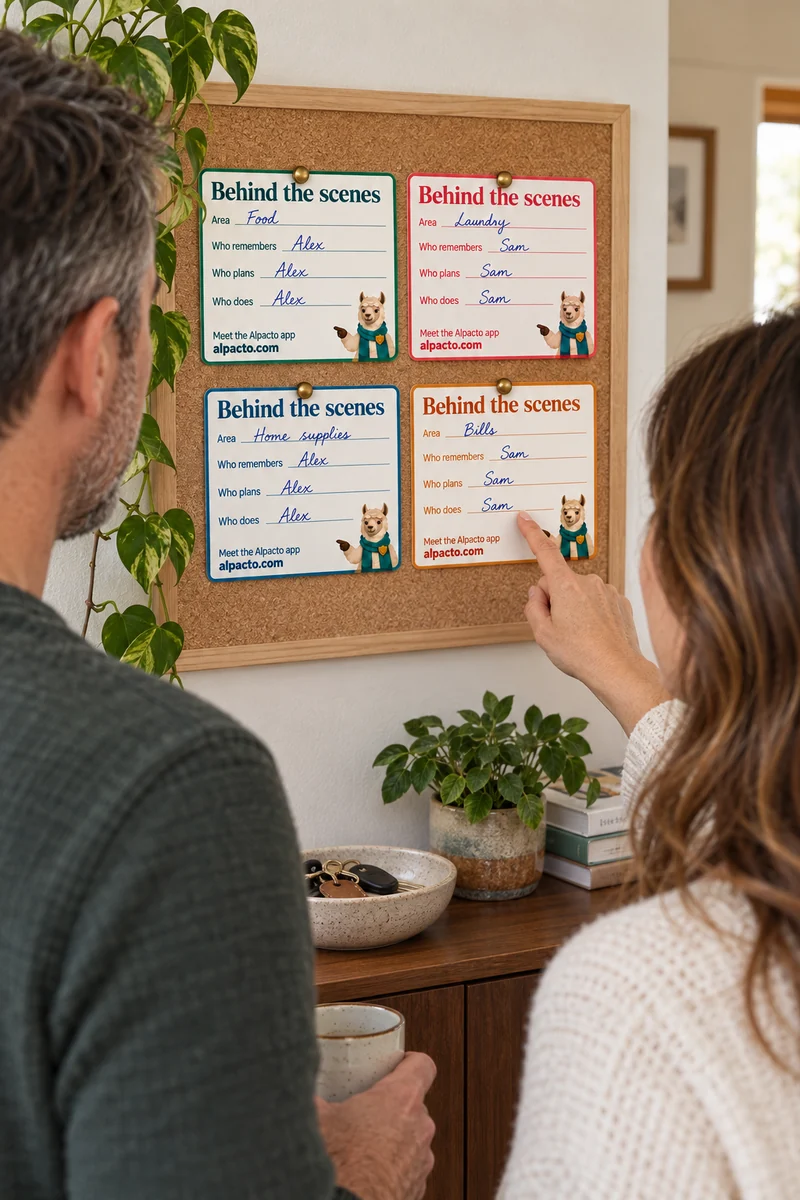
One area per card: who remembers it, who plans it, who does it.
In short
What you carry is the remembering: that the uniform is needed tomorrow, that one shirt cannot go in the dryer, that the detergent is nearly out. Research splits that thinking into four steps, and only one of them, deciding, tends to be shared already.
So the fix is not “help more” or a shared app that one of you fills in. Write down the areas of your home, put one name against the noticing and the planning for each, then hand an area over completely: the standard of done, the deadline, the reminder. Two printable sheets on the cards page do exactly that, and the same handover works in the app.
What the mental load is: the four steps inside every chore
The mental load is the unseen thinking that keeps a household running: noticing what needs doing, weighing the options and deciding, then checking that it got done. Researchers call it cognitive labor. It is separate from the chores themselves, so two partners can split the visible jobs evenly and still carry very different loads.
Allison Daminger interviewed 70 people from 35 couples for the American Sociological Review and found that household management is a separate kind of work with its own anatomy.
“The data demonstrate that cognitive labor entails anticipating needs, identifying options for filling them, making decisions, and monitoring progress.”Allison Daminger, “The Cognitive Dimension of Household Labor”, ASR 84(4), 2019
Run one job through those steps. Anticipating is realizing on Sunday that the school shoes are too small. Identifying is finding two stores that carry the size, deciding is picking one, and monitoring is remembering on Thursday that nobody went.
The word itself reached most people through a comic: Emma’s “You should’ve asked”, published May 20, 2017. Her point was that a partner who waits to be asked has quietly made the other one the manager.
That is why the invisible mental load survives a fair split of chores. Both of you can do half the visible jobs while one of you still runs all four steps for every one of them. A woman in r/breakingmom described being woken to be asked where a clean towel was:
“because it wasn’t in the rack, but instead in the dryer, 10 feet from where he was standing”r/breakingmom, quoted word for word
Why it stays invisible in the numbers
The mental load stays invisible in the numbers because surveys count what people did, not what they noticed. A time diary logs the hour spent cooking, but not the moment you remembered the fridge was empty. Even the closest category, household management, captures only the visible slice of that thinking.
The US time-use survey asks people what they did yesterday, hour by hour. In the 2025 results, women averaged 0.81 hours a day on housework against 0.30 for men, and 0.91 against 0.51 on cooking and cleanup. The category closest to thinking, household management, comes out at 0.22 against 0.12 (BLS, ATUS 2025, Table 1).
A diary records what your hands did. It cannot record the sentence that ran through your head in the shower, so the mental load women describe is the part the survey barely sees. On an average day in the same table, 22.6% of women and 14.4% of men spent any time on household management (BLS, 2025).
What the interviews add
Daminger also reports that deciding is shared: “male and female participation in decision-making […] is roughly equal”. What is lopsided is anticipation and monitoring. So carrying the mental load is mostly carrying the noticing and the following up, and that is the specific thing worth passing across.
Ask parents directly and the gap appears. Ana Catalano Weeks and Leah Ruppanner surveyed 3,000 US parents with a 21-item battery and published the result in the Journal of Marriage and Family. Mothers reported 71% of the tasks that take mental effort; fathers reported 45% (University of Bath).
The same study found the load splits by kind rather than falling entirely on one person. Daily work about family wellbeing sat with mothers at 79%, while episodic work such as finances and repairs sat with fathers at 65% (same release).
Who reports doing the thinking, US parents, 2024
A mental load list you can fill in tonight
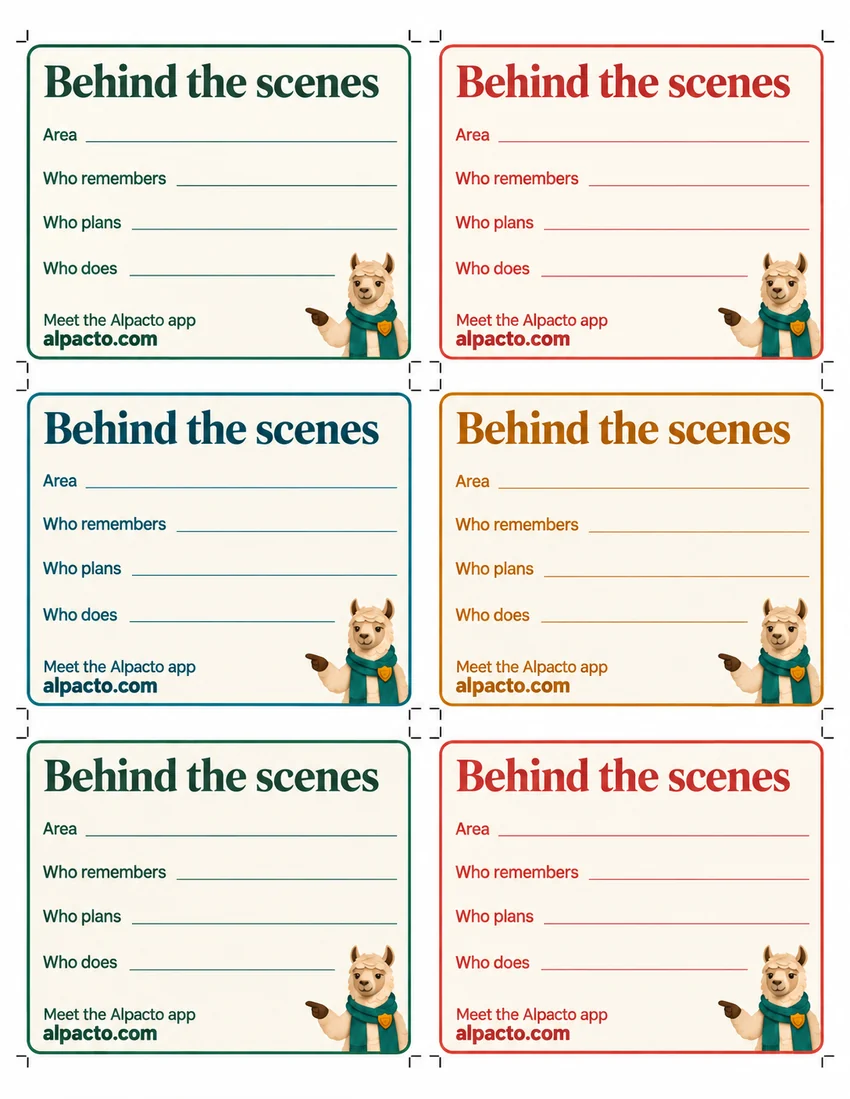
Sit down with one sheet and go area by area, keeping a whole area in one row. For each row write one name under remembering, one under planning and one under doing. Where the three names differ, you have found the household mental load that nobody agreed to.
These are the nine areas printed on our cards, with the kind of thinking each one hides. Cross out what does not apply to your home and add what does.
| Area | The part that is invisible | Who remembers · plans · does |
|---|---|---|
| Food | What is left in the fridge, what was eaten twice this week, when the list has to exist | |
| Children | Forms, shoe sizes, the friend whose party is Saturday, who is picking up | |
| Home | Supplies running low, the bulb, the filter, the thing that has been making a noise | |
| Money | Which bill renews, which subscription doubled, when the insurance ends | |
| Health | Appointments due, prescriptions running out, whose check-up is overdue | |
| Celebrations | Birthdays, the gift, the card, the booking nobody made yet | |
| Relatives | Who was called last, who is expecting a visit, what was promised in December | |
| Car | Inspection dates, tires, the light on the dashboard, the paperwork | |
| Documents | Renewals, passwords, the folder everyone asks about once a year |
Two rules make this list useful rather than depressing. Write one name per cell, because “both of us” is how an area goes back to whoever notices first. And keep the list to areas you truly run, so a sheet of nine lines does not turn into a sheet of ninety.
Sharing the mental load means handing over one area, whole
To share the mental load, hand over one whole area instead of single tasks: the new owner takes the noticing, the planning and the doing, and the old owner stops monitoring. Agree four things at the table in about ten minutes: the area, what the owner needs, the standard of done, and a check-in date. The responsibility chart gives each area one owner and a named backup on a single page.
Handing over a task gives someone your hands. Handing over an area gives someone the noticing, which is the part that costs. Eve Rodsky splits every job into Conception, Planning and Execution, and her own site defines the first of the three as
“the behind-the-scenes mental load where you assess your family’s overall needs and conceive of and define the task that will meet those needs”Eve Rodsky, Fair Play, on her own site
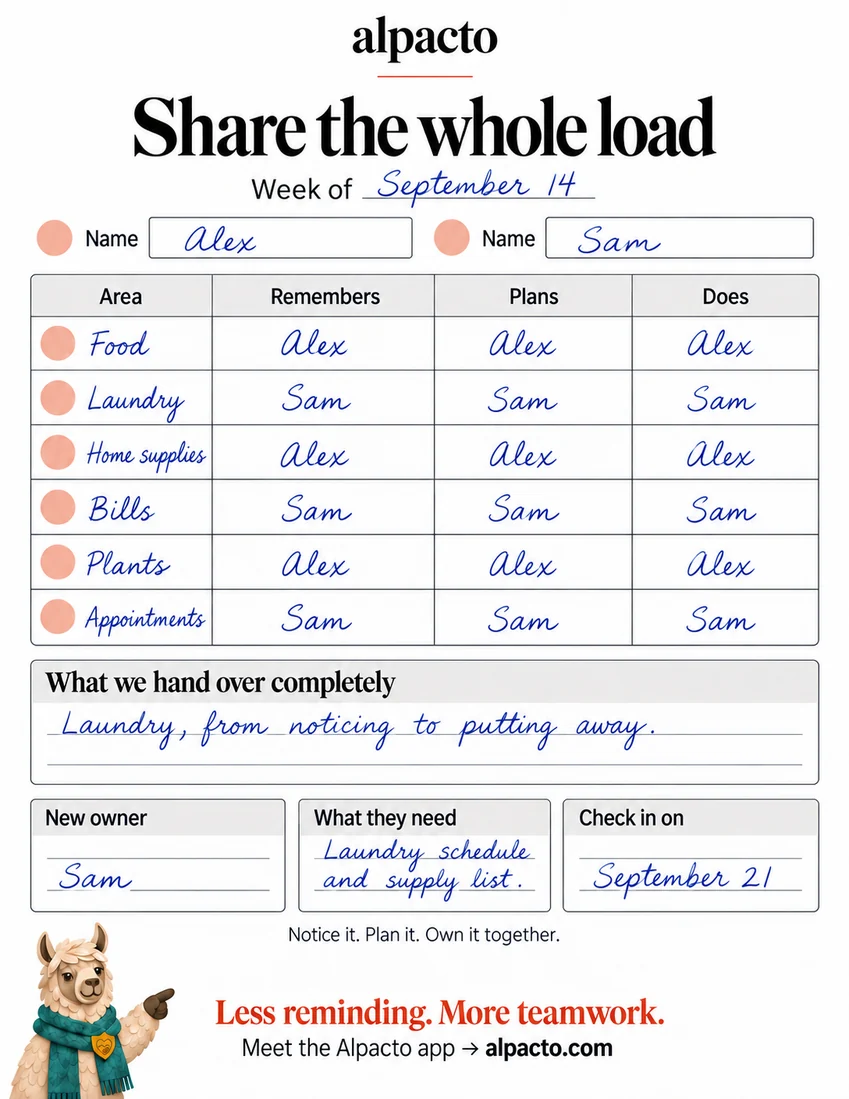
Our weekly sheet turns that into four lines you both fill in at the table. It takes about ten minutes, once.
- Name the area you are moving. One area, not four. The sheet says it in a whole sentence: “Laundry, from noticing to putting away.”
- Write what the new owner needs. The washing schedule, the supply list, the number of the repair place. Handing over without this is a trap, not a gift.
- Agree the standard of done. Clean clothes in drawers by Sunday night is a standard. Keep on top of laundry is an argument waiting to happen.
- Set the check-in date. A week or two out, written on the sheet, so nobody has to ask how it is going before then.
The check-in date is what makes the previous owner stop monitoring. Until there is a date, the person who used to carry the area keeps carrying it silently, and the handover is only half done.
The cards and the weekly sheet are on the cards page, blank and filled in, US Letter and A4. If you also want the visible chores split by minutes, the chore split calculator does that part.
“Just tell me what to do” and a budget for reminders
A reminder budget is a weekly cap on how many times the owner of a job can be reminded about it, agreed in advance. When the cap is used up, a phone alarm takes over and nobody nags again until the week resets. Reminding stops being a mood and becomes a number you can both see.
One thread on r/Marriage describes a wife who does every job the moment she is asked. The home still runs on one person’s asking, and the answer quoted back is the familiar one.
“But if you tell me what to do, I’ll do it! Why are you mad when I’m doing what you asked?”r/Marriage, on a spouse who thinks they are helping
His shared calendar did not fix it either. In his words, after a week he “found myself back to being the only one actually inputting data and checking the lists”. A tool inherits whoever was already doing the noticing.
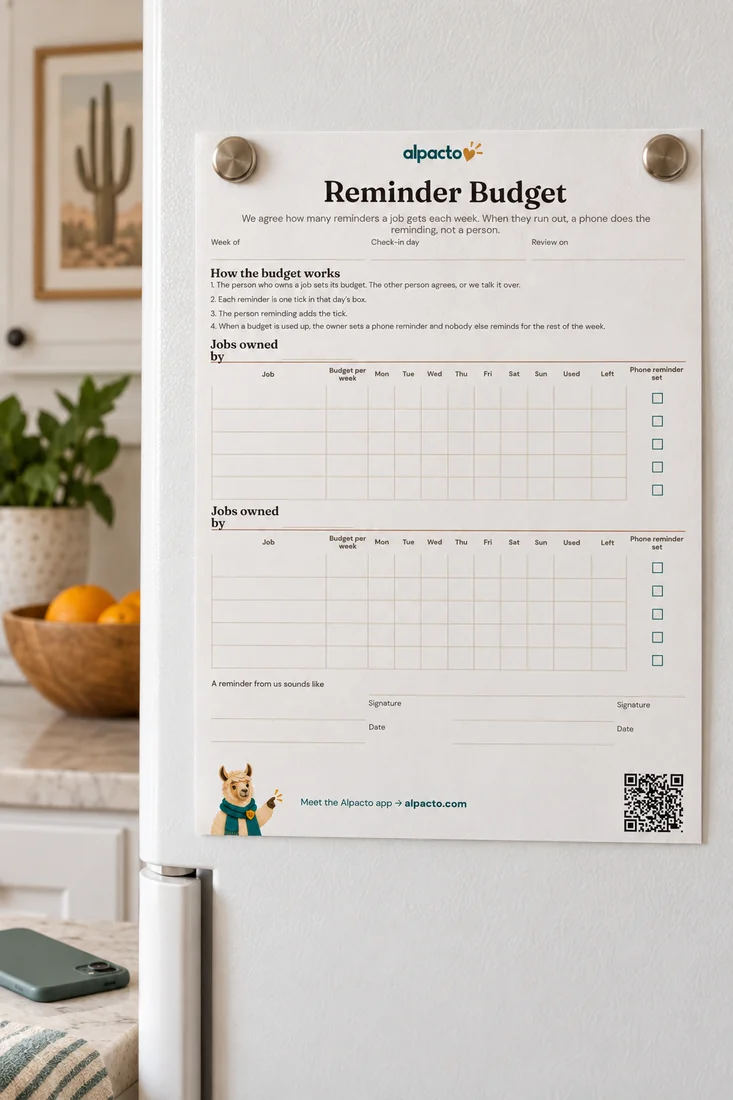
So put the reminding itself into the agreement. Each job gets a number of reminders per week, set by the person who owns it and agreed by the other. Every reminder is one tick in that day’s box, added by whoever gave it.
When the budget runs out, the owner sets a phone alarm and no person reminds again until the week turns over. The nagging stops being a character trait and becomes a number you can both look at on Sunday. That sheet is the Reminder Budget.
The mental load of motherhood and the default parent
The default parent is the one the school calls first, the one the sitter texts, the one who gets asked where things are. Nobody in the couple chose that. It arrives with parental leave, gets confirmed by whoever answered the first twenty calls, and then stays.
This is why the mental load of parenting is hard to redistribute by goodwill. The bottleneck is the routing. Until the school has the other number and the other calendar has the appointments, the requests keep arriving at the same person.
So move the routing along with the area, the same evening.
- Hand over Health, and change the contact number on the school and clinic forms.
- Hand over Celebrations, and the birthdays go into the new owner’s own calendar, not a shared one that only one of you opens.
A list will not make anyone care more, and this page is not a diagnosis. What paper can do is end the argument about whether the work exists, and give you one area to test the handover on before you touch the rest.
Questions people ask
What is the mental load in a relationship?
It is the thinking work behind running a home: noticing what needs doing, weighing the options and deciding, then checking that it happened. It is different from the chores themselves, and in many couples one partner carries most of it without anyone having agreed to that. Splitting it means handing over whole areas, not single tasks.
What are examples of mental load?
Knowing the shoes are outgrown before anyone complains, holding the dentist’s six-month rule, tracking which bill renews in March, remembering who was called last. Each one is thinking that produces work later, and none of it appears on a chore chart.
How do I explain mental load to my husband?
Show one job in four steps rather than arguing about the total. Take laundry: who notices the basket, who decides what gets washed today, who does it, who checks it got put away. Filling that in for nine areas takes ten minutes and usually ends the disagreement about whether the work is real.
Do women really carry more of the mental load?
In a December 2024 survey of 3,000 US parents, mothers reported 71% of the household tasks that need mental effort and fathers reported 45%. The split differed by kind of task: mothers held 79% of daily work such as cleaning and childcare, fathers 65% of episodic work such as finances and repairs (University of Bath).
Is mental load the same as emotional labor?
No. The first is cognitive work: anticipating, planning, deciding, keeping track. Emotional labor is managing feelings, both yours and other people’s, including smoothing things over and keeping everyone comfortable. They travel together and are often carried by the same person, but you can hand over an area of the first without touching the second.
Why don’t men understand mental load?
Usually because the work is invisible by design: it happens before a task exists, so there is nothing to see. Daminger’s interviews found it invisible to the people doing it as well. Writing the four steps down beside each area is what makes it visible to both of you at once.
What to do when your husband doesn’t help with chores?
Stop asking for help with tasks and offer a whole area instead, with the standard of done and the deadline written on paper. “Help me with the kitchen” keeps you as the manager; “the kitchen is yours, here is what done means, we check in two Sundays from now” does not. If nothing moves after two check-ins, the problem is the agreement, not the system.
What are the signs of carrying a high mental load?
You rehearse tomorrow in bed, you feel resentment after being thanked, you cannot answer “what do you want me to do” because the answer would take longer than the task. Another sign is a shared app or calendar that only one of you ever opens.
How do I lower my mental load?
Pick one area and hand it over whole: name it in a sentence, say what done looks like, pass on the schedule and the supply list. Set a date to check in, then stop checking until that date — the checking is what keeps the area with you.
Is there an app that carries this instead?
Alpacto turns each area into a pact between two people: what counts as done, by when, and what it is worth in coins. The app holds the reminder, so the person who owns an area is reminded by their phone rather than by you. It is on iPhone and Android.
The same handover, without anyone doing the reminding
Write the area, the standard of done and the reward once. After that the app counts the coins and sends the reminders, and the person who owns the area owns the noticing too.