
Alpacto › Free printables › Chore charts › Responsibility chart
A responsibility chart for adults that gives each area one owner
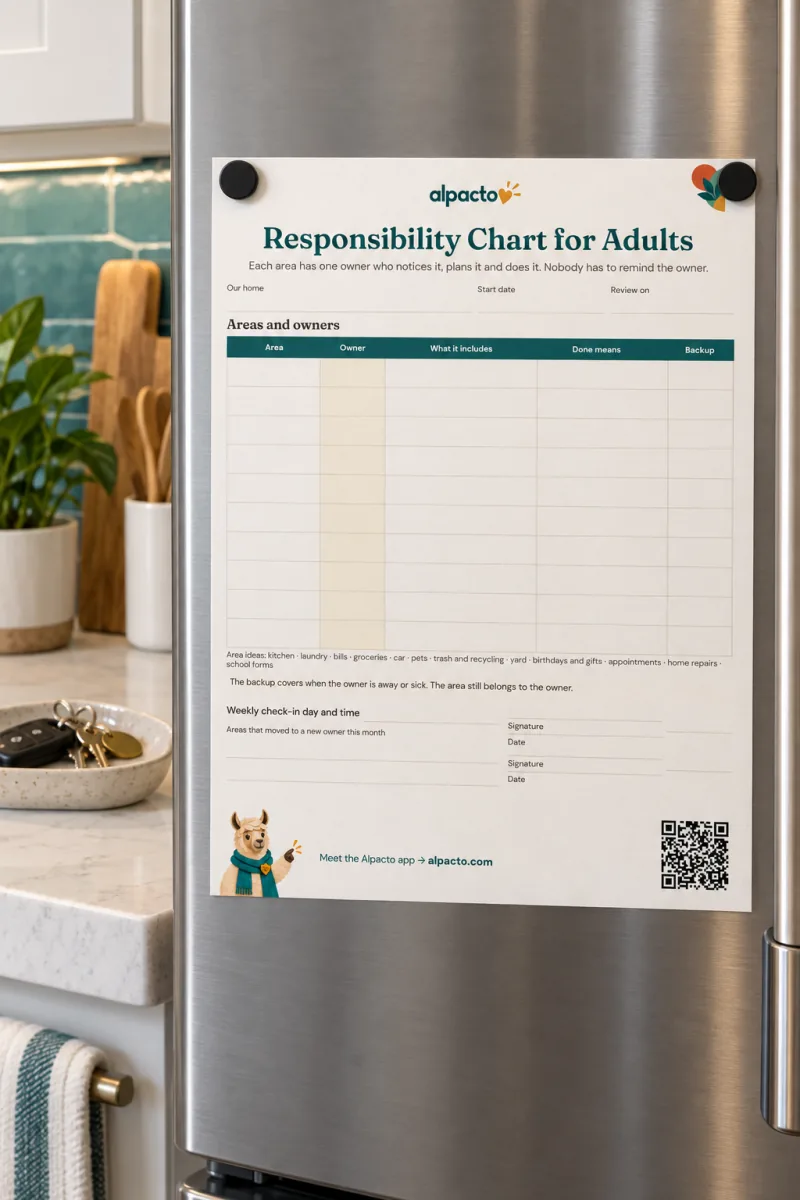
This responsibility chart for adults splits a home into areas, such as the kitchen or the bills, and gives each one a single owner who notices it, plans it and does it. A second name, the backup, covers when the owner is away. A teen version comes with it: eight areas and a check once a week.
- Versions
- Adults, ten areas; teens, eight areas; one page each
- Paper
- US Letter and A4, portrait, print at 100%
- Formats
- Blank and a fillable PDF; the filled-in example is below
- Designs
- Minimal, warm and color
What is on the adult responsibility chart
Areas and owners
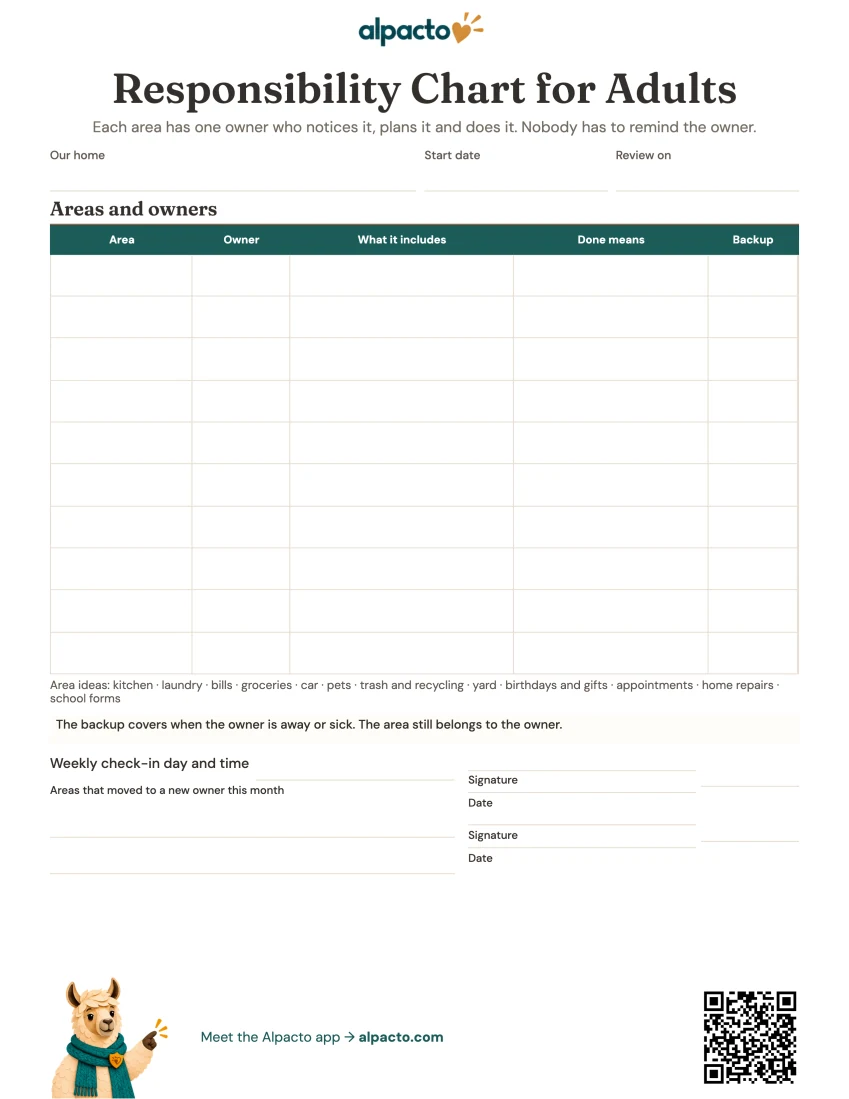
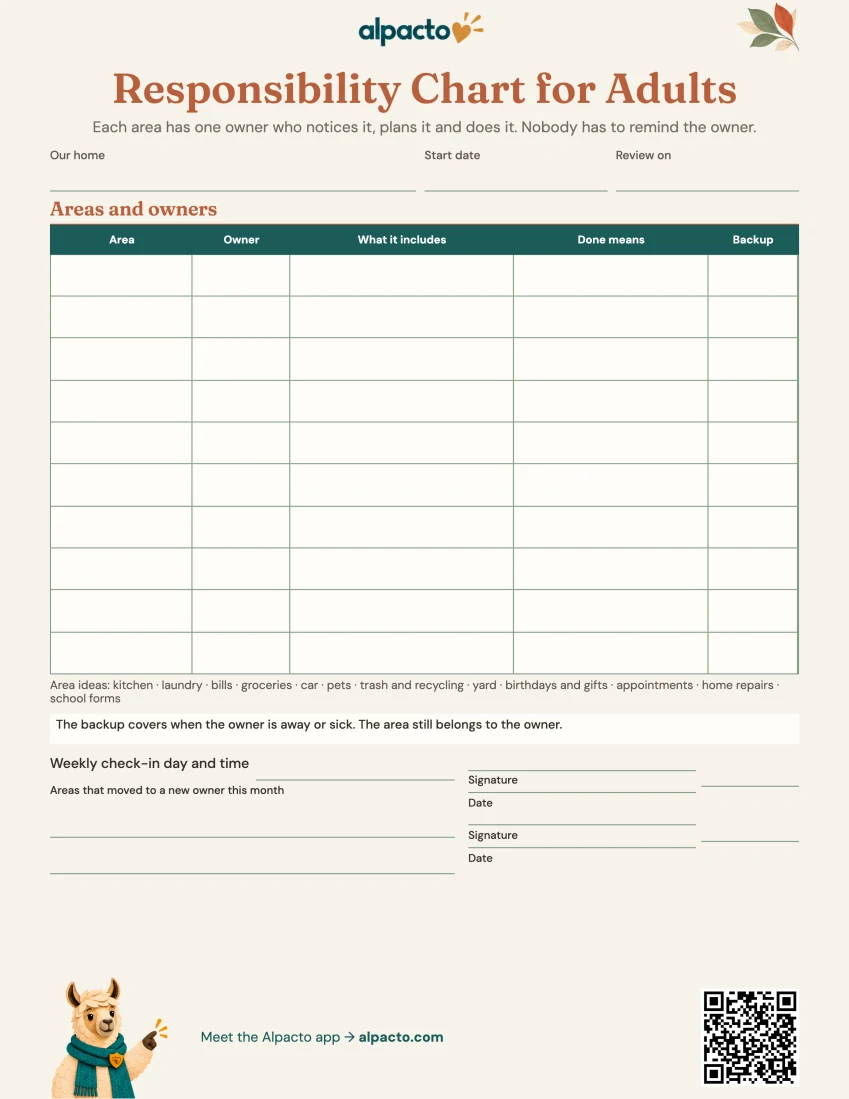
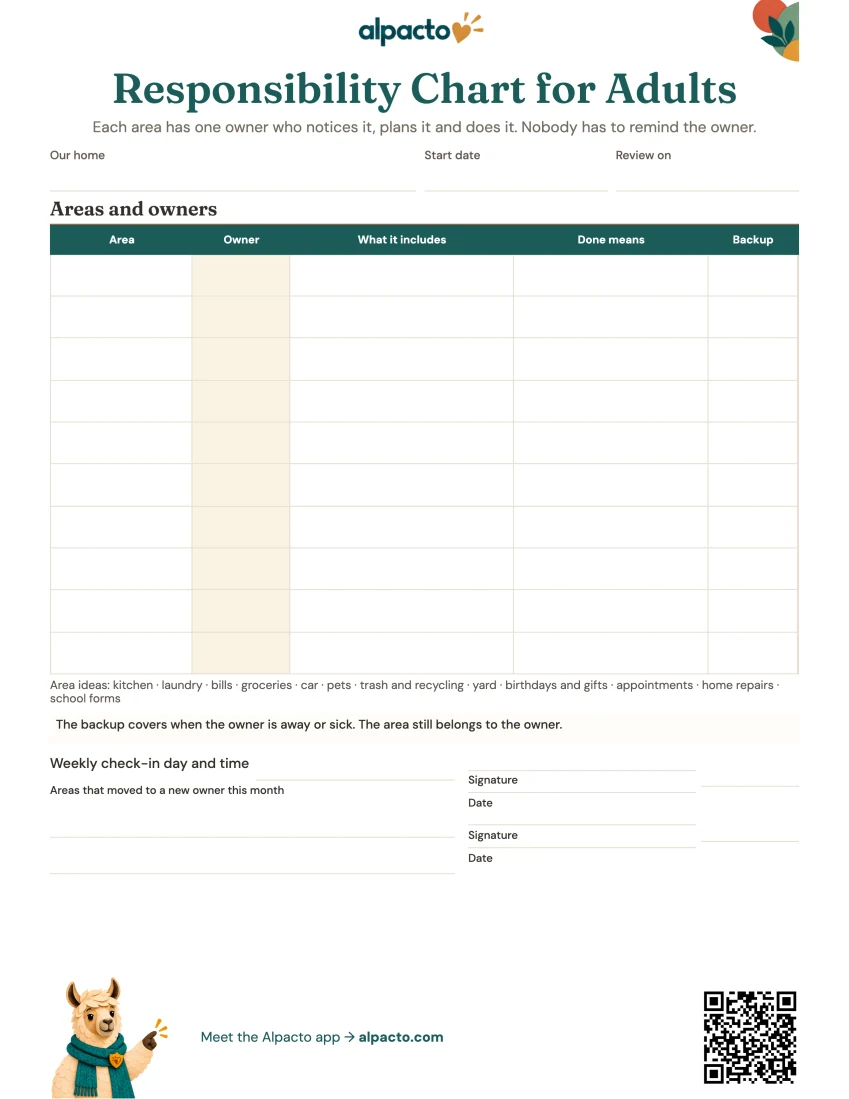
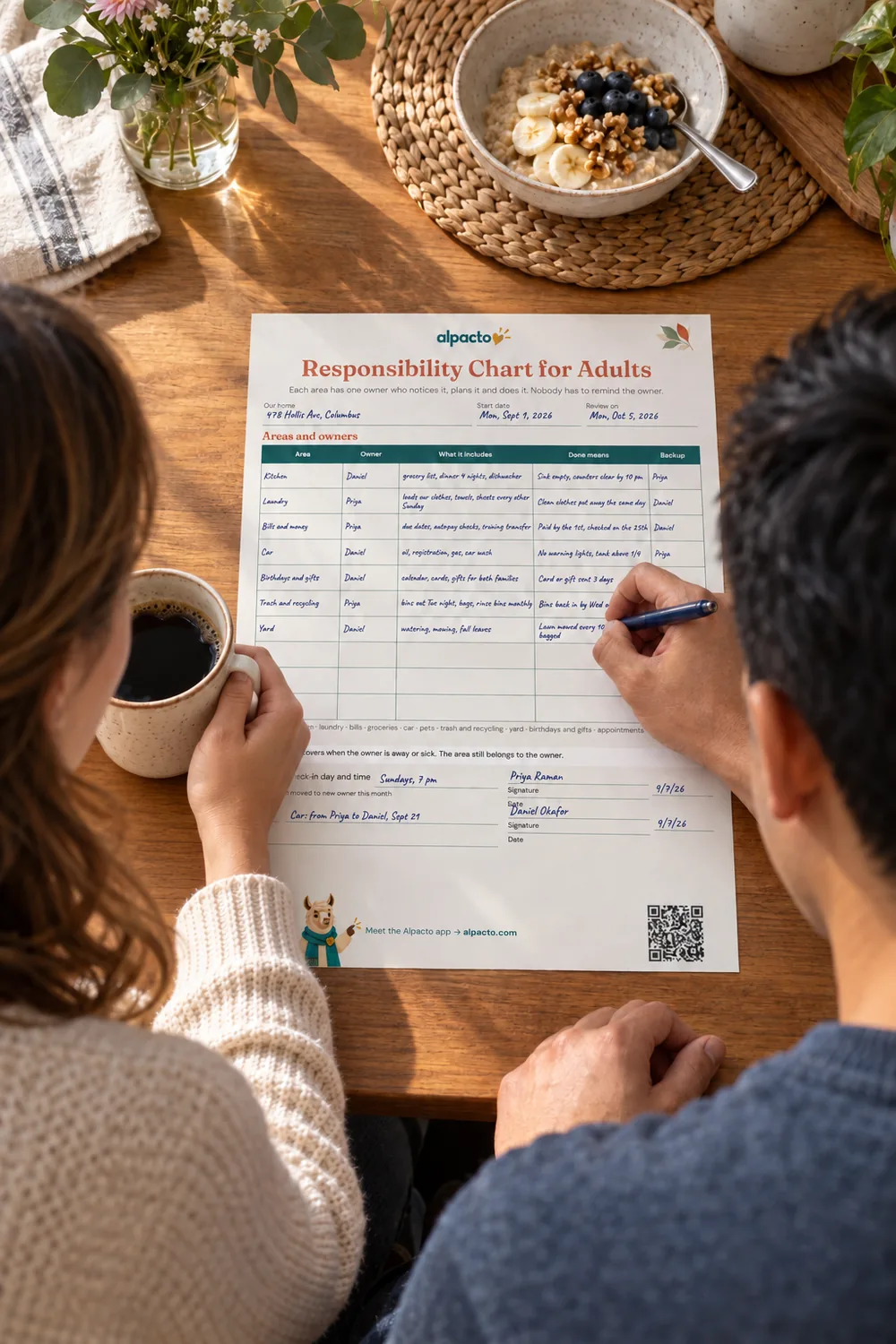
Ten blank rows with five columns: Area, Owner, What it includes, Done means, Backup. Twelve area ideas are printed under the table.
What it includes and Done means
The first lists what sits inside the area, planning included: for groceries, the list as well as the trip. The second is a finish line you can both check, such as sink empty by 10 pm.
Backup
One name per row for when the owner is traveling or sick. The rule is printed under the table: “The backup covers when the owner is away or sick. The area still belongs to the owner.”
Check-in and signatures
The day and time you look at the sheet together, two lines for areas that moved to a new owner this month, two signatures.
An area is more than the chores inside it
Sociologist Allison Daminger interviewed members of 35 couples and described the thinking side of housework as four steps: “anticipating needs, identifying options for filling them, making decisions, and monitoring progress.” Her study calls this work “taxing but often invisible to both cognitive laborers and their partners” and “a frequent source of conflict for couples.”
A chore list hands out only the doing, so one person still keeps track of when the car registration expires and books the appointment. This sheet hands over all four steps at once, and its subtitle says so: “Each area has one owner who notices it, plans it and does it. Nobody has to remind the owner.”
On September 24, 2026 we read the four chore pages from this search that open in full. All four hand out tasks, and the words owner and backup appear in none of them.
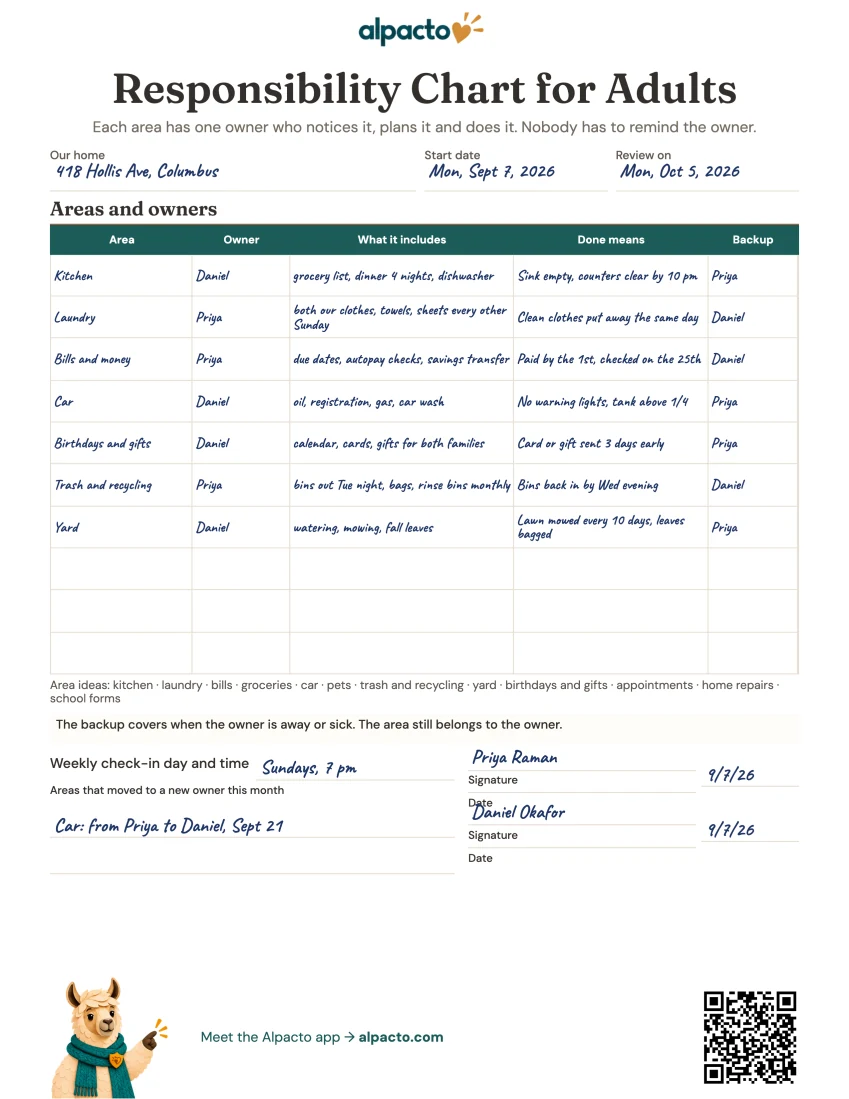
The example: Priya owns bills and money, paid by the 1st and checked on the 25th, with Daniel as backup.
A household responsibilities list, written as areas
The twelve ideas on the sheet run from kitchen and laundry to home repairs and school forms. As a list of household responsibilities for couples it covers most homes: cross out what you do not have and add what is missing, such as a second car.
One name goes in each Owner cell, because a row with two owners slides back into one person reminding the other. The backup is always someone else. An area changes hands only at the weekly check-in and goes on the sheet: in the example, the car passed from Priya to Daniel on September 21.
For the tasks inside each area, use our list of 64 chores sorted by how often they come up. To see whose week is heavier before you choose, the chore split calculator counts minutes.
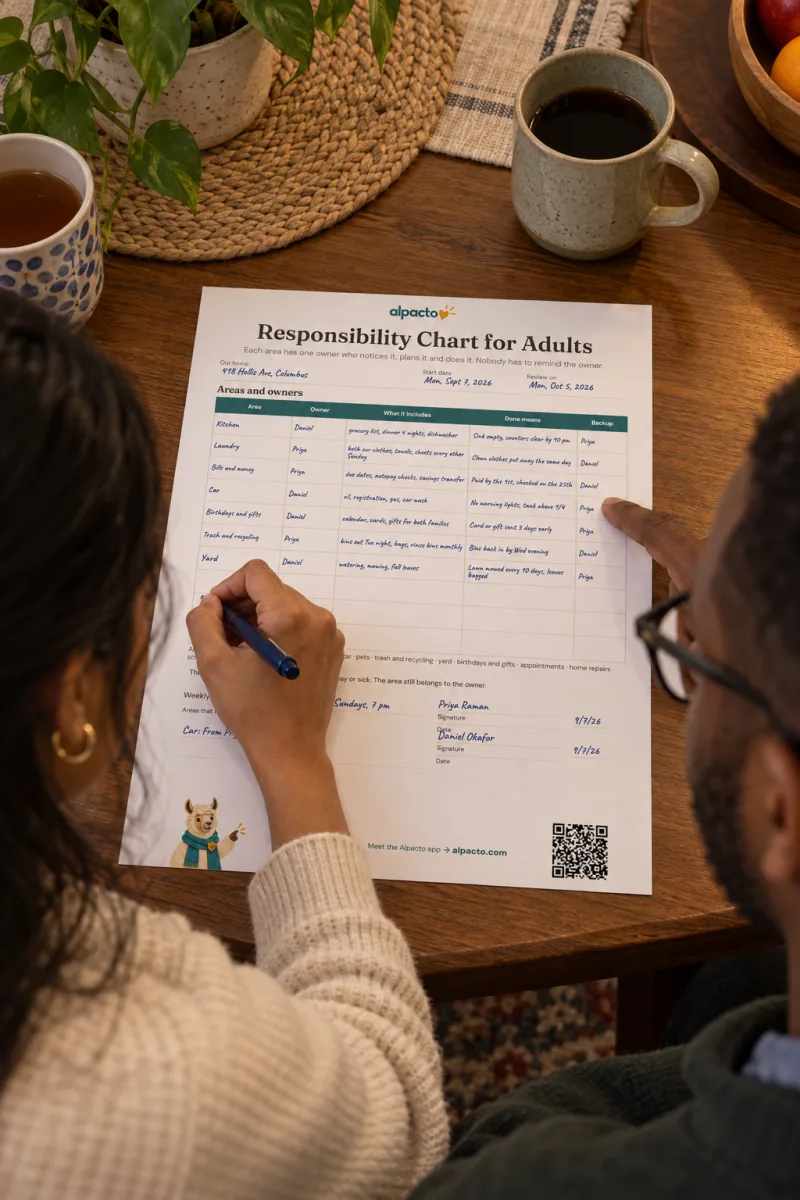
One name in each Owner cell, agreed at the table.
Download the responsibility chart for adults and teens
Two versions, three designs each. Every file is free, with no email and no account.
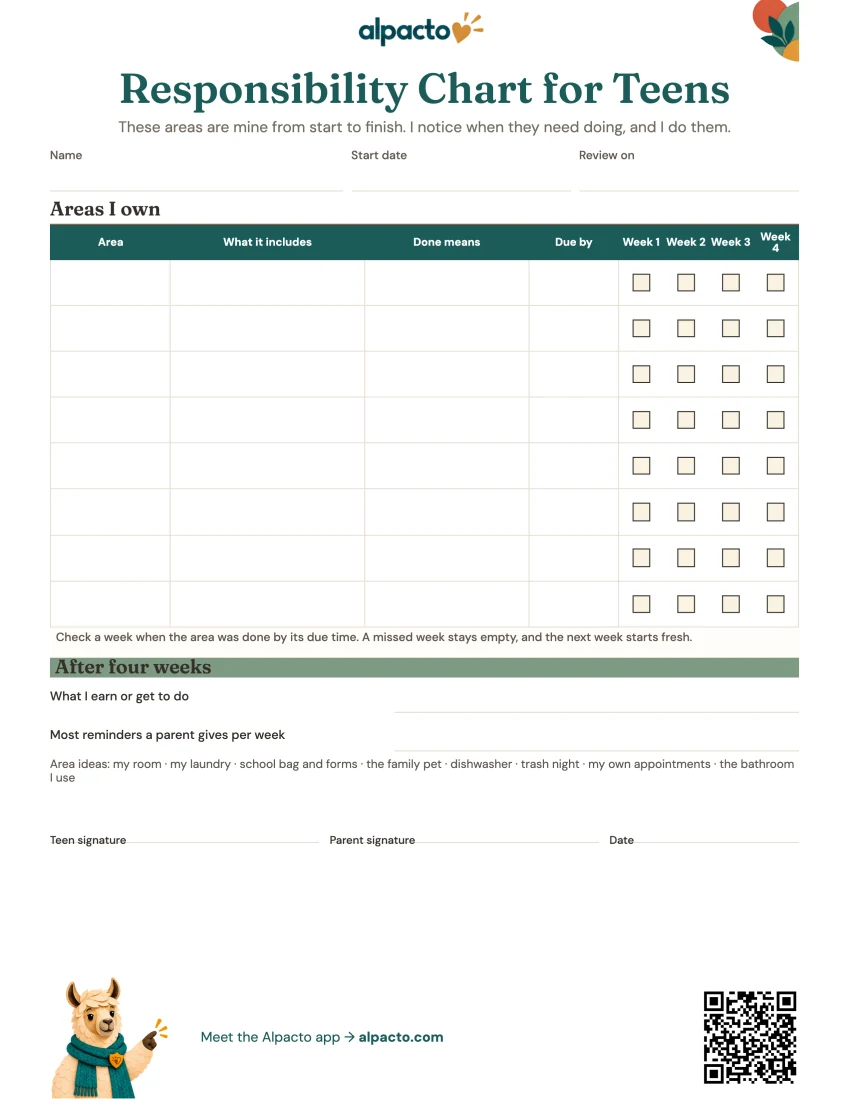
The teen version: areas a 13 to 17 year old owns
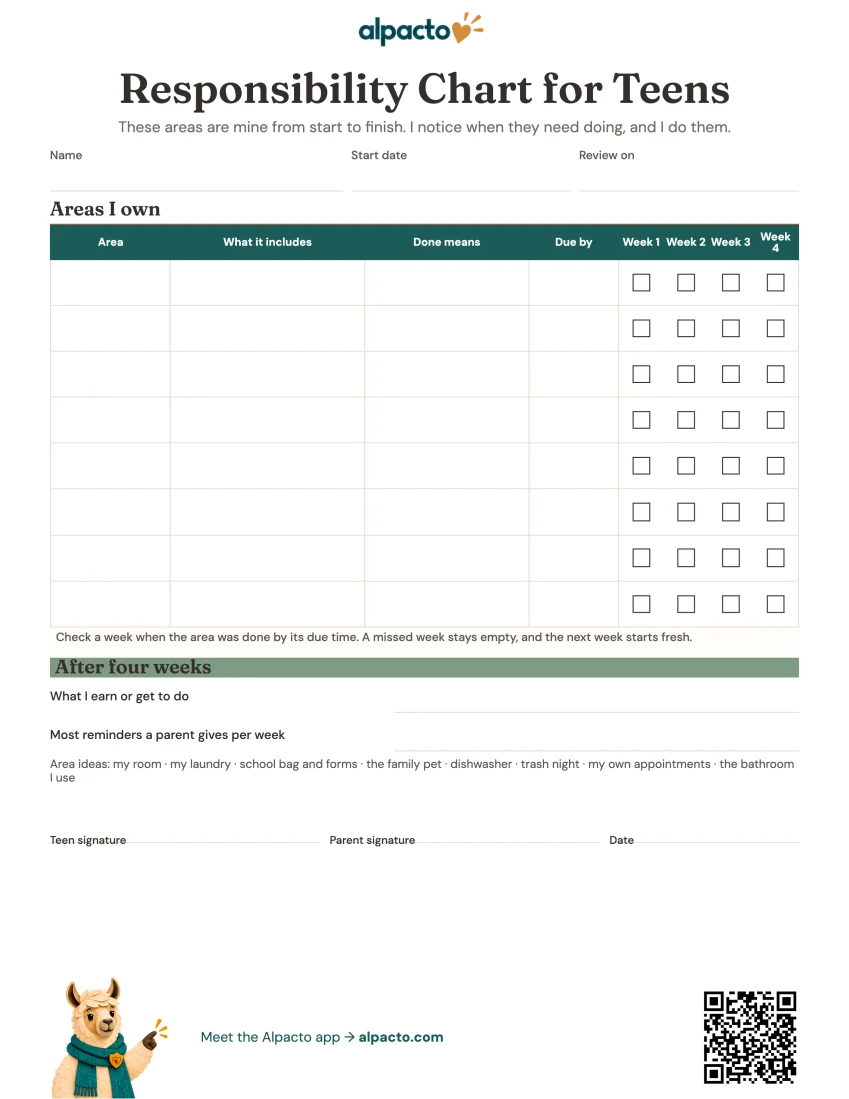
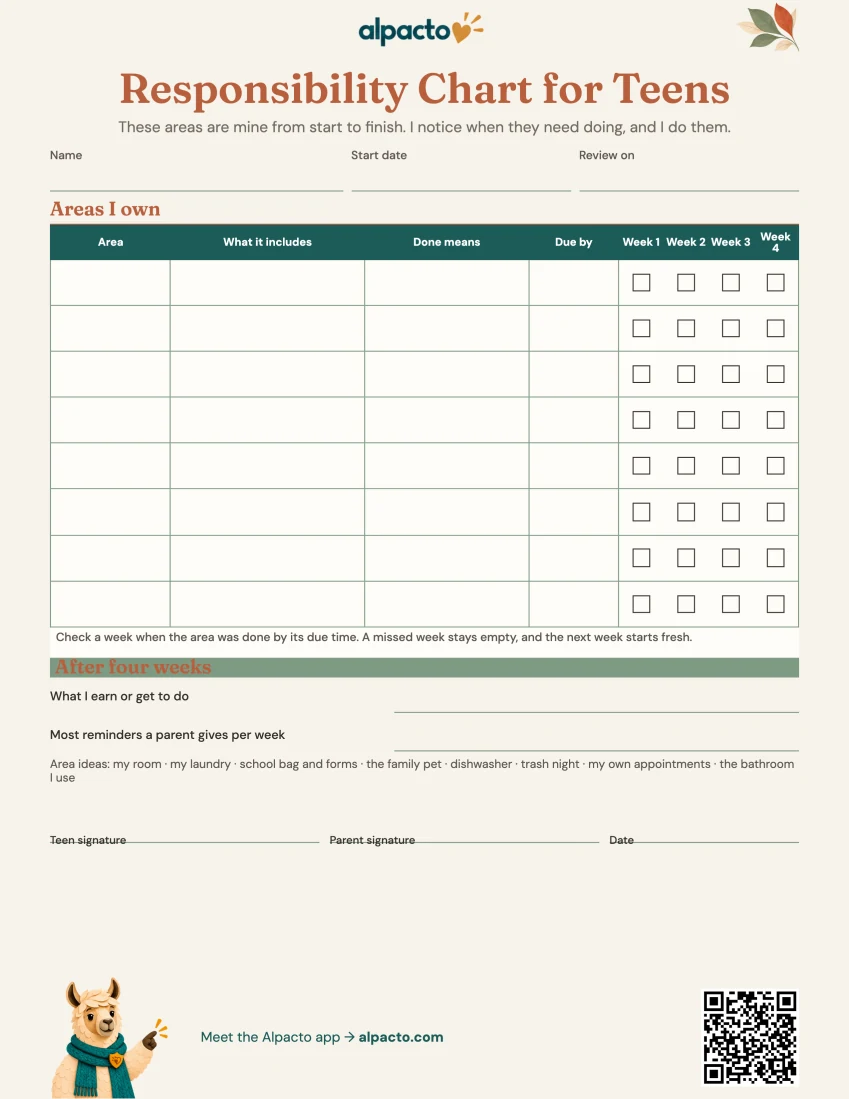
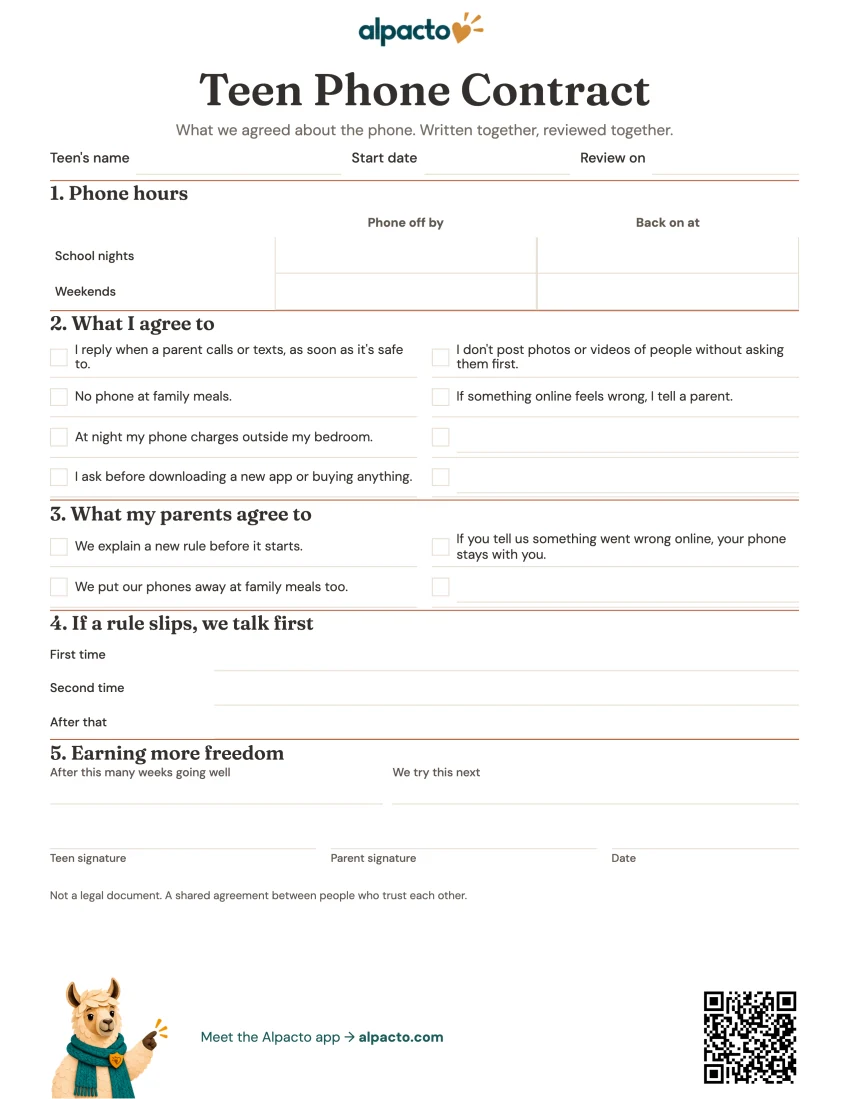
The teen sheet has eight rows, a Due by column, four week boxes and a subtitle in the teen’s own voice: “These areas are mine from start to finish. I notice when they need doing, and I do them.”
A week gets a check when the area was done on time, and the sheet prints what happens otherwise: “A missed week stays empty, and the next week starts fresh.” What the teen earns after four weeks is agreed before the first one; in the example, a Friday curfew moves to 9:30 pm.
The last field is one most charts leave out: “Most reminders a parent gives per week.” The American Academy of Pediatrics suggests praising a child who starts a task “without a reminder” and says “badgering or scolding a child is not an effective method to get them to accept more responsibility.” A number agreed in advance, two per area in the example, turns reminding into part of what both of you signed.
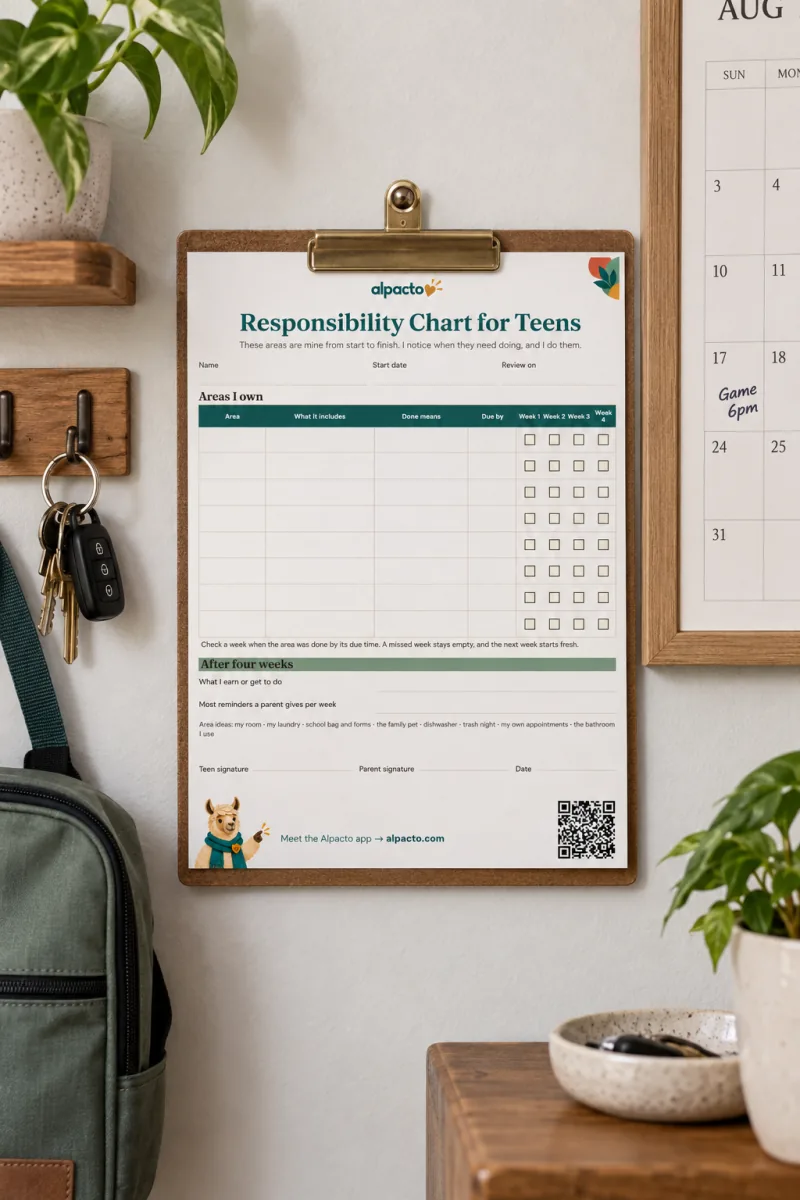
The teen version by the family calendar, where it gets seen every day.
What to do when your adult responsibility chart stops working
A chart usually fails in the same few places, and each one maps to a column on the sheet. Look at the row that keeps slipping at your weekly check-in and ask which of these it is.
- The area is too big. A row called “Home” has no edge, so nobody knows when it is done. Split it into two rows, such as kitchen and laundry, and give each its own owner.
- Done means is vague. “Clean” cannot be checked, but “sink empty by 10 pm” can. Rewrite the cell until either of you could look and agree.
- The owner has no room in the week. Some areas land on the person with the longer commute. Count minutes with the chore split calculator and move one area, on the line for areas that moved to a new owner.
- The backup is doing the owning. If the backup is reminding, the area has not really changed hands. Say so at the check-in, and decide whether the owner keeps the row or hands it over for good.
The Fair Play method splits each card into conception, planning and execution. That is the same idea as the chart: the owner holds all three, so nobody has to ask.
Change one thing per check-in, not the whole sheet. If you change five rows at once, you will not know which change helped.
Questions people ask
What are the responsibilities of a household?
Everything that keeps a home running, and the twelve area ideas printed on the sheet are a fair start. Between partners, what holds up is one owner per area with the other person as backup; add what your home has.
What is the difference between a chore chart and a responsibility chart?
A chore chart assigns tasks, usually by day of the week; a responsibility chart assigns an area and everything it takes, including remembering it. Tasks that rotate suit a chore chart; areas that stay with one person for a month suit this sheet. Our couples chore chart sits in between: zones of the home with two name columns.
Is there a family responsibilities chart for younger kids?
This set stops at the teen version, drawn for ages 13 to 17. For younger children we have a reward chart for kids, which counts steps toward one reward agreed in advance.
How often should we change who owns what?
Whenever the weekly check-in shows that an area sits badly with its owner; write the move on the line for areas that moved to a new owner this month. In the example the review date comes four weeks after the start, which is a natural point to print a fresh sheet.
Is there an A4 version, and can I type into it?
Both: every design comes in US Letter and A4, each with a fillable PDF. The adult version has 58 fields and the teen version 70, including 32 week checkboxes; signatures are left for a pen.
Other free printable sheets
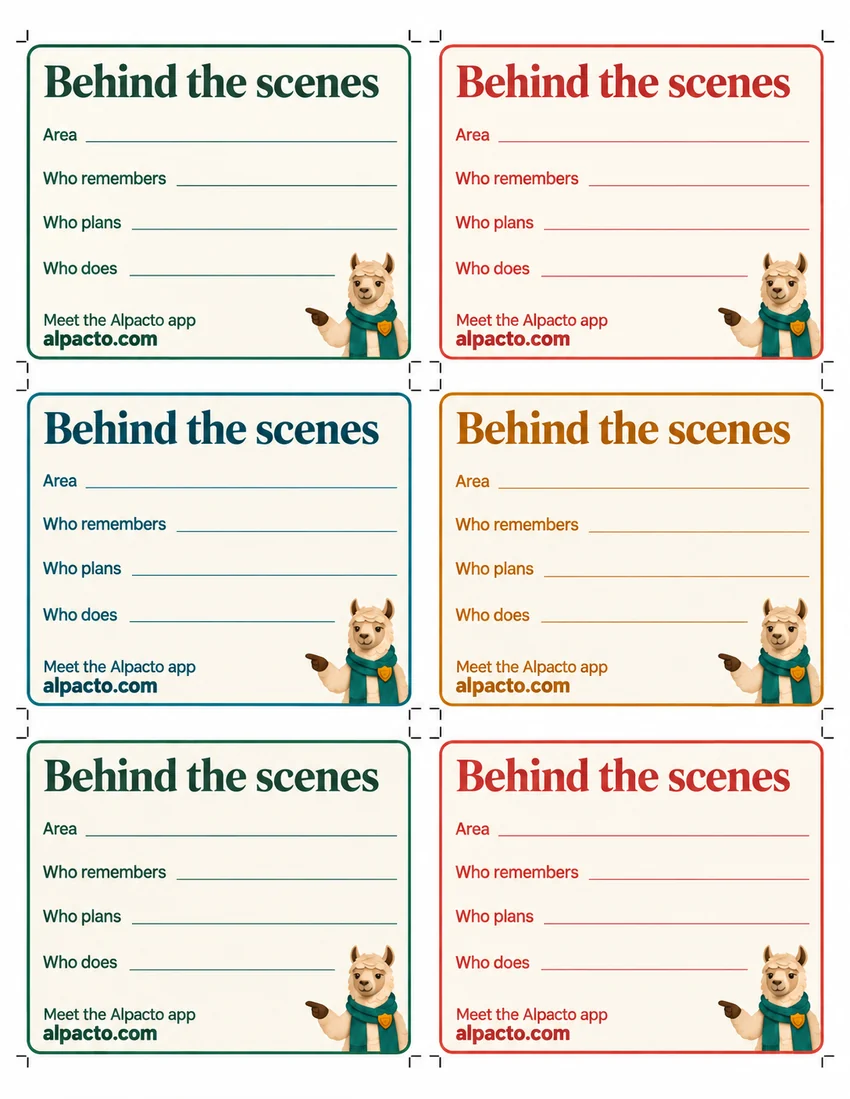
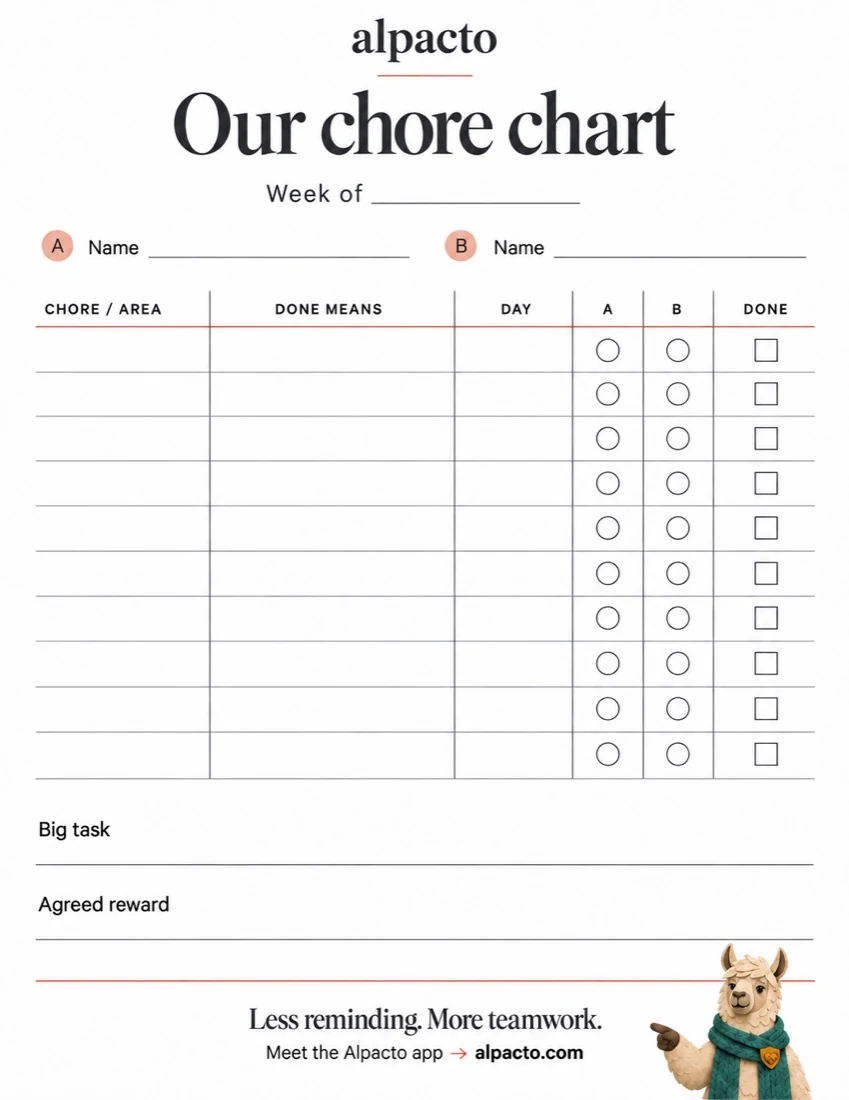
Save this chart to Pinterest
Pin it now and the sheet is ready for the evening you both sit down with a pen. Ten areas, one owner and one backup for each, and a teen version with four weeks of checks.
The same areas, as pacts
In Alpacto each row of the adult sheet can become a routine with one owner. That person checks in, the other confirms, and the pact holds the reminder. The teen version becomes a challenge with a four-week finish line and the reward you agreed; accounts start at 13.