
Alpacto › Apps
The best couple apps depend on the job: five comparisons, 43 listings, one day
The best couple apps question splits five ways, so this is five comparisons of apps for couples and families rather than one ranking. Every row in them was read off the store listing on September 18, 2026 rather than copied from another round-up. Prices are what the storefront printed that day, ratings are kept per store, and our own app is marked as ours wherever it appears.
In short
Living together and wanting to talk more: the couple apps. Dividing the cleaning: the chore apps, where the shape of the app matters more than its features.
Keeping one calendar for a household: the family organizers. Keeping a promise to yourself: the habit trackers. Money that two people share: the budget apps.
The best couple apps question has five answers, not one
A thread on r/apps asking for recommendations puts the problem in one line: “there are a lot of apps out there and it’s hard to tell which ones are actually worth sticking with”. Nearly two hundred replies later it is still a list of names.
Google’s own summary for this search says the same thing in the opposite direction: the best app depends on your primary goal, whether that is daily connection or logistics. A relationship app and a chore app have nothing in common except the two people using them.
So we split the question five ways and answered each one against the listings. One reply in that thread is worth keeping next to every comparison on this site: “Also, the apps help a lot but you need to put in the work too.”
Five comparisons of apps for couples and families
An app for two people
Nine listings for couples who want to talk more, from a subscription whose own listing prints two different yearly prices to a couples games app that is a card deck with no account at all. The couple apps compared.
Chores
Nine listings, and the finding is about shape rather than features. Five of them need somebody standing above somebody else: that is a chore app for families, and it fits two adults badly. The chore apps compared, and the best chore app for families with kids.
One family calendar
Nine listings for a family organizer app, including one whose store listing was already gone, with its own site saying it shuts down at the end of the year. The family organizer apps.
Habits
Nine listings for a habit tracker app, priced from free to a lifetime purchase, with the thing most round-ups skip: what each one does on the day you miss. The habit tracker apps.
Shared money
Seven listings for a money app for couples, with every price the storefront prints, and the ads label that turns up exactly where the app has nothing else to sell. The budget apps for couples.
One app or one job, read line by line
Paired
The site quotes one yearly price, the App Store prints several, and one partner pays for both. How much the Paired app costs.
Cupla
Your own calendar is free; seeing your partner’s whole month is what the subscription sells. What the Cupla app costs.
Nipto or Tody
A chore game with points for two, or a cleaning plan that is free for one and paid once you share it. Nipto vs Tody.
Splitwise, and what to use instead
Four expenses a day on the free plan and no printed Pro price, against six apps that split a trip, a flat or a couple’s month. Splitwise alternatives.
Long distance
Nine apps sorted by the problem distance creates: time zones, feeling present, a movie together, a daily question. Long distance relationship apps.
How we read a listing, and what we refuse to do with it
Every price is the one the storefront printed on the day named at the top of the table. That includes the ones that contradict themselves: a yearly plan shown at two different prices on the same listing gets written down twice, not averaged.
Ratings stay separate by store, because an App Store average and a Google Play average are two different populations and adding them makes a number that means nothing. Where a rating rests on a handful of reviews, we say how many.
Nobody here installs the apps or scores them out of ten. A store listing tells you what a company promises and what it charges, not how an app feels in week three. Pretending otherwise is how round-ups end up recommending whoever owns the page.
Alpacto is ours, and it is in the tables anyway
Alpacto appears as a row in every comparison, marked as ours, and that row carries no rating and no download count. Grading ourselves next to apps graded by their listings would be worth nothing to you.
What the row does say is what the app is for: a pact between two people, where one promises, the other accepts, and what was agreed is visible to both. Everything else on those pages is somebody else’s product described in their own words.
When the answer is a sheet of paper
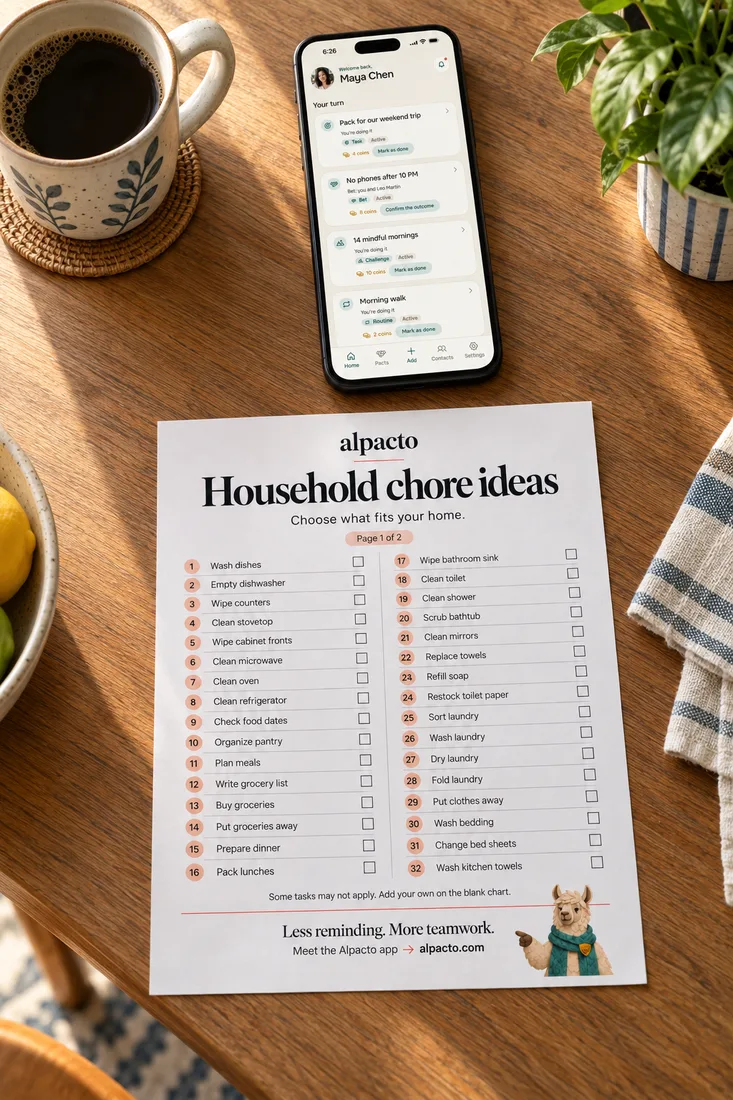
Half the jobs on this page have a paper version that works better. A chore rotation for two adults, a week of habits on the fridge, a reward a child can see coming (see the reward chart apps compared): none of these needs an account. Free apps for couples also stop being free at the point where the second person has to sign up.
Our printables are free PDFs with no email and no account. If the thing you actually want is a conversation rather than a tool, the couples articles are the other half of this site.
Questions people ask
What are some good apps for couples?
It depends on the job, which is why the best couple apps live on five pages here rather than in one list. For talking more, the couple apps; for the cleaning, the chore apps; for a shared calendar, the family organizers; for money, the budget apps. Each page names prices as of the day it was read and marks our own app as ours.
Why five separate pages instead of one list of the best?
Because a single ranking would have to compare a card deck with a shared bank ledger. The five pages ask different questions of different listings, and each ends with the same limit: what the store printed, not how the app feels in month three.
How do you decide what an app costs?
We copy every price the storefront shows on one day, including in-app purchase lists, and we write the date at the top of the table. Storefronts cap those lists at ten rows, so where an app has more we say the list is capped rather than pretending we saw the end of it.
What is the 7 7 7 rule for couples?
It is a dating-cadence idea, not an app feature, and it turns up in searches next to these queries. We looked at it in one line on the budget apps page, where the same kind of rule keeps being sold as a budgeting method. The 3-6-9 and 2-2-2 rules are the same genre of advice and equally unrelated to which app you install.
What if we do not want another app?
Then do not install one. The printables do most of these jobs on paper, and a chore rotation stuck to a fridge has never once failed to sync.
What our own app does
Alpacto is a pact between two people who know each other: one promises, the other accepts, and both see what was agreed and what is still owed. Accounts start at 13.