
Choosing a budget app for couples: seven listings, read on one day
Seven money apps for two people, read off their own store listings on September 18, 2026, because a budget app for couples is easy to install and easy to abandon in the second month. We are not giving financial advice and we are not promising savings. We compare three things the round-ups skip: where each free version actually stops, what the store prints instead of a price, and who else can see the numbers.
In short
Two people who keep separate accounts: Honeydue. One dashboard for everything you both own: Monarch. Every dollar given a job, on one subscription for up to six people: YNAB.
Envelopes shared across phones: Goodbudget. Who owes who after dinner: Splitwise or Tricount. A budget built for two and nothing else: Balance.
How we compared, and what this page will not do
We compared seven budget apps for couples by asking the same six questions of each store listing, read on September 18, 2026. The questions cover the free limit, the paid price, who sees the numbers, whether the app wants your bank, where it runs and when it was last updated.
- Where the free version stops. Named by a number wherever the listing names one.
- What paid costs. The store prints a list of purchases, and the period is often somewhere else entirely.
- Who else sees the numbers. One partner, a group, or anybody you invite.
- Whether it wants your bank. Some connect accounts; some never ask.
- Where it runs. Phone, tablet, desktop, browser.
- When it was last updated. The date in the table is Apple’s; where the stores differ, the gap is named below.
This page gives no financial advice and promises no savings. It reports what seven store listings said on one day, and every number in it can be checked by opening the link in the first column.
Alpacto is our own app, and its row carries dashes instead of store figures. One more thing to have in mind before any ranking: here the round-ups are written by financial publishers rather than by the apps, with one exception, and that exception lists itself first.
The best budget app for couples, case by case
The best couples budget app depends on how the two of you share money. Honeydue suits separate accounts, Monarch one shared dashboard, YNAB a single plan, Goodbudget envelopes, Splitwise and Tricount bill splitting, and Balance a joint view built for two.
The table has four columns, because a phone screen holds four. Everything in the third column was read on September 18, 2026 from the listings linked in the first.
| App | What it is for | What the listing showed on Sep 18, 2026 | Who else sees the numbers |
|---|---|---|---|
| Honeydue | Two people who keep separate accounts | iPhone and Android, with no iPad, Mac or web · free, and all ten purchases on the listing are Monthly Tips from $0.99 to $9.99 · 4.5 from 10K App Store ratings, 4.3 from 2.83K Play reviews · 16+ · updated Jun 19, 2026 | Your partner, and the listing says you choose how much you share |
| Monarch | One dashboard for everything you both own | iPhone, iPad, Android, web · free 7 days, then four names over ten rows: Monthly $14.99 and $15.99, Yearly $99.99, Monarch Subscription $99.99, Yearly Plus $199.99 · 4.9 from 110K App Store ratings, 4.8 from 25.1K Play reviews · 4+ · updated Sep 16, 2026 | A partner or a financial professional you invite to the same accounts |
| YNAB | Giving every dollar a job, on one plan | iPhone, iPad, Android, web · free for 30 days, then YNAB Subscription at $14.99 and at $109.00, with the period only in the description · 4.8 from 62K App Store ratings, 4.6 from 25.2K Play reviews · 4+ · updated Sep 16, 2026 | Up to six people on one plan and one subscription |
| Goodbudget | Paper envelopes, shared across phones | iPhone, iPad, Android, web · free forever with 10 regular and 10 annual envelopes, then Monthly Plus $5.99–$7.99, Monthly Premium $9.99, Annual Plus $49.99–$69.99, Annual Premium $79.99 · 4.6 from 13K App Store ratings, 3.2 from 19.2K Play reviews · 4+ · updated Sep 14, 2026 | Whoever you share the budget with, on their own device |
| Splitwise | Who owes who, not what you earn | iPhone, iPad, Android, web · free, then Splitwise Pro printed ten times at $2.99, $3.99, $4.99, $29.99 and $39.99 · 4.0 from 28K App Store ratings, 4.0 from 194K Play reviews · 4+ · updated Sep 16, 2026 | Everybody in the group sees the same balance |
| Tricount | Splitting a bill without an account | iPhone, iPad, Android · free, and the listing carries no In-App Purchases section at all · 4.9 from 7K App Store ratings, 4.8 from 195K Play reviews, published on Play by the bank bunq · 4+ · updated Jul 13, 2026 | Whoever you send the tricount link to |
| Balance | A budget built for two and nothing else | iPhone, iPad, Android · free for 7 days, then Balance Premium at $3.99, $24.99 and $79.99 · 4.5 from 29 App Store ratings, 4.2 from 1.3K Play reviews · 4+ · updated Sep 13, 2026 | Your partner, in one joint view |
| Alpacto (ours) | The agreement about money, not the accounting | — | Both of you: what was agreed, by when, and what it is worth in coins |
Seven budgeting apps for couples, one by one
Honeydue
Built for two people who have not merged their accounts and are not going to. Its listing says you choose how much of each account your partner sees, which is the feature the others treat as an afterthought. Two caveats sit on the same listing: on Apple it runs on the iPhone alone, with no iPad or Mac build, and it is rated 16+, the highest age rating of the seven.
Monarch
The one the summaries name first, and the one with the highest App Store rating here, by a whisker over Tricount: both show 4.9, on 110K ratings against 7K. It is a whole-picture app rather than a couples app, and the partner is invited the same way an accountant would be. Its prices are the clearest here, though not perfectly: three of its four names carry a period, and the fourth is simply Monarch Subscription at $99.99.
YNAB
A method first and an app second: every dollar gets a job before the month starts. For two people the useful line is in the description, where one subscription covers a shared plan for up to six people. The price list shows $14.99 and $109.00 without saying which is which, and only the description explains that billing is monthly or annual.
Goodbudget
Envelopes on paper, moved onto two phones, and the only app here whose free tier is named by a number: ten regular envelopes and ten annual ones, free forever. It is also where the two stores disagree most sharply on this page. Apple shows 4.6 from 13K ratings; Google Play shows 3.2 from 19.2K reviews, and 19 thousand reviewers is not a rounding error.
Splitwise
Not a budget at all, and that is why it keeps appearing in couples threads: it answers who owes who after the rent, the groceries and the dinner. Nothing in it looks at income or category limits. Splitwise Pro appears ten times on the listing at five prices from $2.99 to $39.99, and the description says plans renew monthly or yearly without saying which line is which.
Its free limit and six apps to use instead: Splitwise alternatives.
Tricount
The most-named Splitwise alternative, doing the same job with less ceremony, and the only listing of the seven with no In-App Purchases section at all. Its own description claims 17 million users and calls itself free and unlimited. On Google Play it is published by bunq, a bank, which is a fact to weigh before you put your household spending into it.
Balance
The only app here built for a couple and nothing else, with a joint view as the default rather than a setting. It rests on the thinnest evidence here: 29 App Store ratings against Monarch’s 110 thousand, while Google Play shows 1.3 thousand reviews and 50,000 installs. A 4.5 average from 29 people tells you almost nothing, and the two stores do not even agree on how small this app is.
What the badge “In-App Purchases” is actually hiding
The In-App Purchases badge on a store listing means only that money changes hands somewhere in the app. It does not mean you have to pay. An app with the badge can be fully free to use, and the real price sits in the purchase list and the description, often in two different places.
Honeydue carries the In-App Purchases badge, and Google’s AI overview for this search, read the same day, calls it completely free. Both are right, and the listing explains why: all ten purchases on it are called Monthly Tip, priced from $0.99 to $9.99. There is no paid tier to buy, only a way to pay the developers if you want to.
The badge tells you that money changes hands somewhere, and nothing more. On Google Play the same two apps with nothing to sell, Honeydue and Tricount, are the only two of the seven carrying a Contains ads label, and neither carries an In-app purchases one. Goodbudget sells the other side of that trade in words, describing its free tier as “Ad-free, Free Forever”.
Where the price lives
The second thing worth knowing is where the price lives, because the number and the period sit in different places. Monarch prints Yearly Subscription $99.99 and joins them for you. YNAB prints $14.99 and $109.00 in the list and leaves “monthly or annually” in the description, so “YNAB costs $109 a year” is true but cannot be read off one screen.
The four round-ups above this one, and when they were last touched
The four round-ups at the top of this search for budget apps for couples differ in size, age and publisher: from about 500 to 4,500 words, and from March to August 2026. The oldest, published on March 16, 2026, comes from a money app that lists itself first. The Penny Hoarder’s is the longest at about 4,500 words, was updated on August 25, 2026, and carries a named reviewer with a financial certification.
NerdWallet’s runs about 4,000 words and was last updated on June 2, 2026, which is three and a half months of price changes ago. The third is a bank’s blog post of roughly five hundred words. The fourth is published by Origin, a money app, and its list of the ten best budgeting apps for couples opens with Origin.
None of that makes any of them wrong. It does mean the dates matter more here than in other categories, because subscription prices move and a figure quoted in June is a figure from June. That is the whole reason every number on this page carries the day we read it.
Four things this table cannot hold
A table of store listings cannot hold four things. They are the store’s cap of ten purchases, separate polling of Apple and Google ratings, the follow-up question behind “free”, and the gap between a budget and an expense splitter. Each one changes how you should read the table above.
- Ten is the store’s limit, not the app’s. The App Store shows at most ten purchases, and Honeydue, Splitwise and Monarch all print exactly ten. It means ten or more, and comparing the length of two capped lists measures the store.
- The two stores are polled separately. Goodbudget sits at 4.6 on the App Store and 3.2 on Play, and its Android build is five weeks older than its Apple one. Subtracting one from the other means nothing, and picking whichever suits the argument is how round-ups get written.
- “Free” always needs a follow-up question. A free budget app for couples is free until which envelope, which day or which device, and these seven answer that unevenly. Goodbudget says ten envelopes, Monarch says seven days, and Honeydue says nothing at all because there is nothing to buy.
- A shared expense tracker app is not a budget. Splitwise and Tricount settle a balance between people; Monarch, YNAB and Goodbudget plan money before it is spent. A page that ranks them together is ranking two different jobs.
Questions people ask
What is a good budget tracker for couples?
The best budget tracker for couples depends on whether your accounts are joined. If they are not, Honeydue is built for exactly that and lets you choose what your partner sees, though on Apple it runs on the iPhone alone. If they are, Monarch puts everything in one view for a partner you invite, and YNAB covers a shared plan for up to six people on one subscription.
What is the best couples budget app?
There is no single best couples budget app, because it depends on how you share money. In the seven store listings we read on September 18, 2026, Honeydue fits separate accounts, Monarch one shared dashboard, YNAB one plan for up to six people, and Balance is the only one built for two and nothing else. See the comparison table for what each one costs and who else sees the numbers.
Is there a budgeting app for couples that is free?
Yes, though free means different things. Honeydue and Tricount are free to use, Goodbudget is free forever up to ten regular and ten annual envelopes, and Splitwise is free with a paid Pro tier. Monarch, YNAB and Balance are free only for a trial, as the listings read on September 18, 2026.
What is the best way to budget as a couple?
The best way to budget as a couple is a question about your household, not about software, and we are not going to answer it with advice. What the apps differ on is narrower: whether the plan is shared or mirrored, whether the other person sees every account or the ones you pick, and whether the app connects to a bank at all. Decide those three, and the shortlist writes itself.
What is Dave Ramsey’s favorite budget app?
Dave Ramsey’s favorite budget app is EveryDollar, which his own company publishes, so the recommendation and the product come from the same place. It is not in our seven because the seven are the apps the first page of this search is itself about, and EveryDollar is not one of them. Its own listing does name a couples budget, and it is larger than five of ours, so if you want the Ramsey-shaped version it is the one the round-ups mean.
What is the 50/30/20 rule for couples?
The 50/30/20 rule is a rule of thumb about what share of income goes to needs and to wants, with the rest saved, and it is not an app or a feature. We mention it because it is the most searched question next to this one, not because we recommend it. None of the seven listings above requires it or teaches it.
Is there a free budget app for couples?
Yes, though free means different things here. Honeydue and Tricount are free to use, Goodbudget is free forever up to ten regular and ten annual envelopes, and Splitwise is free with a paid Pro tier. Monarch, YNAB and Balance are free only for a trial of 7 to 30 days.
Do couples keep their money separate or combined?
Many keep at least some of it apart. A December 2024 Bankrate survey of 2,217 US adults, reported by CNBC, found that 62% of couples in a committed relationship keep at least some money separate. That is why this page asks about separate accounts before it asks about features.
The answer people arrive at is not an app
Before a couple picks a budget app, the two of you have to agree what counts as shared and in what proportion, because no app asks that for you. A tracker records what was spent; the agreement about who pays for what has to come first, and it comes from you.
What one thread said
In a thread on r/personalfinance eight months ago, someone moving in with their partner asked for a budget app for couples. They described the situation precisely: one of them budgets on a spreadsheet, the other does not, and there are things both would rather keep private for now.
Two of the answers name no app at all. One says to agree “what your shared expense items are, and how much you each should be contributing to those”; another says to establish what each person puts toward rent and utilities “and you’re set”. The person who asked came back later to add that they went with Splitwise.
That is the shape of the problem. Before any app can track a shared expense, the two of you have to have agreed what counts as shared and in what proportion, and no tracker asks you that. Our shared expenses calculator does the proportion part, and splitting bills in a relationship covers the conversation around it.
When the argument is about the agreement, not the ledger
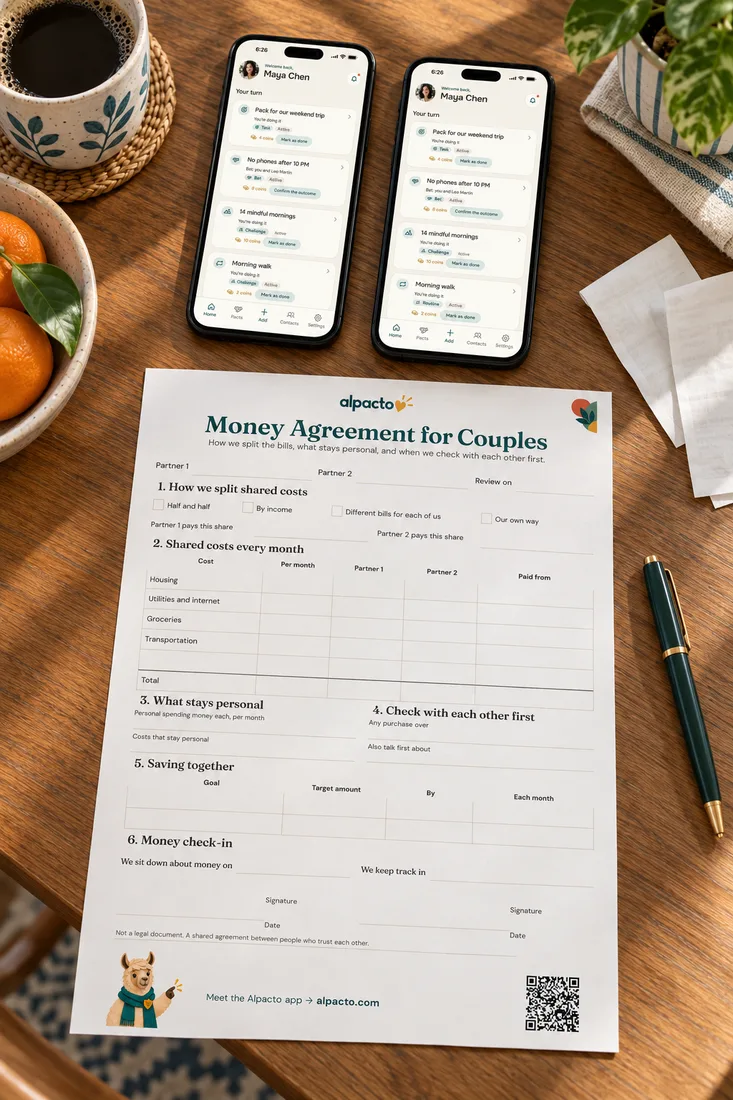
A budgeting app records what was spent. It does not record what the two of you agreed to spend it on, who took which bill this month, or what happens when somebody forgets. Alpacto is our own app and it is not a budgeting app: it holds the agreement itself, signed by both, with what counts as done, by when, and coins that buy rewards you wrote for each other.