
Alpacto › Tools › How to split expenses
How to split expenses: a shared expenses calculator for two
Put your monthly bills in the table below, mark who actually pays each one, and add both take-home incomes. The calculator divides the total half and half, by income, or by shares you set, then names the single payment that settles the month. It also shows what each of you has left afterwards, which is the number these arguments are usually about.
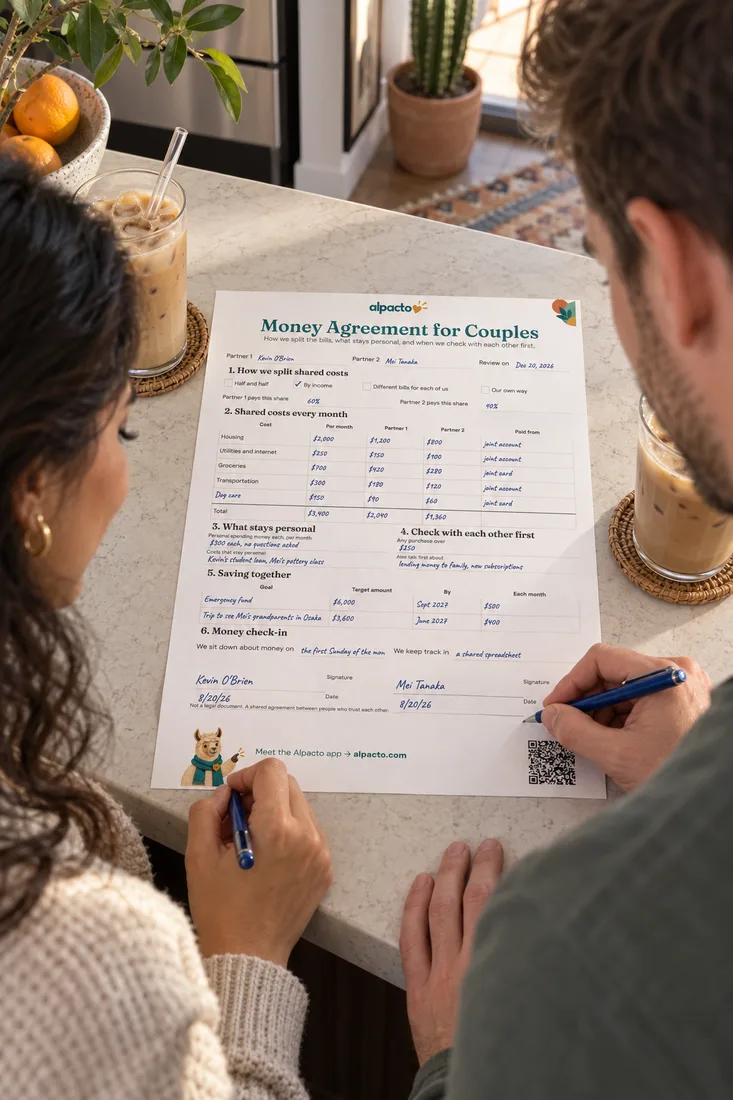
One list, one rule, one transfer a month.
In short
List every cost the two of you share each month, mark who actually pays each line, and enter both take-home incomes. The calculator divides the total by the rule you choose and names the one payment that squares the month between you.
Half and half is the simplest rule and the one that stings when the two paychecks are different sizes. Splitting in proportion to income leaves each of you the same slice of your own pay. Shares you pick yourselves work too, as long as you can both say why.
Nothing you type is sent anywhere or saved, and the copy button hands the result to the other person.
The shared expenses calculator: your month, line by line
What the calculator does with your numbers
Most split calculators ask for one total and two incomes and hand back two shares. That is half an answer: one of you already paid the rent this month, and a share alone does not say who owes whom.
This one asks a third thing: who actually pays each line. Rent can leave your account, groceries can leave theirs, and the phone bill can be split at the till. With that column filled in, the month closes with one payment instead of five.
- Every line adds up to the month’s shared total.
- Your share of it is half, your share of the two incomes, or a percentage you type in.
- What you actually paid is the sum of your own lines plus half of every line marked as split at the till.
- Share minus paid is the transfer: one number, one direction, once a month.
- Income minus share is what you have left for everything that is not shared.
How to split expenses when you earn different amounts
Half of a bill is easy to agree to in the abstract. It stops being easy when one paycheck is two thirds the size of the other.
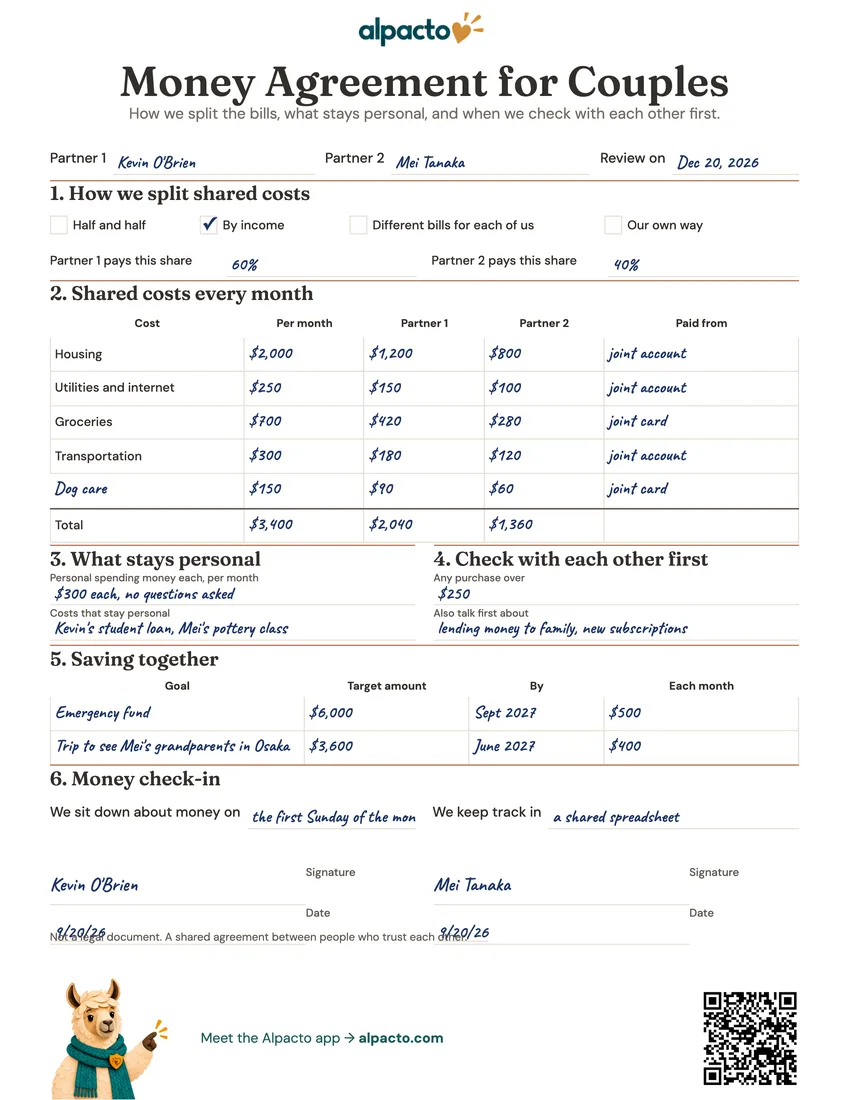
The example below uses $3,400 a month of shared costs, close to the $3,036 that housing and food came to for the average American household in the 2024 Consumer Expenditure Survey. One person takes home $4,200, the other $2,800.
| Rule | Partner A pays | A has left | Partner B pays | B has left |
|---|---|---|---|---|
| Half and half | $1,700 | $2,500, which is 60% of their pay | $1,700 | $1,100, which is 39% of their pay |
| By income, 60/40 | $2,040 | $2,160, which is 51% of their pay | $1,360 | $1,440, which is 51% of their pay |
Splitting in proportion to income is the only rule that leaves you both the same slice of your own pay.
And one thing that is not obvious
Decide what counts as income before you divide anything. A student loan, child support from an earlier life, a medical bill on a payment plan: each comes out of one person’s pay and never touches the shared list.
Write that answer next to the rule. A split agreed on gross salary and run on take-home a year later is two different deals.
What is left after the shared costs
Four rules for shared costs, and when each one breaks
No rule is correct for every household. The calculator runs three of them by name, and the fourth through the who-pays column. Pick the one whose failure you can live with.
| Rule | How the money moves | Works when | Breaks when |
|---|---|---|---|
| Half and half | Each pays half of every line, or half into a joint pot | Your incomes are close, and so are your spending habits | One paycheck is much smaller and funds the same bills, so that person runs out first |
| By income | Each pays the share of the total that matches their share of the two incomes | Incomes differ, or one of you is studying or between jobs | Pay swings monthly and nobody re-runs the numbers after a raise |
| Different bills each | You take the rent, they take groceries and the car | The bills add up close to the split you wanted anyway | Prices move, and a heavy grocery month quietly becomes the bigger half |
| Shares you pick | You agree on 70/30 for a reason you both say out loud | One of you brought the dog, works from home, or owned the place first | The reason expires and the share does not |
Where to draw the line splitting costs with your partner is a separate decision from the rule. Shared is what you would still be paying if the other person left for a month: rent, power, the internet, the food in the fridge.
Personal is the rest, including your gym and their concert tickets. Two extra lines are worth agreeing on: how much personal money each of you keeps with no questions asked, and the price above which a purchase gets a conversation first. If you want to cut that personal side for a month, try a 30-day no spend challenge.
Split expenses with friends, roommates and a group
The calculator holds two names: a monthly bill between two people is a different problem from a trip with six. A month repeats, so you want a rule and one transfer; a trip is a pile of one-off receipts, so you want a running balance.
For three or four in one home, the table still earns its keep. Put in the shared lines and the who-pays column; dividing the total three ways is where the calculator stops.
When receipts arrive daily, an app that keeps a running balance, such as Splitwise, is built for that.
How to split expenses when moving in together
One person pays the deposit, the other buys the sofa, and eight weeks later neither of you remembers what was meant to be shared. Four answers in the first month prevent most of what comes after.
- What counts as shared. Rent, power and the internet bill usually do; a car only one of you drives usually does not.
- The rule, as a percentage. Half and half, in proportion to income, or a share you both name with its reason.
- Who pays which bill, from which account. Direct debits are easier to agree on now than to unpick later.
- The day you settle, and the date you look again. A raise or a move is a reason to re-run the split, not to resent it.
Keep the four answers somewhere you both see, with a review date on them. Money disagreements predict divorce more strongly than other kinds of disagreement. In the study of 4,574 couples that found it, the sense of an unfair deal did its damage by turning into those arguments.
Questions people ask about splitting the bills
How do couples split bills?
Most use one of three rules: half and half, in proportion to income, or different bills each. The one that holds is the one you both agreed to out loud.
Is a 50/50 split fair when one of you earns more?
It is fair only if you both look at what is left afterwards and still say yes. Both spouses earn about the same in 29% of US marriages, so half the bill is rarely half the pain.
What if one of us has no income right now?
The by-income rule sends the whole bill to the earner: the calculator prints 100% and 0%. Put a date on it and re-run the split when that changes.
Should we use take-home pay or gross salary?
Take-home pay, and the same basis for both of you. It is the money that can actually pay a bill, and it already accounts for deductions that differ between two jobs.
How to split costs in a relationship when one of you has debt?
Keep the debt in that person’s own column, out of the shared list. It is not a household cost, but it does change what someone can carry, which is a fair reason to pick your own shares.
Is there an app to split expenses?
Several, and they solve a different problem: one-off receipts and a running balance. This page is for the bills that repeat every month. Alpacto is our own app, and it holds the agreement rather than the money.
Can I use this as a split expenses with friends calculator?
Yes, for two friends who share a home and split a monthly list. For a group trip with many small receipts, a running-balance app fits better.
Does a spreadsheet work just as well?
An Excel or Google Sheets file does the same arithmetic. It asks for one thing this page does not: that somebody keeps opening it.
Does the calculator save or send my numbers?
No. The arithmetic runs in your browser, nothing is sent to a server, and nothing is stored when you close the tab.
The same split, without anyone chasing the transfer
In Alpacto the monthly money check-in is a routine you both see, and sending your share is a task the other person confirms. Coins pay for the jobs around the money, and they are not money themselves: they never leave the app.