
Alpacto › Free printables › Challenges › No spend challenge
A 30-day no spend challenge with the rules written down first
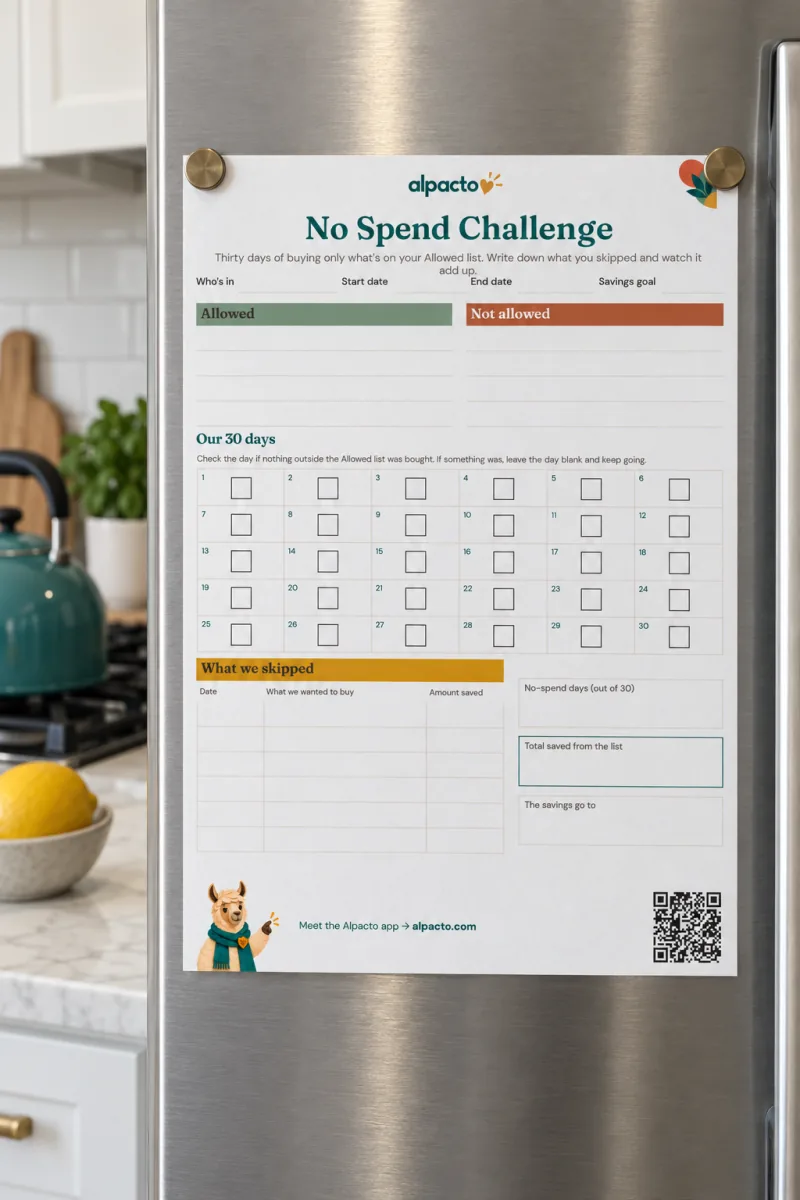
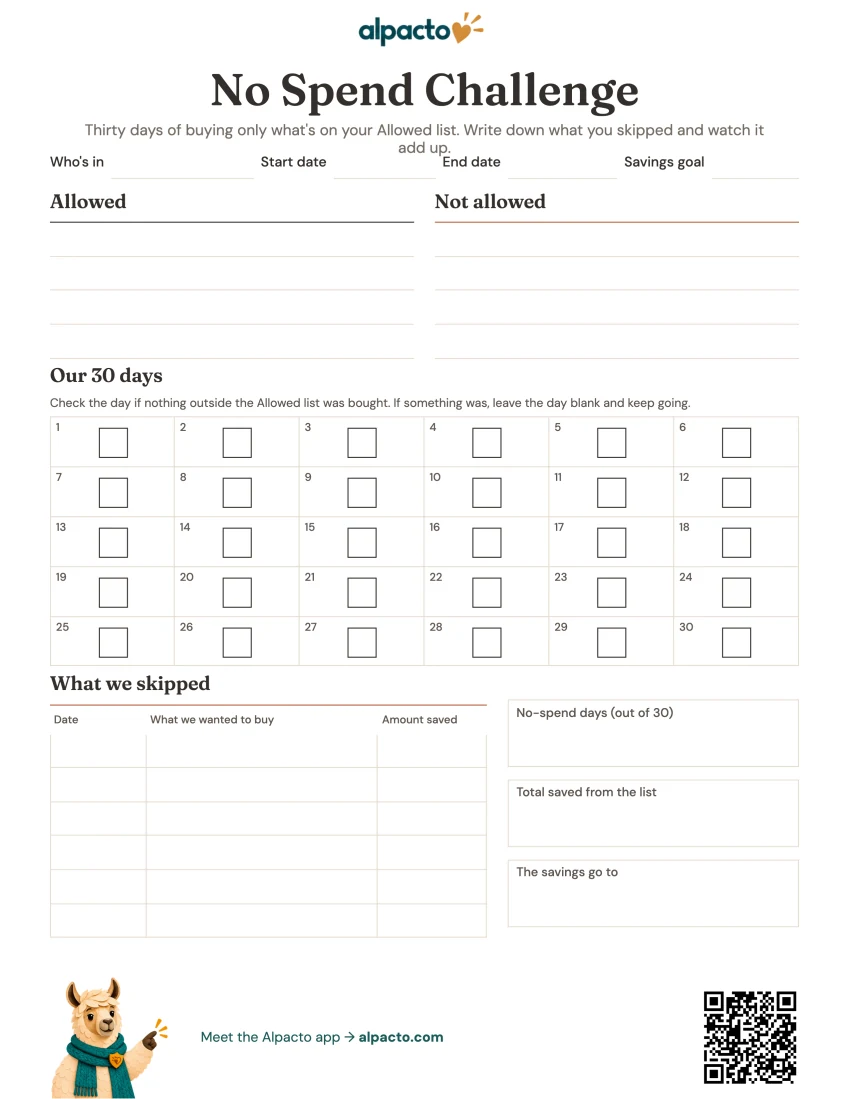
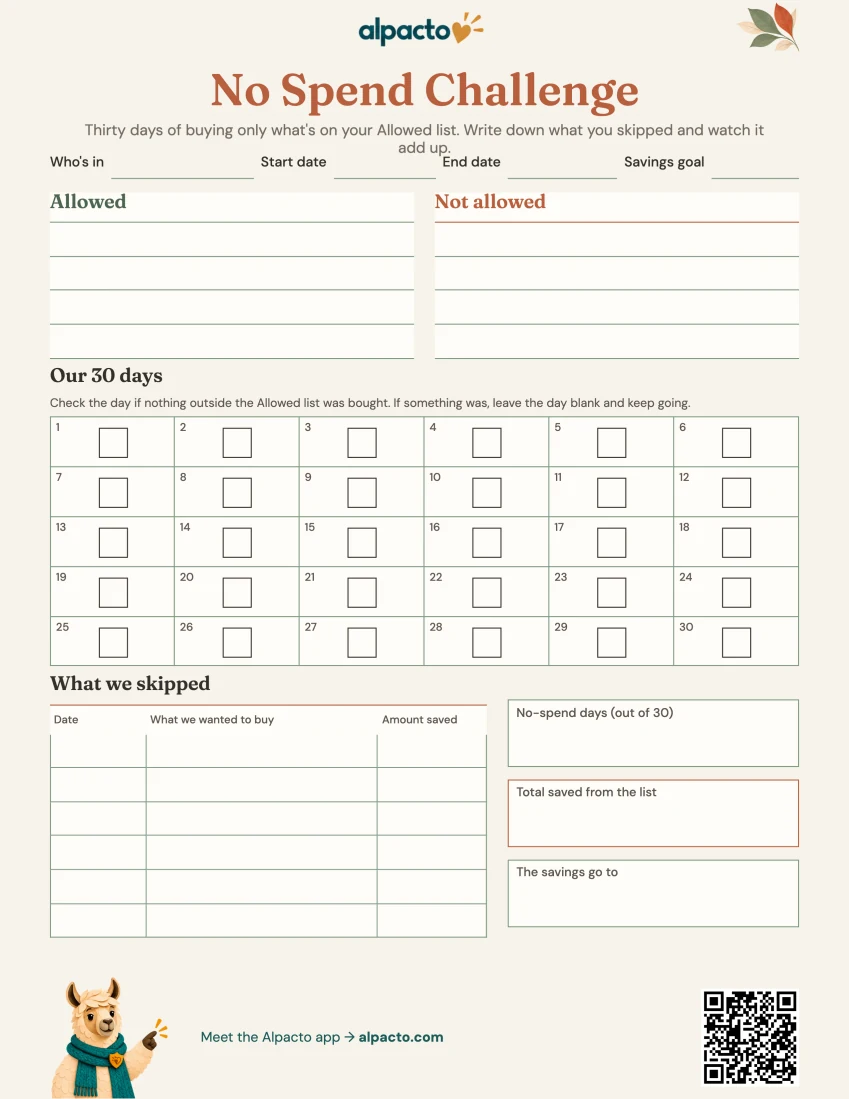
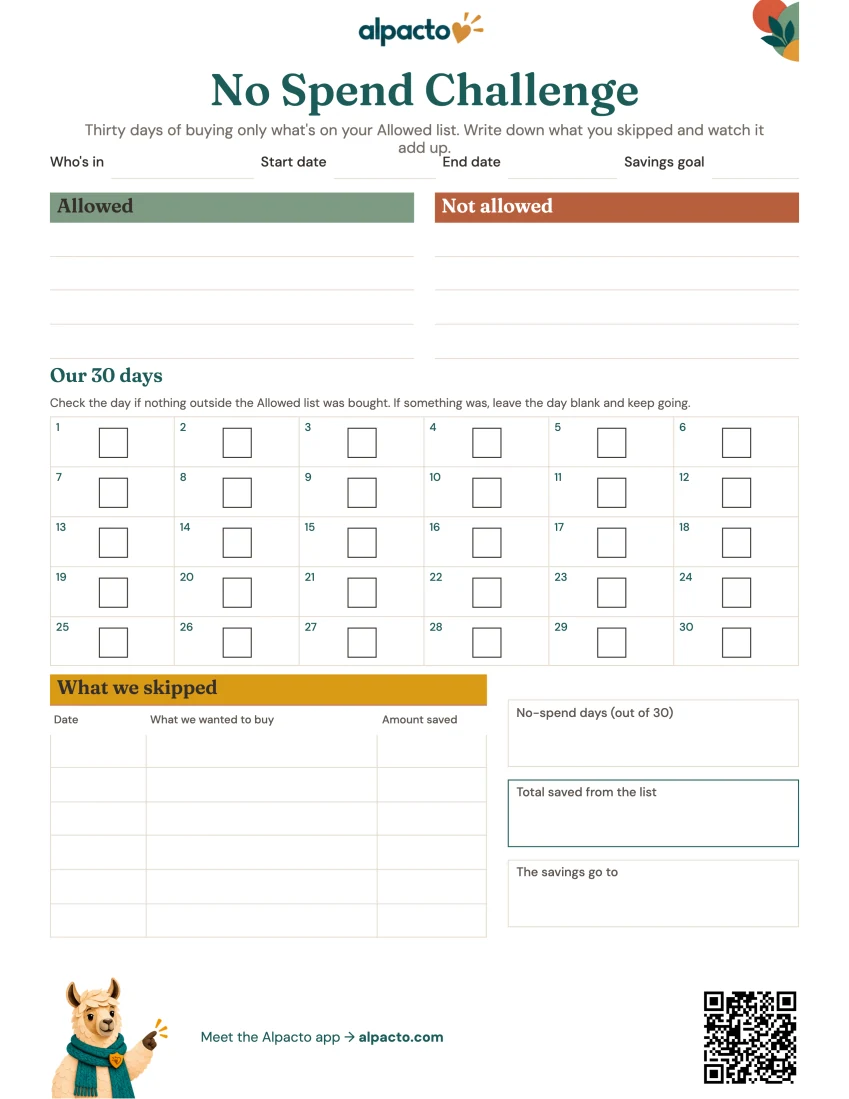
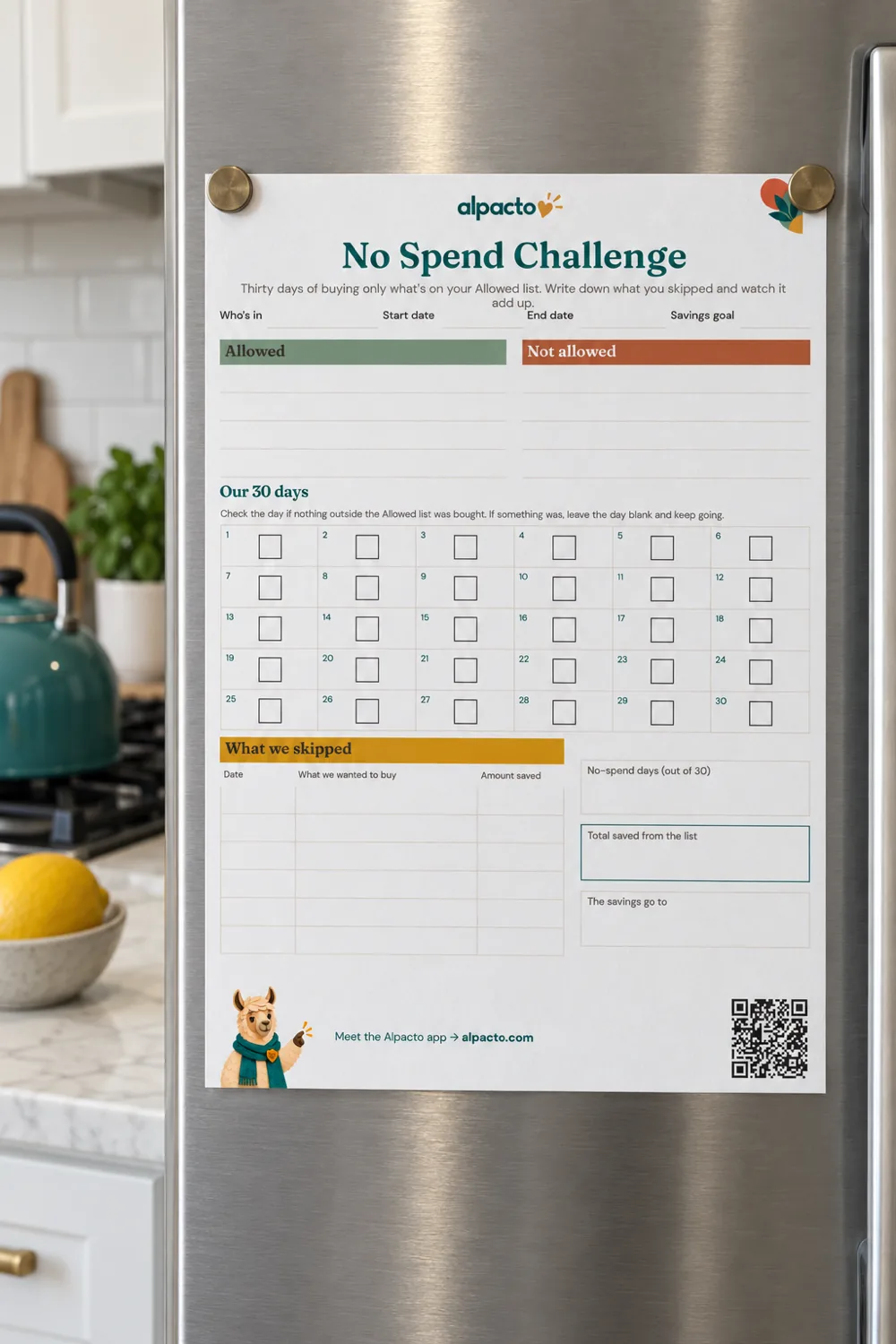
This no spend challenge sheet covers 30 days for one person, a couple or a whole household. Before day one you write your own Allowed and Not allowed lists, four lines each. Then you check off the days and list each thing you wanted and skipped, with its price.
- Paper
- US Letter and A4, portrait, one page, print at 100%
- Formats
- Blank, or a fillable PDF with 30 day checkboxes and 33 text fields
- Designs
- Minimal, warm and color
In short
A no spend month holds when the rules are on paper before the first tempting purchase. A day with a purchase outside the list stays blank, and the count goes on.
Decide in advance what happens if the car breaks down. In the filled-in example, a couple checks 24 of 30 days and skips $206 of purchases against a $200 goal.
What is on the sheet
Who’s in and a goal
Who’s in, Start date, End date and Savings goal, in one row.
Allowed and Not allowed
Two columns, four blank lines each. Nothing is printed in advance: the people on the sheet decide.
Our 30 days
Thirty numbered boxes, six to a row, under one printed rule: “Check the day if nothing outside the Allowed list was bought. If something was, leave the day blank and keep going.”
What we skipped
Six rows for Date, What we wanted to buy and Amount saved, plus three boxes: “No-spend days (out of 30)”, “Total saved from the list” and “The savings go to”.
No spend month rules you write before day one
Ramsey Solutions lists what stays allowed: “food, your rent or mortgage, utilities, gas for your car, medical expenses, debt payments, insurance premiums and other regular bills.” The hard calls sit in between: takeout after a long day, a birthday gift, the cat’s vet visit.
| Allowed | Not allowed |
|---|---|
| Rent, bills, gas for the car | Takeout and delivery |
| Groceries from our list | Coffee out |
| Gifts we’d already planned | Clothes and home decor |
| Pet food and vet visits | Apps, games, “just because” orders |
The eight lines from the filled-in example, as Aisha and Tom wrote them.
“Groceries from our list” lets the weekly shop through, but not the candy at the register. “Gifts we’d already planned” covers a mid-month birthday without reopening the rules.
If two of you share the sheet, fill in both columns at one sitting, before the start date. Keep only lines you would both read the same way on day ten.
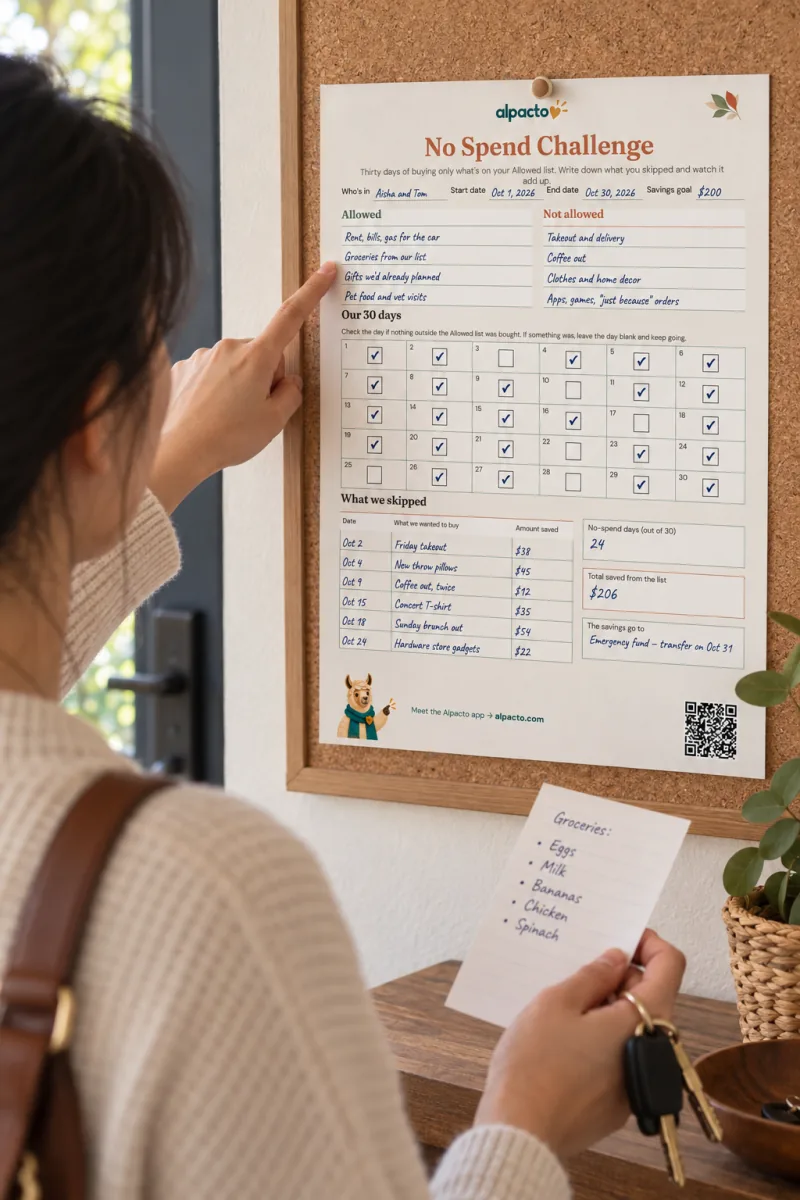
The Allowed list gets checked on the way out, before the store.
What counts as a no spend day
On this sheet, a no spend day is a day when nothing outside the Allowed list was bought. Rent and the weekly shop from the list still earn a check. With two names under Who’s in, there is one grid: a day is checked only if neither of you bought outside the list.
A day with a purchase stays blank, and the next day starts clean. Life with Less Mess tells readers to “Put a red mark on the chart” after a slip; this sheet has no red marks and no crosses.
Emergencies need a decision before day one. In the Federal Reserve’s latest survey, 59% of adults had a major unexpected expense within a year. Ramsey’s answer is “permission to stop the challenge and start again another month”; on this sheet, you write on the Allowed list which repairs you pay for, and the count goes on.
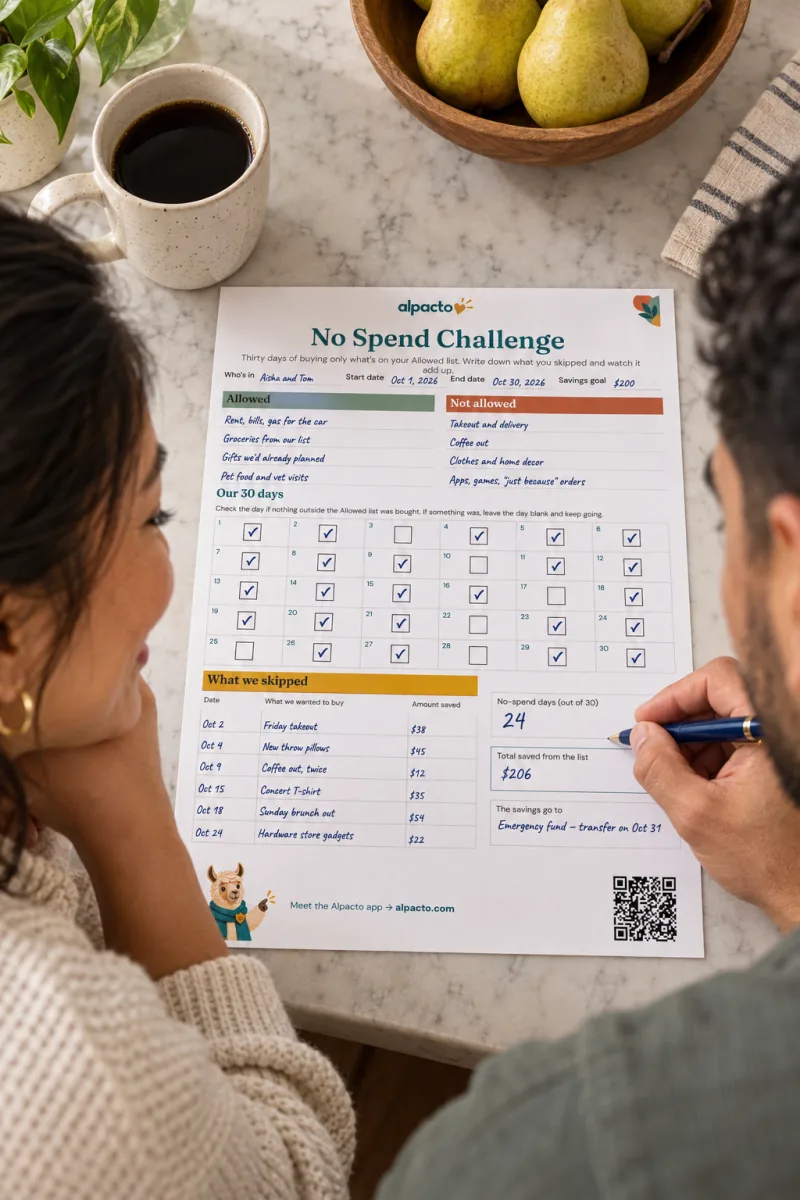
Six blank days, and the month still ends at 24 out of 30.
A filled-in month: 24 days and $206
Aisha and Tom ran it from October 1 to October 30, 2026, with a savings goal of $200. Six days stayed blank: the 3rd, 10th, 17th, 22nd, 25th and 28th. The other 24 got a check.
| Date | What we wanted to buy | Amount saved |
|---|---|---|
| Oct 2 | Friday takeout | $38 |
| Oct 4 | New throw pillows | $45 |
| Oct 9 | Coffee out, twice | $12 |
| Oct 15 | Concert T-shirt | $35 |
| Oct 18 | Sunday brunch out | $54 |
| Oct 24 | Hardware store gadgets | $22 |
| Total saved from the list | $206 |
Three of the six lines are food someone else cooks: $104 of the $206. The average US household spent $3,945 on food away from home in 2024, per the BLS.
The last box says where the money goes: “Emergency fund — transfer on Oct 31”, the day after the challenge ends. Until that transfer, $206 is a number on paper.
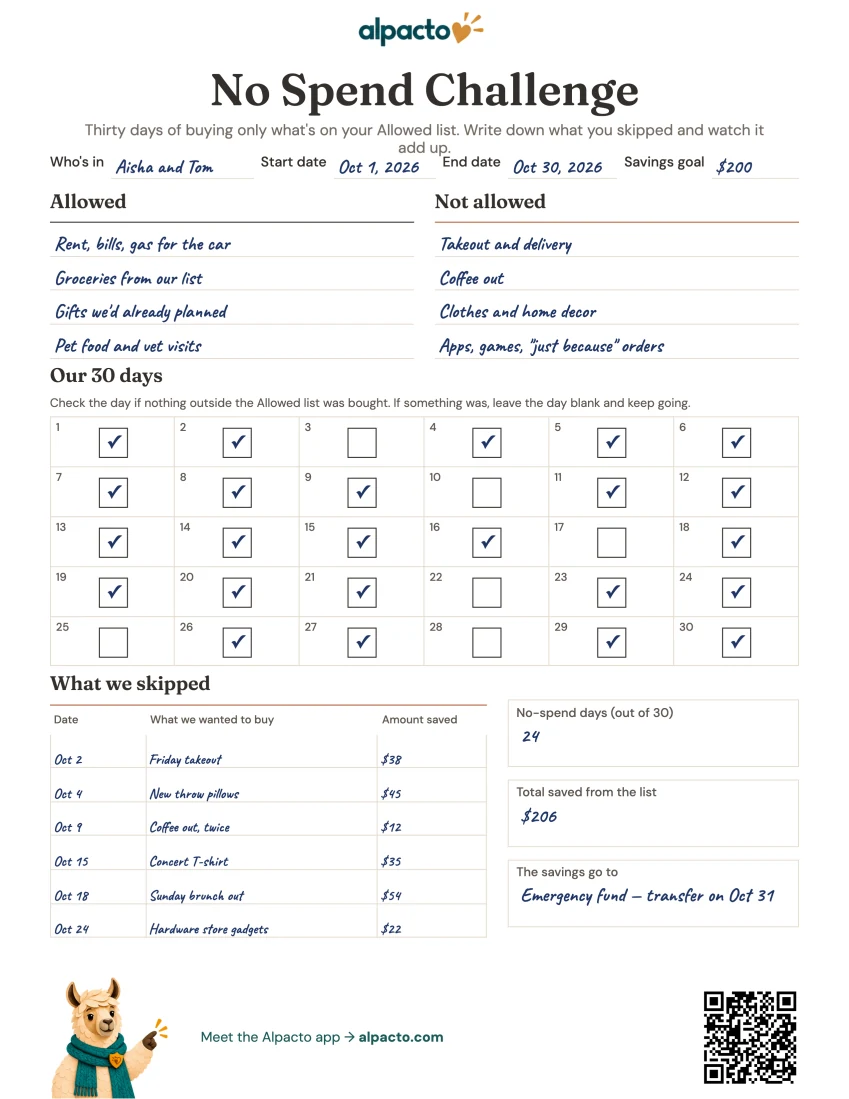
The example adds up: 38 + 45 + 12 + 35 + 54 + 22 = $206.
Download the no spend challenge printable
Three designs with the same text, free and with no email.
What to do with the money at the end of a no spend month
The “Amount saved” column adds up what you did not spend. It does not move any money. In the example, $206 stays in the checking account until someone transfers it.
Fill in “The savings go to” before day one, and give it a name you can send money to, such as a savings account or a credit card balance.
- Transfer as you skip. When you skip a purchase and write it down, move that amount the same day. The transfer will not be left for a day-30 decision.
- Or transfer once, on a set date. Pick day 30 in advance and put it on the sheet, so the total does not quietly get spent.
- Compare the total with the goal. The example beat its $200 goal by $6, so the goal was about right. If you miss by a lot, the goal was too high or the Not allowed list too short.
A couple that shares the account should agree on the destination together. The guide to splitting bills covers joint and separate accounts.
If 30 days feels long, run the first seven boxes as a trial week and see what you skipped. To track the money itself, see budget apps for couples.
Questions people ask
How does the no spend challenge work?
For a set period, often 30 days, you buy only what is on a list agreed in advance. Each clean day gets a check, and each skipped purchase goes on a list with its price. At the end you add up the list and move the money.
What items are OK to buy during a no spend challenge?
Whatever is on your Allowed list. Ramsey’s list includes food, rent or mortgage, utilities, gas and medical expenses; the example adds planned gifts, pet food and vet visits.
Is a no buy challenge the same thing?
Neither term has an official definition. The Not allowed list sets the scope: write only clothes and home decor, and the sheet works as a no buy challenge for things.
Is no spend January the best month to start?
Any month without a big planned event works. Ramsey mentions January and November as popular picks and suggests checking the calendar for birthdays and anniversaries first.
What is the $27.40 rule?
It is a savings target that circulates online: $27.40 set aside every day adds up to $10,001 over 365 days. On this sheet, your own target goes in Savings goal.
Is there an A4 version, and can I type into it?
Yes to both: each design comes in US Letter and A4, blank or fillable. The fillable PDF has 63 fields: 30 day checkboxes and 33 text fields.
Other free printable sheets
Save this challenge to Pinterest
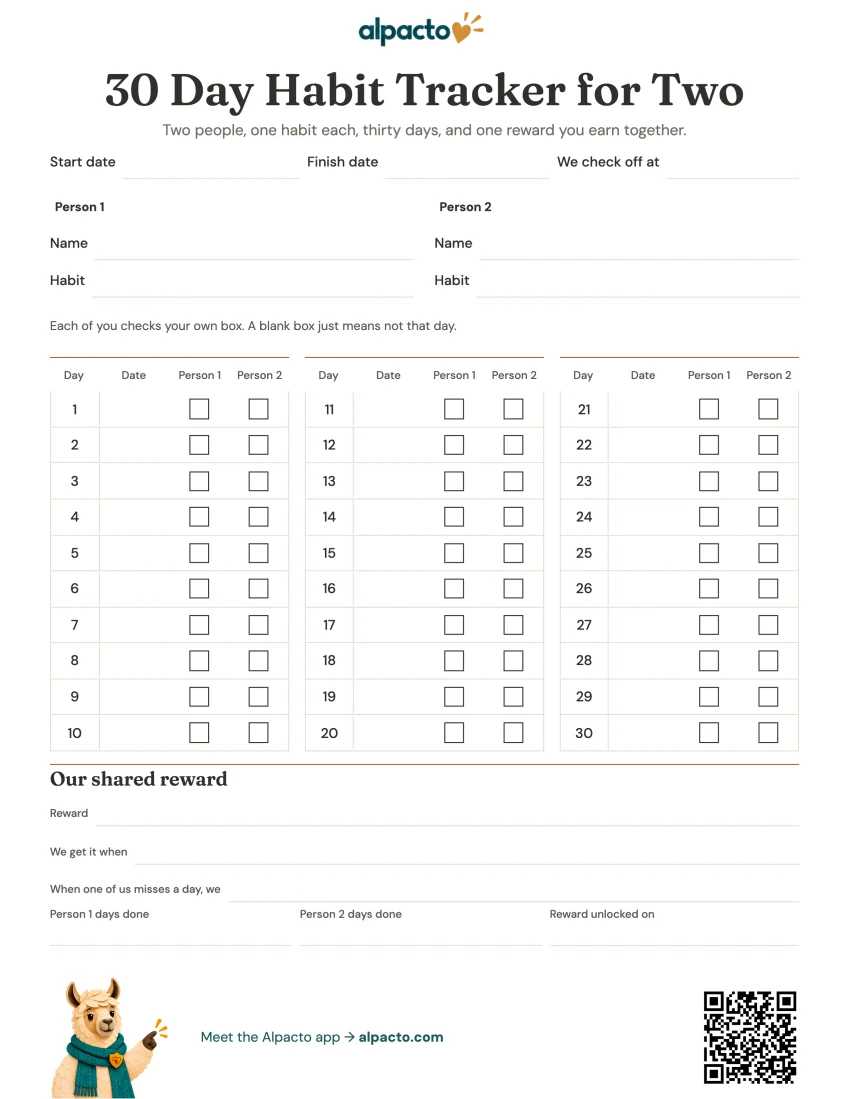
Pin it now and the sheet is on your board for the month you decide to spend less. Your own Allowed and Not allowed lists first, then thirty days to check off.
The same 30 days as a pact
Alpacto is our own app. In it, the same month can be a challenge between two people: a goal with a finish line, a period you can see and a reward at the end.
Both of you see the terms before anything starts. Coins stay inside the app and are never money, and accounts start at 13.