
Alpacto › Free printables › Challenges › 30-day habit tracker
A 30 day habit tracker for two people and one shared reward
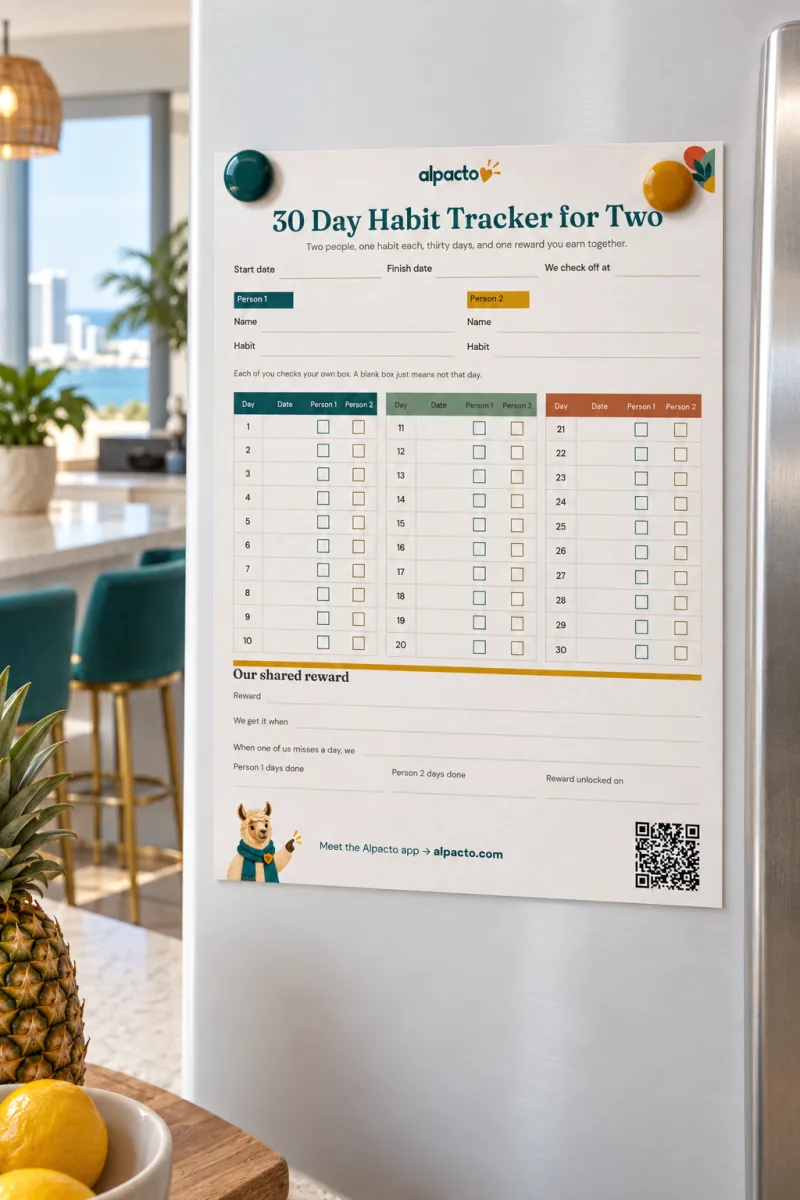
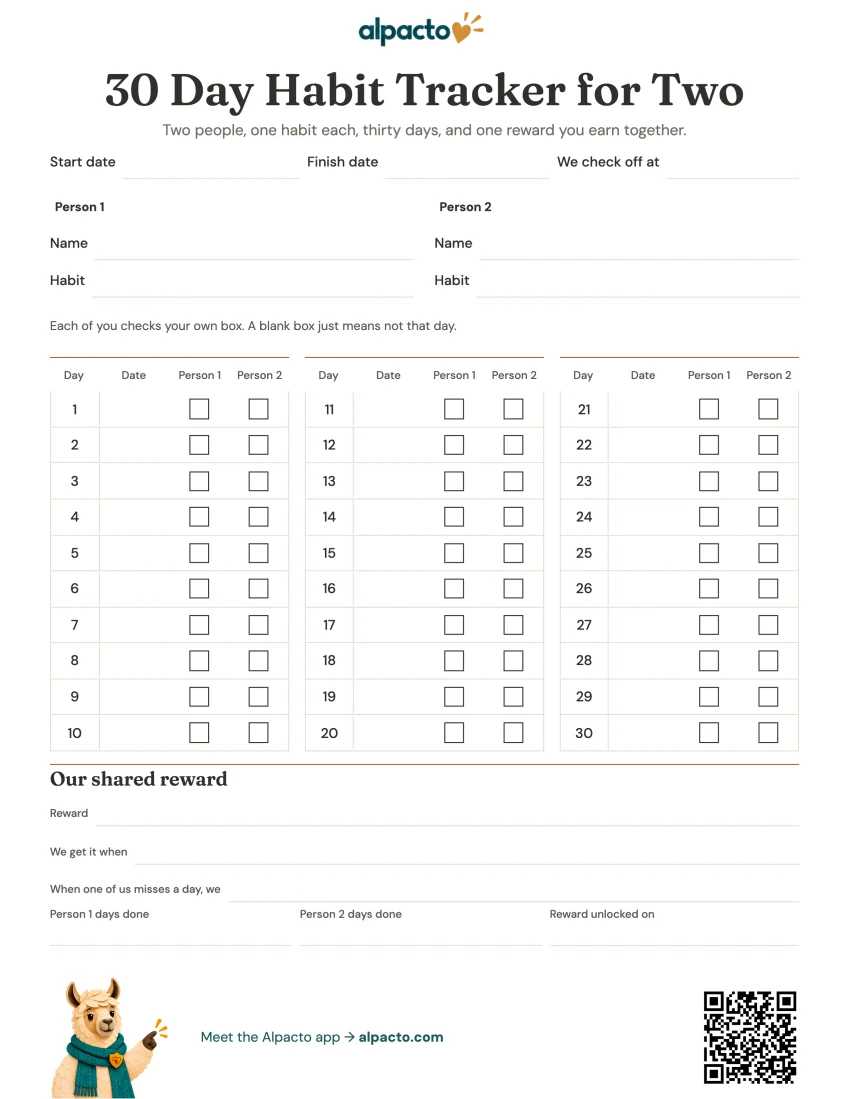
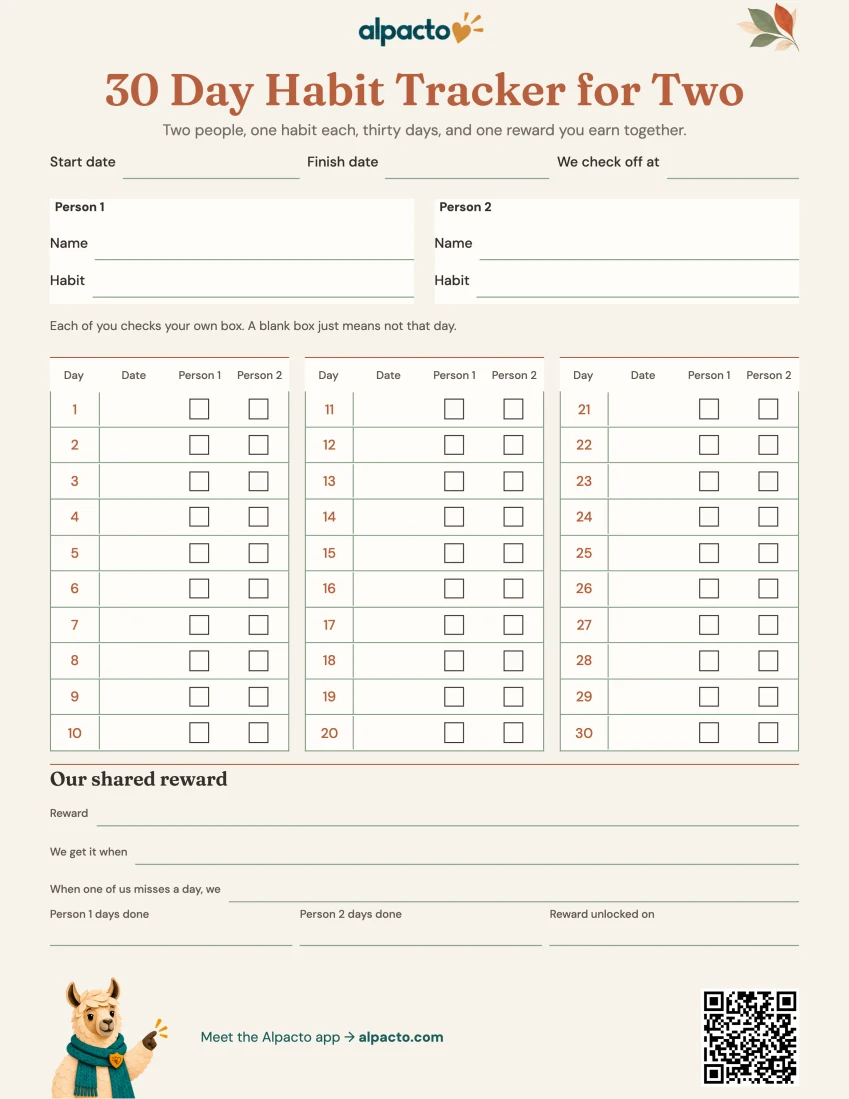
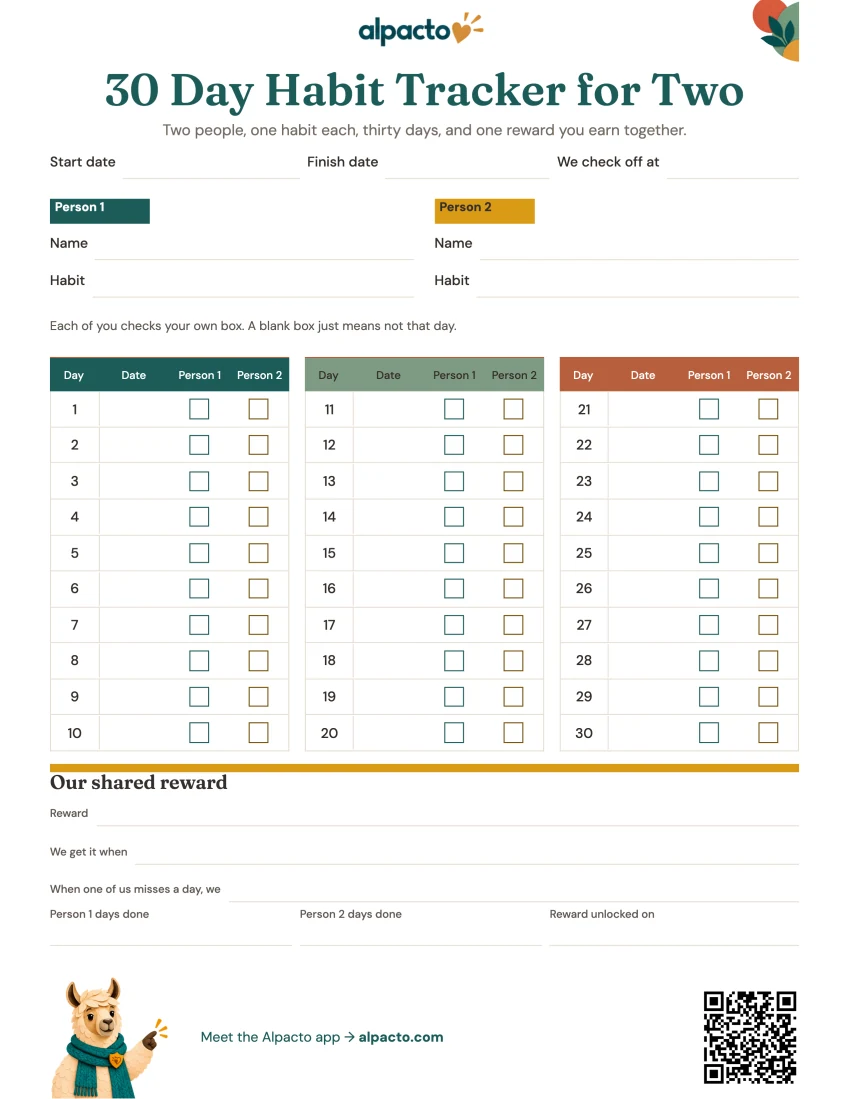
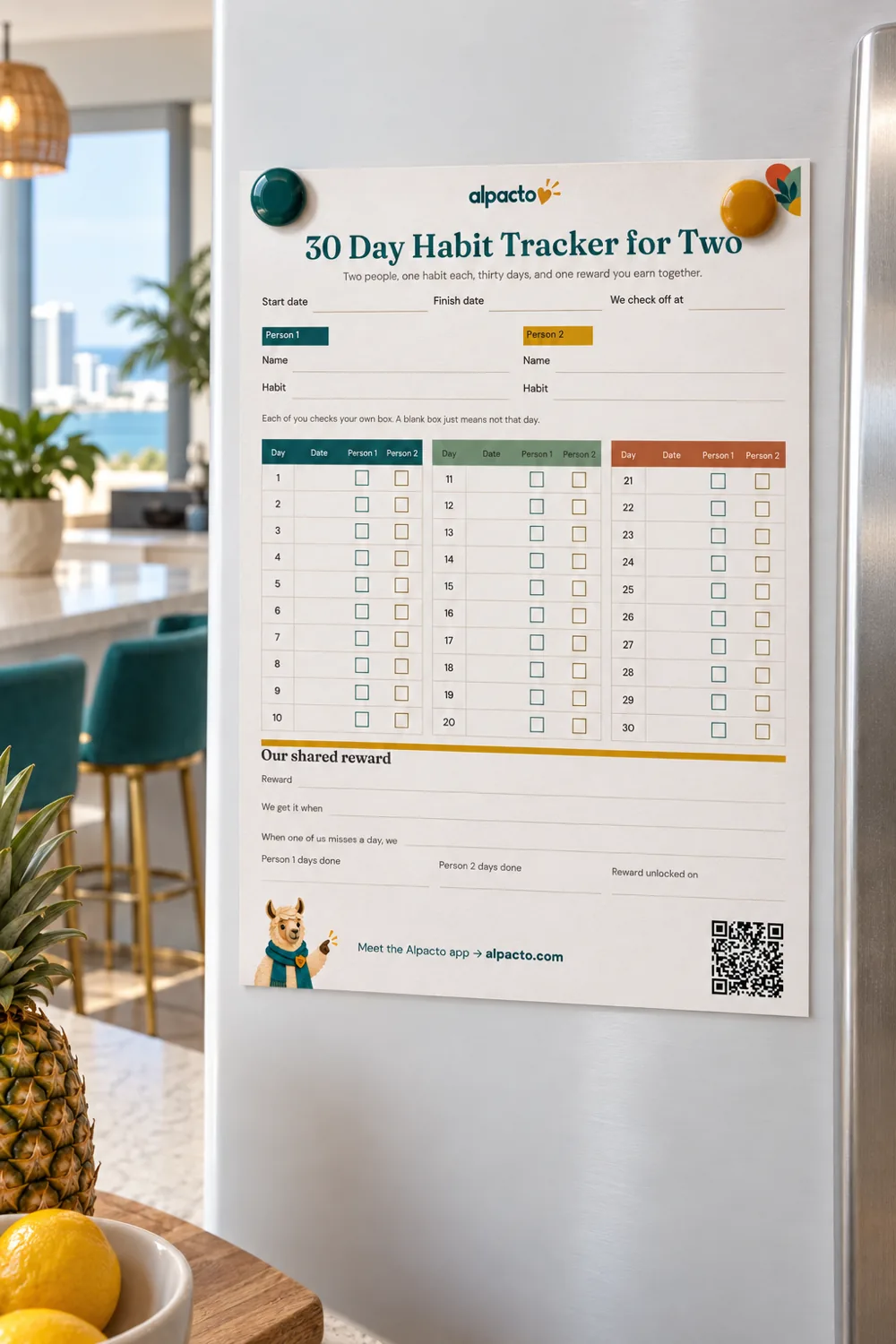
This 30 day habit tracker is one page for two people. Each of you writes in your own habit, and every day has two boxes in the same row, one for each of you. At the bottom goes one reward you earn together, with the rule for getting it written down before day one.
- People
- Two, one habit each
- Days
- 30, in three tables of ten, with a Date column
- Paper
- US Letter and A4, portrait, one page, print at 100%
- Formats
- Blank, or a fillable PDF with 103 fields
- Designs
- Minimal, warm and color
In short
Before day one, fill in the top and bottom together: dates, a check-off time, both habits, the reward and your rule for a missed day. Then each of you checks your own box every evening, and on day 30 you count.
What is on the sheet
Dates and a check-off time
Start date, Finish date and “We check off at”: one time when you both tick your boxes.
Person 1 and Person 2
A Name and a Habit line each. The habits do not have to match.
Three tables of ten days
Day, Date, Person 1, Person 2. Above them: “Each of you checks your own box. A blank box just means not that day.”
Our shared reward
Reward, “We get it when” and “When one of us misses a day, we”, then days done for each of you and the date you earned it.
How two people fill in one sheet
- Write the dates in the Date column. Day 1 is your start date, so this 30 day habit calendar can begin on any day.
- Pick a check-off time that suits you both. In the example it is 9:30 pm.
- Each of you names one habit. Simpler is quicker: in the UCL study below, habit strength for a glass of water peaked sooner than for 50 sit-ups.
- Write the reward and its condition before day one. Then on day 30 you only count.
- Agree on what happens after a missed day. The sheet has a line for it and no word for penalty.
- Check only your own box. Nobody ticks or grades for the other person.
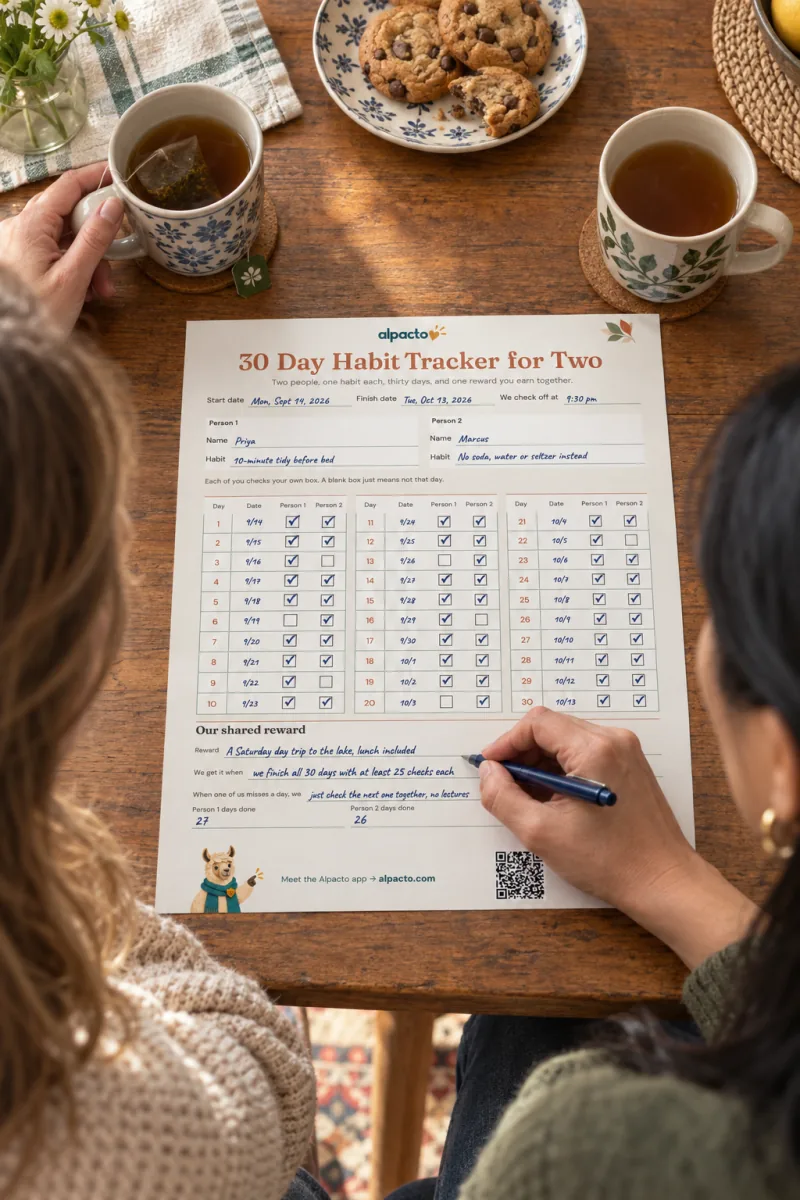
Reward, condition and the missed-day rule share the bottom of the page.
The example: 27 days, 26 days, one trip to the lake
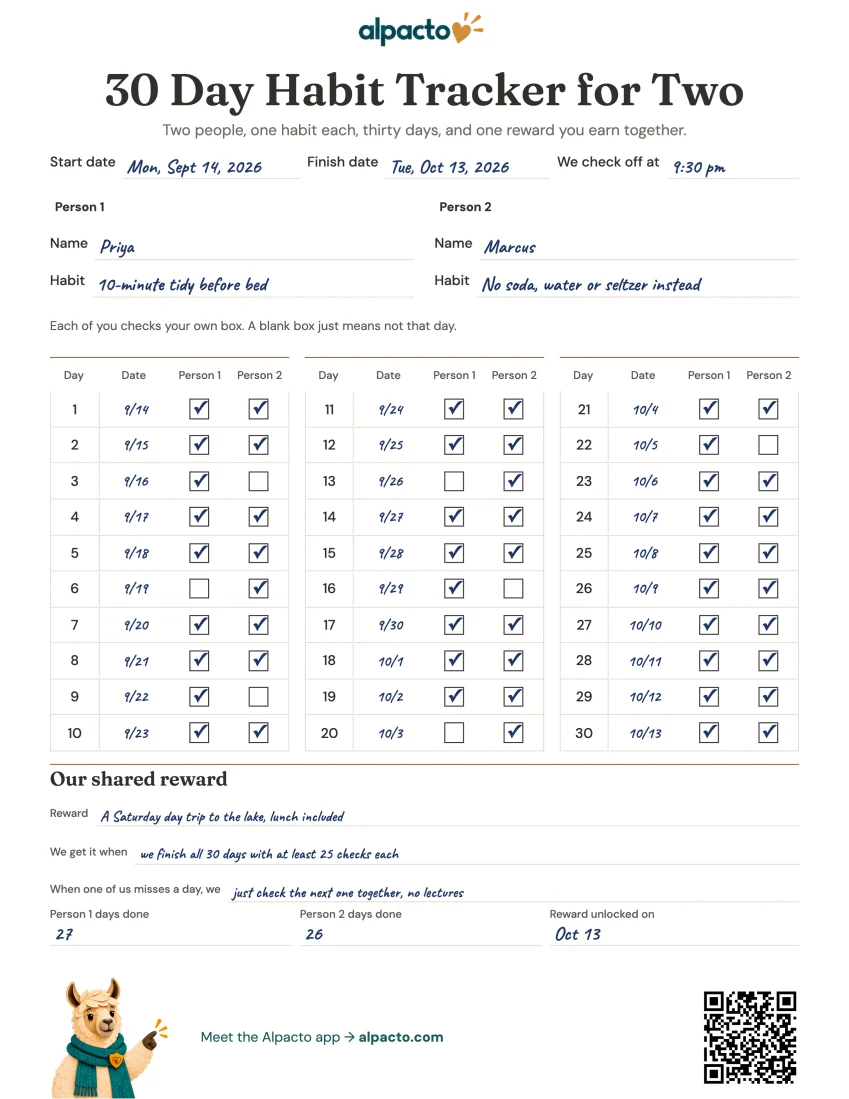
Priya and Marcus run the sheet from Monday, September 14 to Tuesday, October 13, 2026, and check off at 9:30 pm. Their reward is a Saturday day trip to the lake, lunch included.
The condition they wrote: “we finish all 30 days with at least 25 checks each”. After a miss they “just check the next one together, no lectures”.
| Habit | Blank days | Days done | |
|---|---|---|---|
| Priya, Person 1 | 10-minute tidy before bed | 6, 13, 20 (three Saturdays) | 27 |
| Marcus, Person 2 | No soda, water or seltzer instead | 3, 9, 16, 22 | 26 |
Both are above 25, so the last line of the sheet reads Oct 13, day 30.
Is 30 days enough to build a habit?
Usually not all the way: in a University College London study led by Phillippa Lally, 82 people repeated one daily health behavior for 84 days. On average it took 66 days to become automatic: 18 days for one person, a predicted 254 for another. Source: BPS Research Digest; UCL Health Behaviour Research Centre
The UCL researchers trace the 21 days many trackers promise to a 1960 book by a plastic surgeon, Maxwell Maltz, who wrote that his patients took about 21 days to get used to a new face. The UCL blog puts it plainly: “21 days is a myth; habit formation typically takes longer than that.”
So a habit tracker 30 days long is a first stretch; print a second sheet after it. The same study explains the blank box: “a single missed day had little impact on later automaticity gains”, while many misses added up. A good missed-day rule gets you back to the next box.
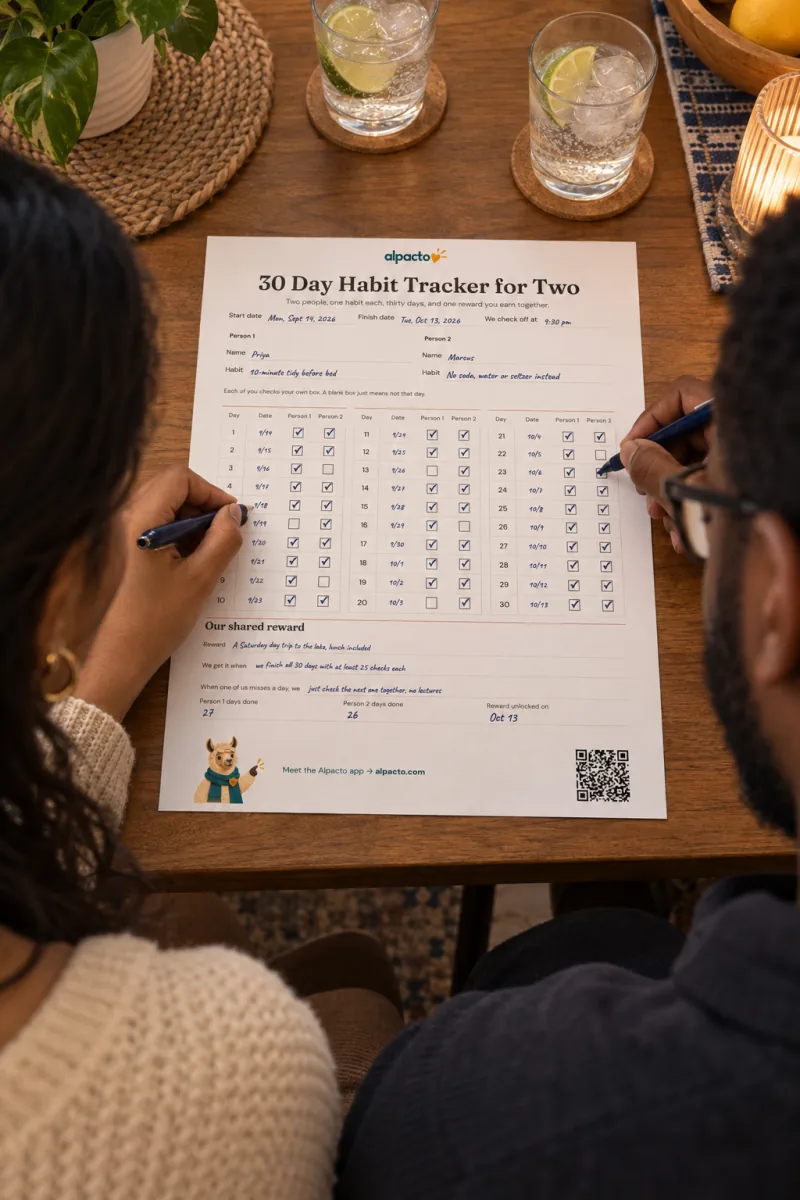
Two boxes in one row: each of you checks only your own.
Download the 30 day habit tracker printable
Three designs, the same page in each, free with no email. The fillable PDF lets you type before printing.
What to do on day 31 of a 30 day habit calendar
On day 30 you count your boxes against the line you wrote for the reward. Day 31 is when most people drift, so decide before the start what happens next.
- Read the blank boxes. In the example, Priya’s misses were all Saturdays and Marcus’s were spread across the month. A cluster on one weekday points to a cue that is missing that day, not a lack of will.
- Pick one of three moves. Keep the same habit on a new sheet, make it a notch harder, or swap it for a new one.
- Keep the check-off time. It is the part of the sheet that fits into the evening, so it carries over even when the habit changes.
- Write the next reward before you print. A new reward and a new condition go on the second sheet on the same evening you finish.
If you want a 21 day habit tracker instead, cross out boxes 22 to 30 and rewrite the reward condition, for example at least 18 checks each. The page stays the same.
If you want to keep checking in with one person after the month ends, read about an accountability partner. To keep many habits in one place, compare the best habit tracker apps.
Questions people ask
What is a good habit tracker for a month?
One page that says in advance what a missed day means. For one person and up to eight habits, use our monthly habit tracker; for two people, this sheet.
Is there a PDF template for a habit tracker?
Yes: this one comes blank in US Letter and A4, and fillable with 103 fields, 60 of them checkboxes.
Is there a free template for tracking habits in Google Sheets?
Not here. This printable 30 day tracker is PDF only; the fillable one is the closest to typing into a spreadsheet.
What is the best free habit tracker app?
It depends on whether you track alone or with someone. We compared nine trackers on the best habit tracker apps page.
Is there a 21 day habit tracker?
Not from us. The 21-day figure most likely comes from a 1960 book, not a habit study; the UCL study above averaged 66 days.
Can one person use it?
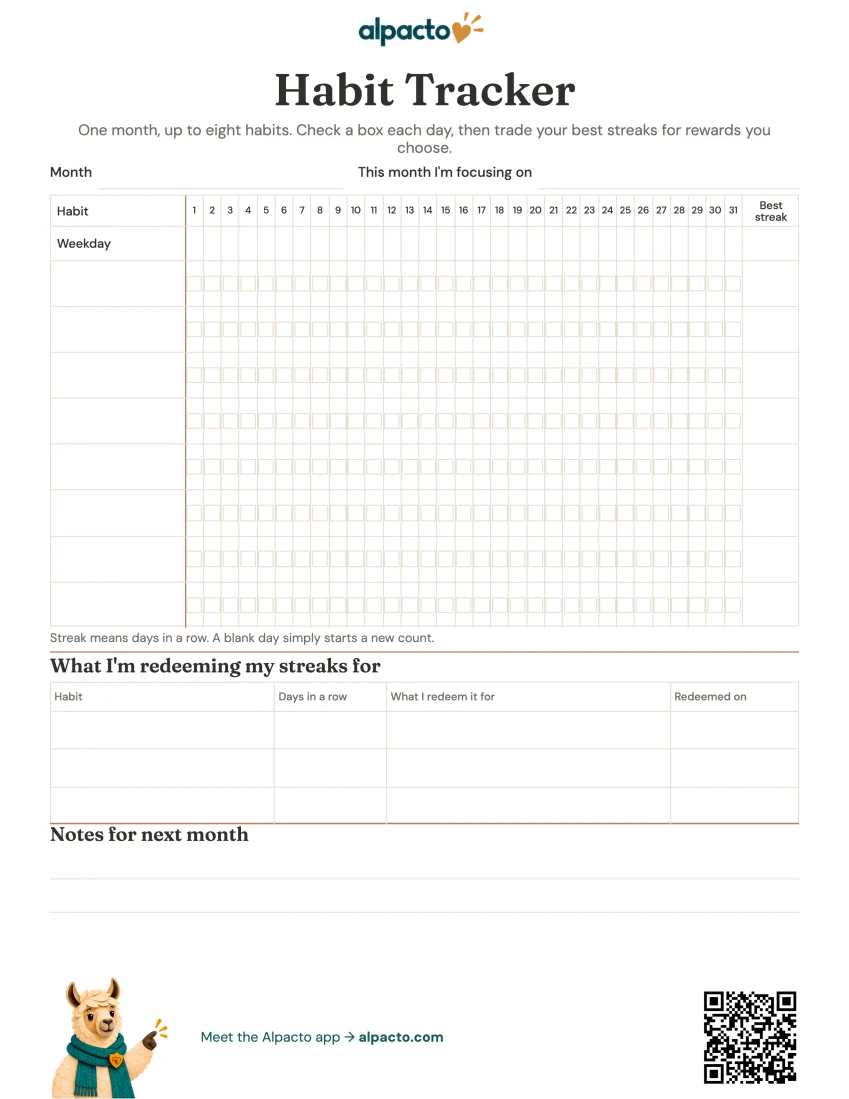
Yes: leave Person 2 empty. For several habits at once, the monthly sheet has eight rows.
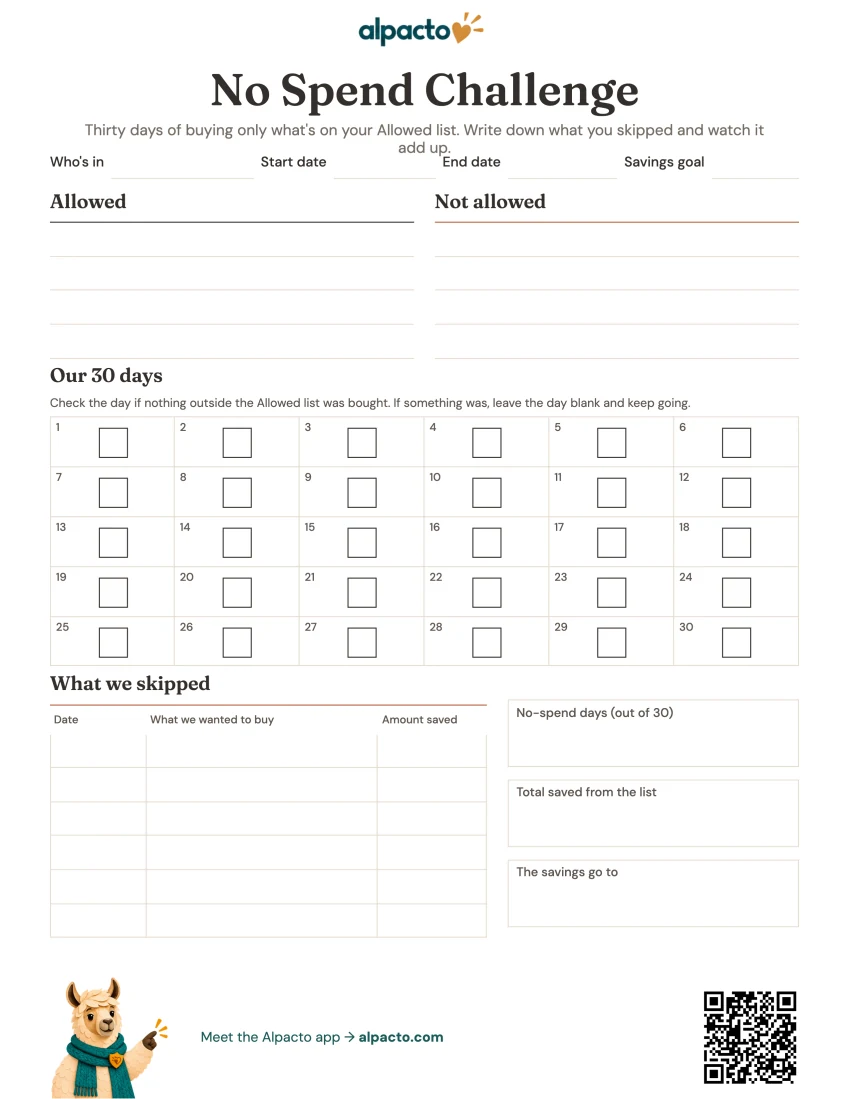
Other free printable sheets
Save this tracker to Pinterest
Pin it now and the tracker is on your board for the first of the month. Two people, one habit each, thirty days, and one reward you earn together.
The same thirty days on both phones
Alpacto is our own app, and there this sheet becomes a challenge: a goal with a finish line, a period you can see and a reward at the end. Coins stay inside the app and are never money, and you can choose your own reward instead. Accounts start at 13.