
Alpacto › Agreements › Accountability partner
Accountability partner: what it means and how to set one up that lasts
An accountability partner is someone you report your progress to on a schedule, so a missed goal gets noticed by a person besides you. It holds up when both of you write five lines before day one, including what happens when one of you misses a day.
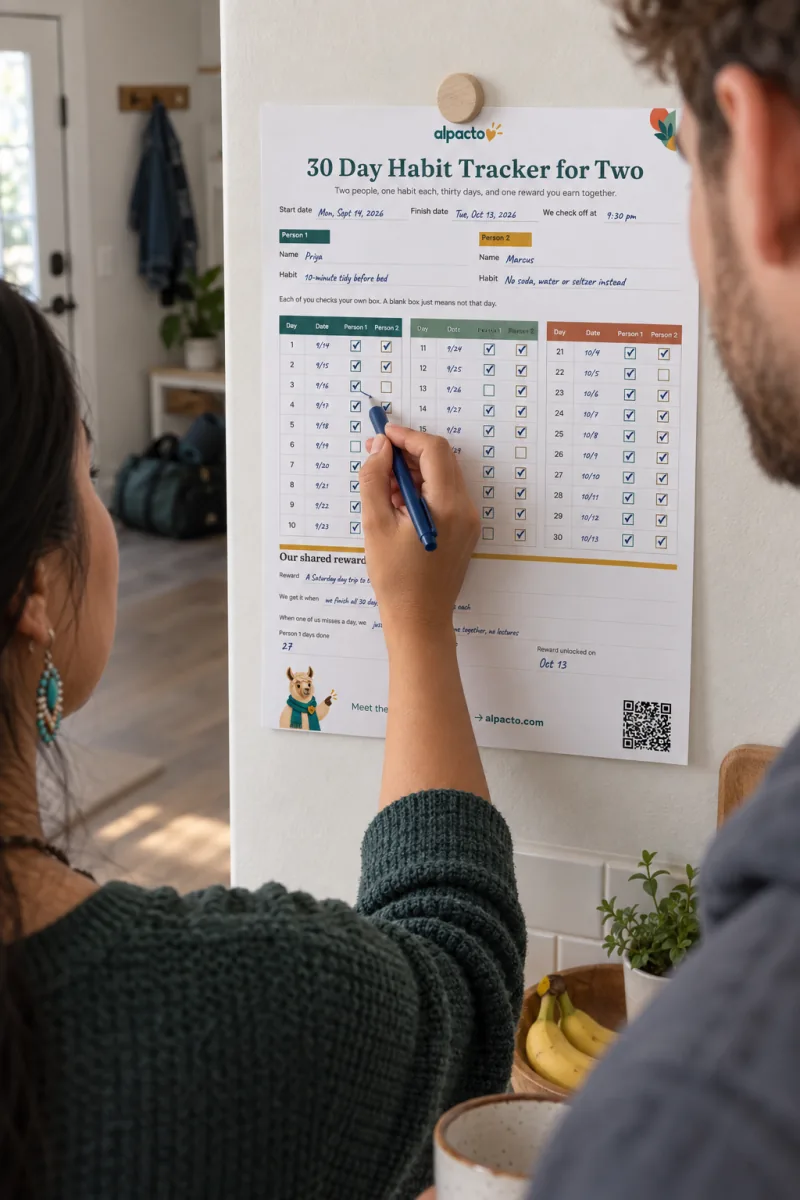
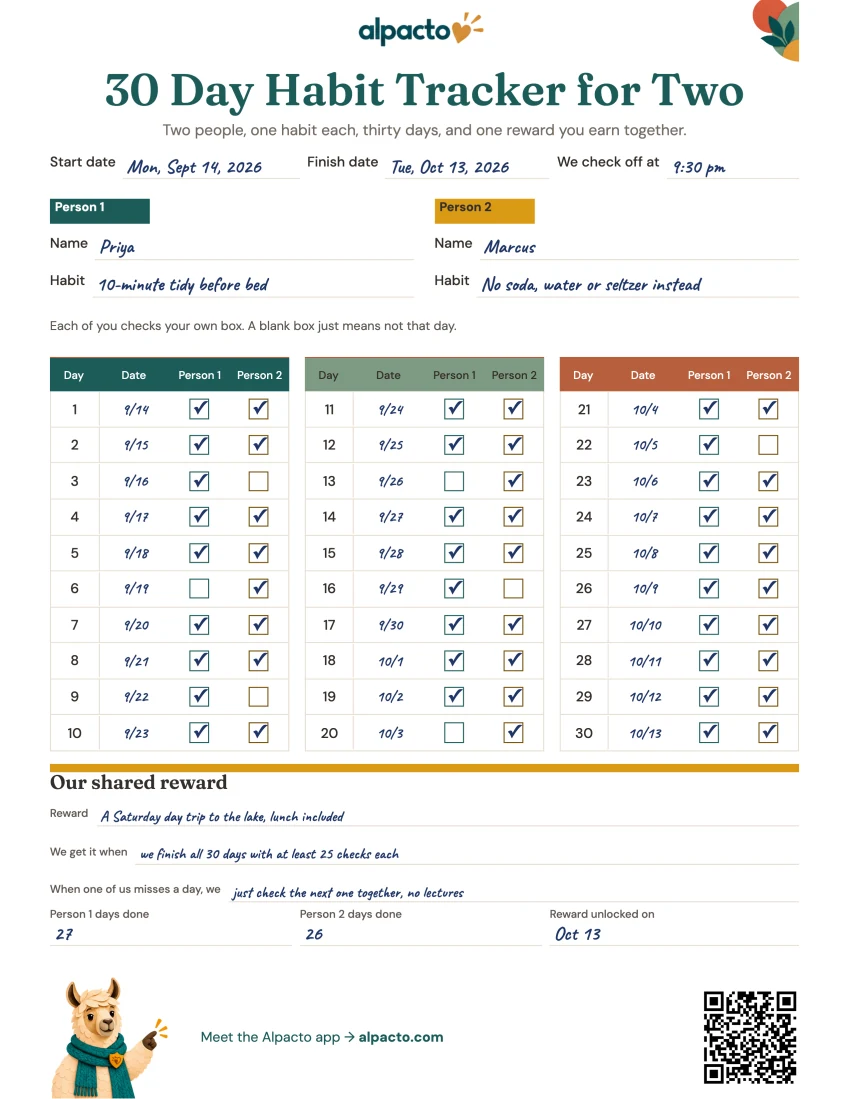
One box each, checked at the time you both agreed on.
In short
The person can be a friend, partner, relative or stranger who hears about your progress at a set time and notices when it stalls. It helps most when the reports are regular and both people make a change together. A partner who only watches adds little.
Before day one, write down each person’s goal, when you check in, what counts as done, what happens after a missed day and what you both get at the end. The free tracker below prints those lines for two people, with a column each.
Accountability partner meaning, and the other names for it
The accountability partner definition on Wikipedia is short: “someone who supports another person to keep a commitment or maintain progress on a desired goal”. The same article covers two places the term is used: evangelical churches and everyday goals such as exercise or work.
The arrangement can run one way or both ways. In a one-way setup one person reports and the other listens; in a two-way setup both of you have a goal and both report, which is how WGU describes the two versions.
| Name you will see | What it usually means |
|---|---|
| Accountability buddy, accountability friend | The same role, said casually. Usually a peer with a goal of their own. |
| Accountabilibuddy | A joke word from a 2007 South Park episode that stuck. |
| Body double, study buddy | Someone who works next to you, in person or on video, while you do the task. |
| Accountability coach | A paid professional who does the checking as a service. |
| Sponsor | The related role in twelve-step recovery programs, with its own rules. |
Does an accountability partner work? What four studies found
The study most often behind the benefits of an accountability partner comes from psychologist Gail Matthews at Dominican University. 149 people picked a goal for four weeks and were split into five groups; the group that emailed a friend a weekly progress report rated its progress highest.
Compare the last two bars. Sending your plan to a friend once helped a little; the weekly report is where the jump happens. The useful part is the schedule, and the friend is the reason you keep to it.
The other two studies point the same way
Among 3,722 older couples in England (JAMA Internal Medicine, 2015), people were far more likely to start exercising, quit smoking or lose weight when their partner made the same change. In a weight-loss program studied in 1999, 95% of people who joined with friends and got support finished it, against 76% of those who came alone to the standard program.
One 2018 trial found the limits. Skin self-checks rose from 58% to 83% of patients overall, and adding a partner made no difference; the partner-only group was the least satisfied, at 71%. A partner without a shared plan is just one more person to report to.
Why the famous 95% figure is not here
Many pages say a regular accountability appointment raises your odds of reaching a goal to 95%, credited to the ASTD, now the Association for Talent Development. The pages we checked point to other blog posts rather than to a study, so the number stays off this page.
Average self-rated progress after four weeks
Why most accountability partnerships fizzle out
Read the threads where people look for a partner and the same story repeats. The pair agrees to keep each other accountable, and nobody says what that means on the evening one of them skips.
“What do accountability partners even do to hold you accountable? … And then nothing happens”A commenter on r/Fitness
The second failure is quieter. When one person misses check-ins, the other stops too, because the silence reads as permission.
“All it takes is one person missing check-ins for a couple of days, and the whole system collapses.”A commenter on r/getdisciplined
Workout partners hit a third version: the plan depends on both people turning up, so one cancellation cancels two workouts.
“Like, oh, he is busy today and can’t go? Guess I won’t go. And eventually neither of us ever went.”Another commenter in the same thread
All three are missing rules, and the fix happens on paper before day one. Each person owns their own habit, the check-in has a fixed time, and a missed day already has an agreed answer.
How to be a good accountability partner: five lines to write before day one
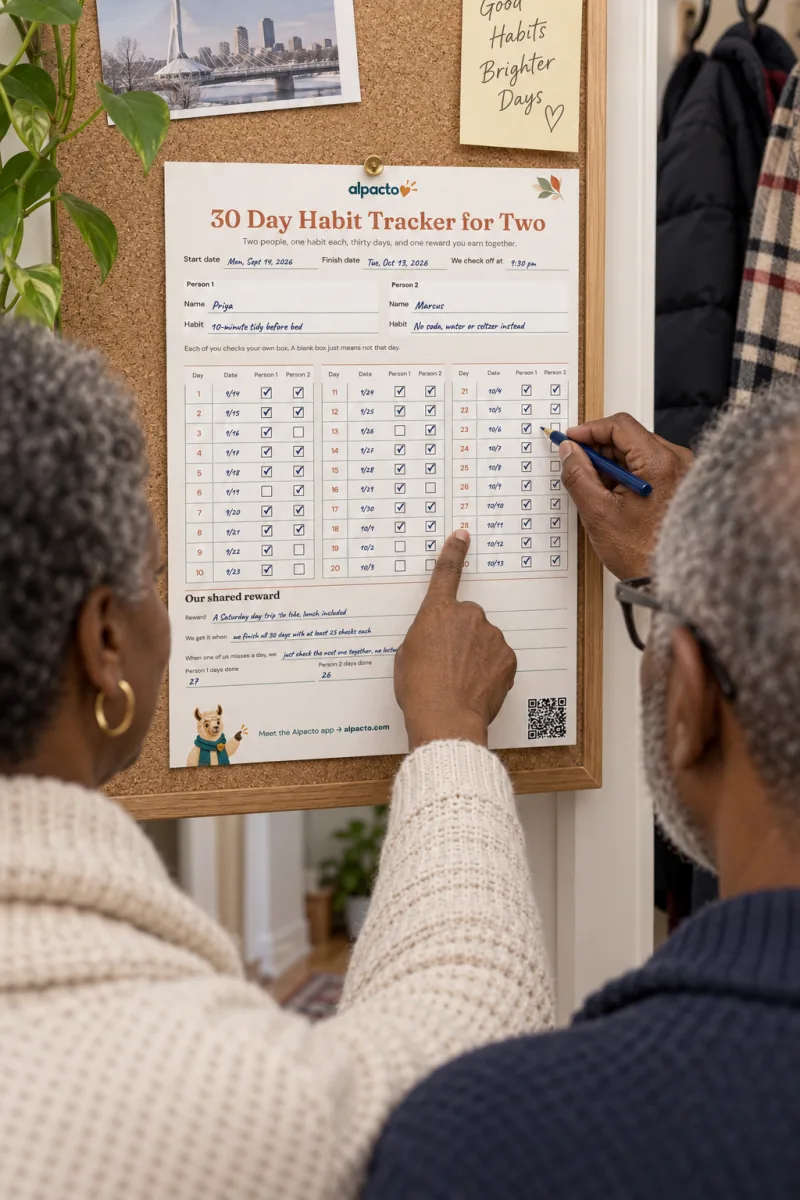
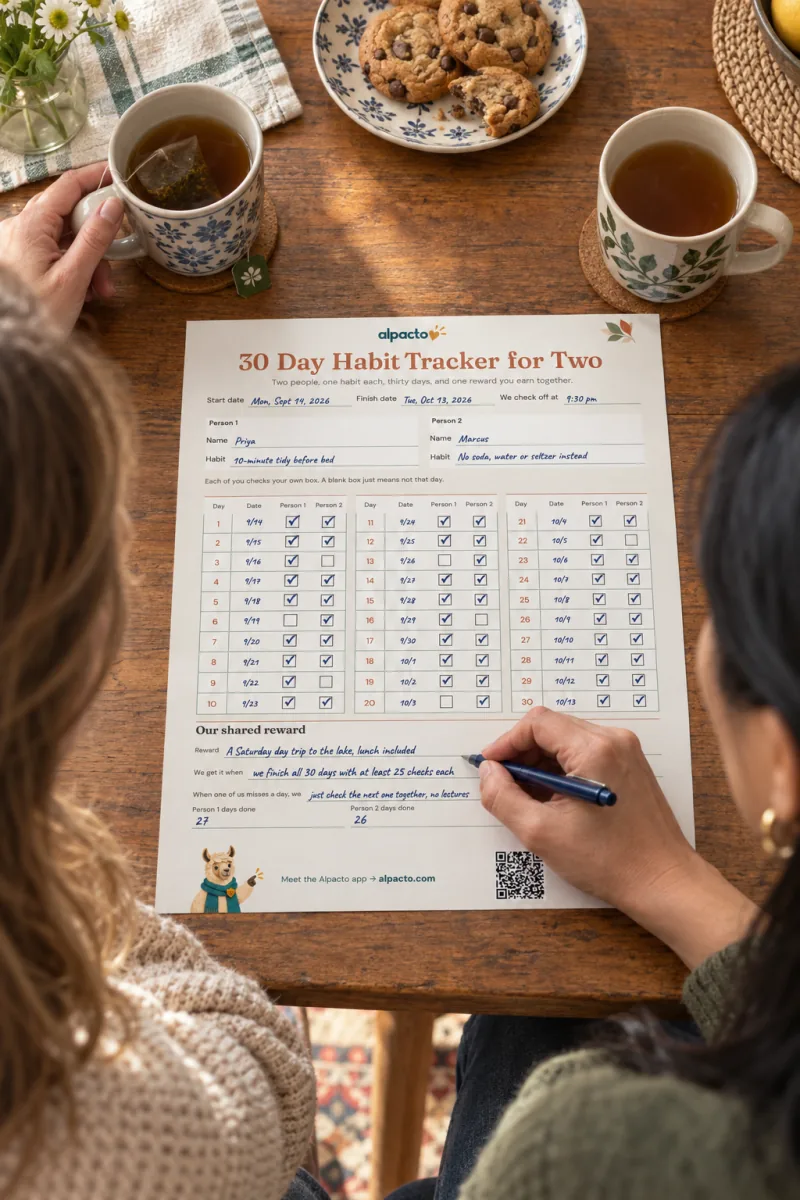
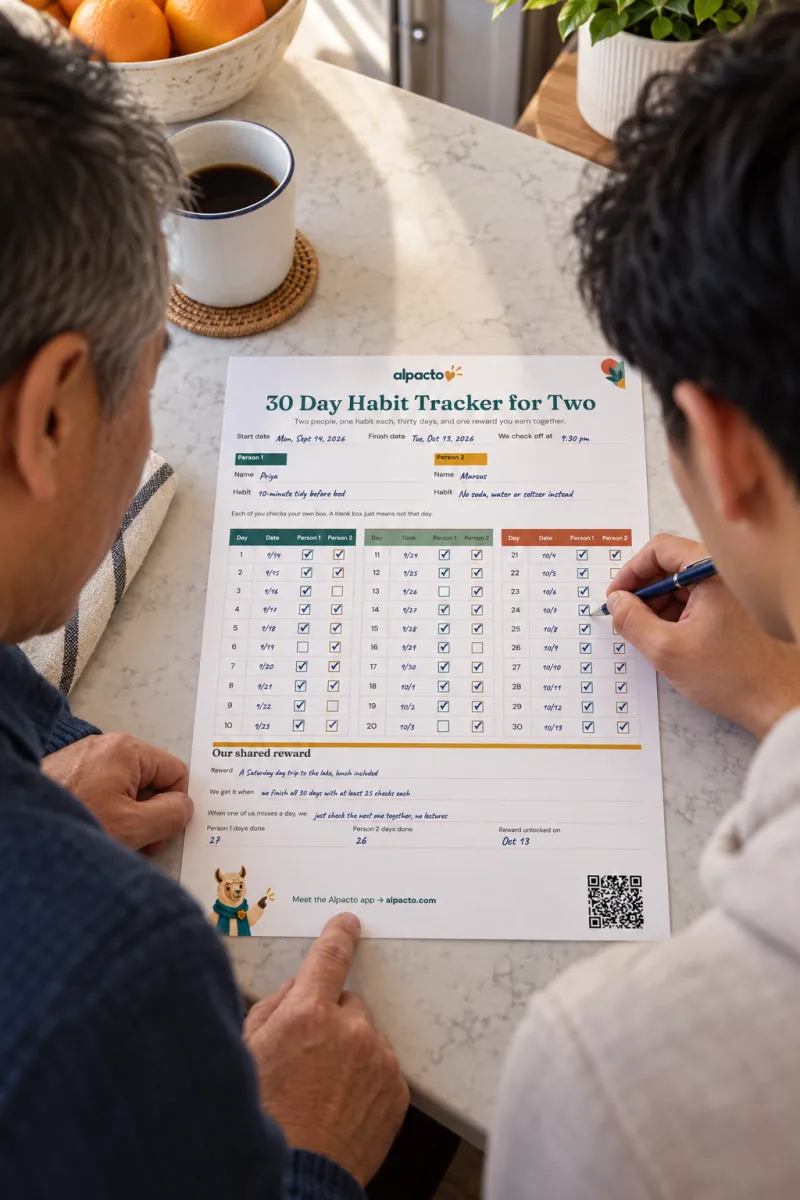
Think of it as a small accountability partner contract, one page and no legal words. These are the printed lines of our tracker for two, with the example a filled-in sheet uses.
| Line on the sheet | What to write | Example from the sample sheet |
|---|---|---|
| “Habit”, once per person | One habit each, small enough to do on a bad day | 10-minute tidy before bed; no soda, water or seltzer instead |
| “We check off at” | One time of day when both of you tick the box | 9:30 pm |
| “Reward” | Something you both get, chosen together | A Saturday day trip to the lake, lunch included |
| “We get it when” | The finish condition, with room for missed days | We finish all 30 days with at least 25 checks each |
| “When one of us misses a day, we” | What happens next, agreed while nobody has missed anything | Just check the next one together, no lectures |
The last line does the most work. It answers the question a commenter on r/loseit put to a couple dieting together: “Do you have a plan in case one of you do backslide while the other continues to excel?” Write the answer while you are both still on track.
Questions for the weekly check-in
One pair on NPR’s Life Kit keeps a shared spreadsheet with questions like the first two below. The last two lines are ours:
- How did I do?
- What worked, and what didn’t?
- Which day was hardest to check, and what was going on that day?
- Does the habit or the check-in time need to change for next week?
Stakes without punishment
A reward you earn together gives the missed day a cost without turning your partner into a judge. The tracker has no line for fines or a loser, on purpose: each of you checks your own box, and the other person does not grade it.
How to find an accountability partner, including at home
Some productivity blogs warn against using the people closest to you. Flow Club puts it bluntly: “A friend or a family member is often the worst accountability partner.”
The health research above points the other way for habits you practice at home. Couples changed together, and people who joined a program with friends stayed in it. Someone you see every evening can check in after dinner without a calendar invite.
| Where | Good for | Watch for |
|---|---|---|
| Your partner, roommate or someone you live with | Daily habits at home, a fixed evening check-in | Keep it two-way, so neither of you becomes the supervisor |
| A friend, sibling or coworker | Workout, study or work goals with a weekly report | Separate habits, so one cancellation does not cancel both |
| A stranger on video | Focused work sessions; Focusmate runs 25, 50 and 75-minute sessions, free for three a week | It covers sessions, not a month-long habit |
| Reddit, r/GetMotivatedBuddies or r/Accountabilibuddies | Finding someone with the same goal | Commenters there describe partners who drop out within days; agree on the rules first |
| A paid coach | Someone whose job is to follow up | Cost, and the role is one-way |
Whoever it is, pick someone who can meet at the same time every week and has a goal of their own. For a workout accountability partner, each person should keep their own habit, so the plan survives the day the other one cancels.
A tracker for two that has the rules printed on it
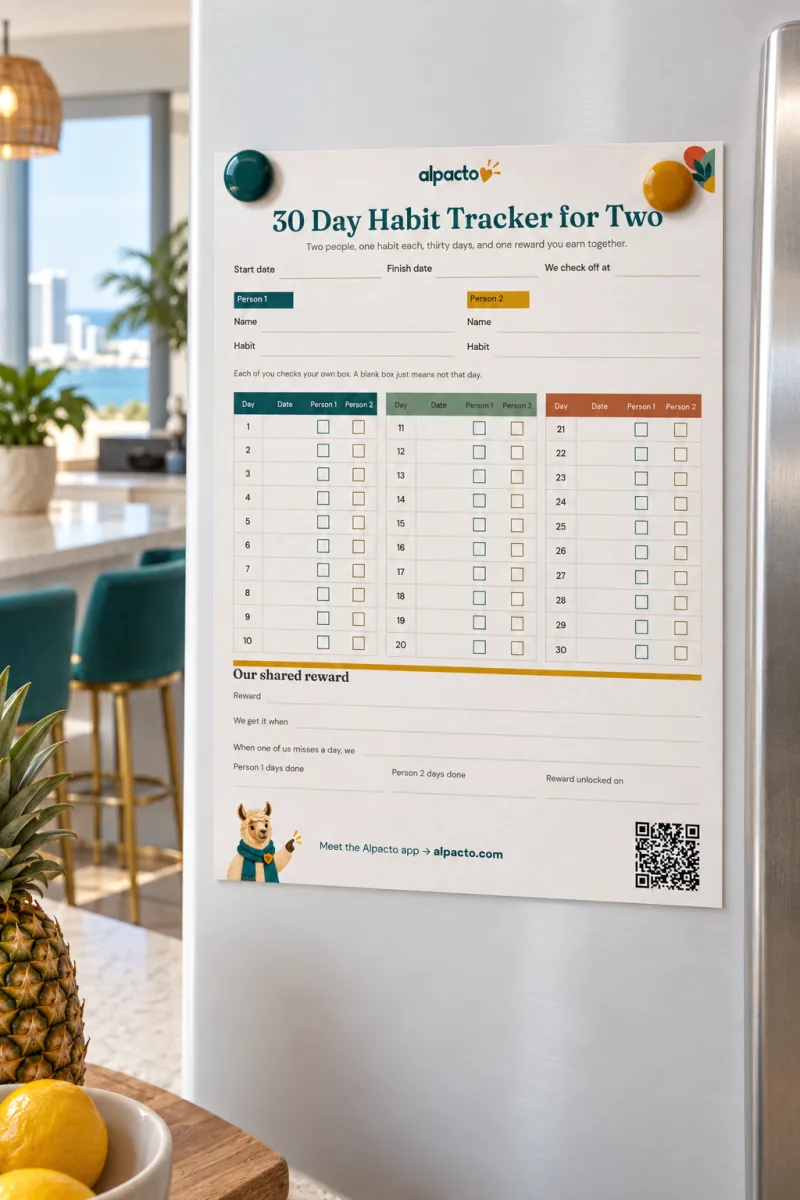
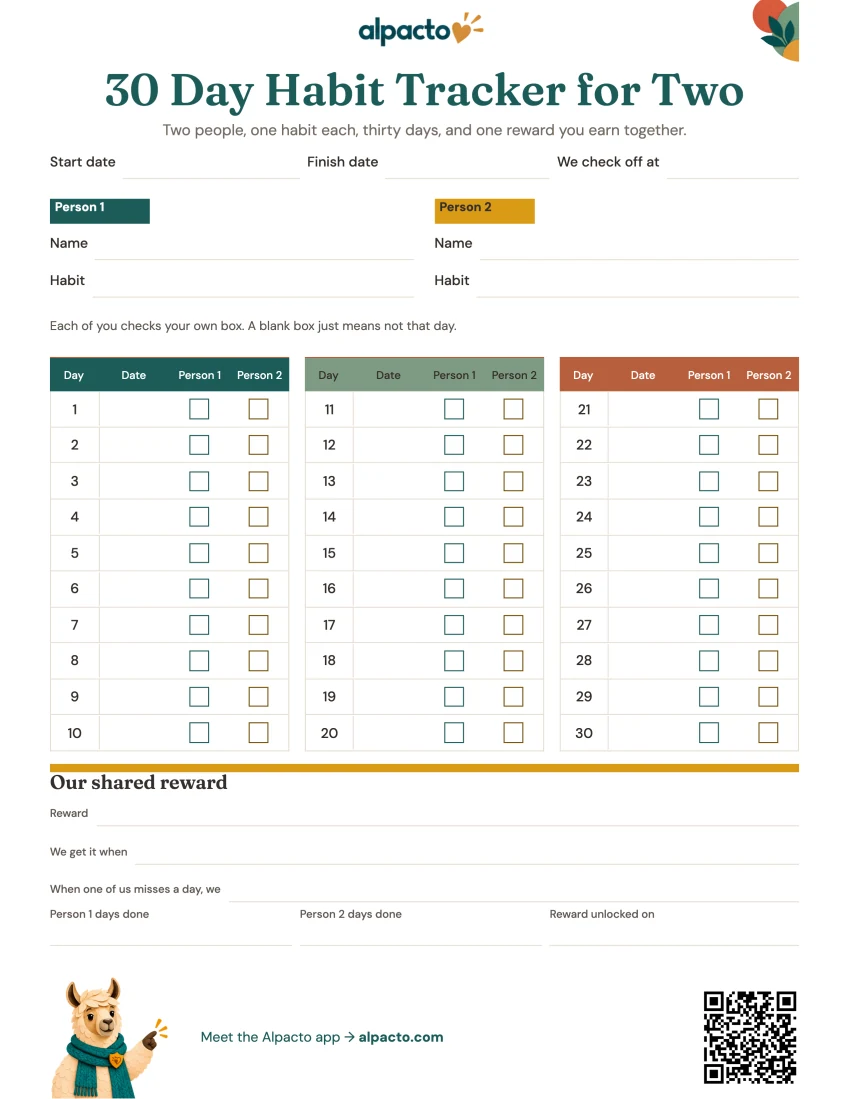
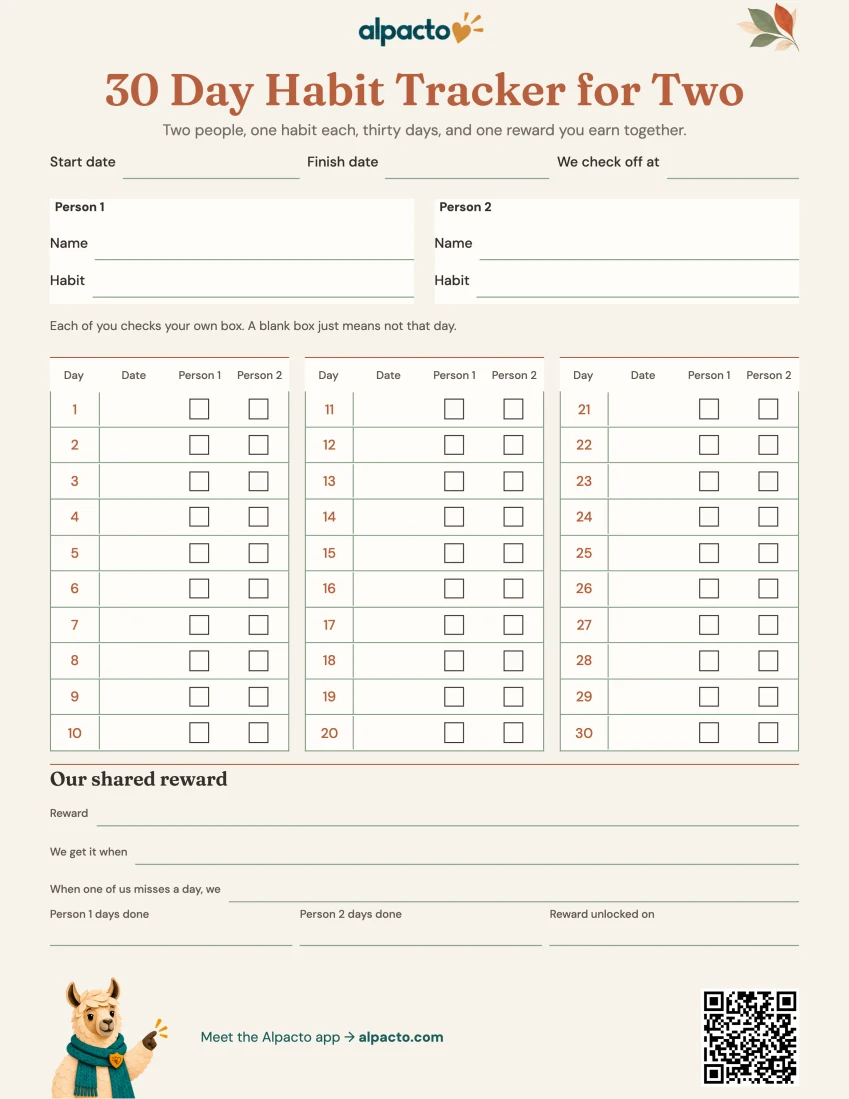
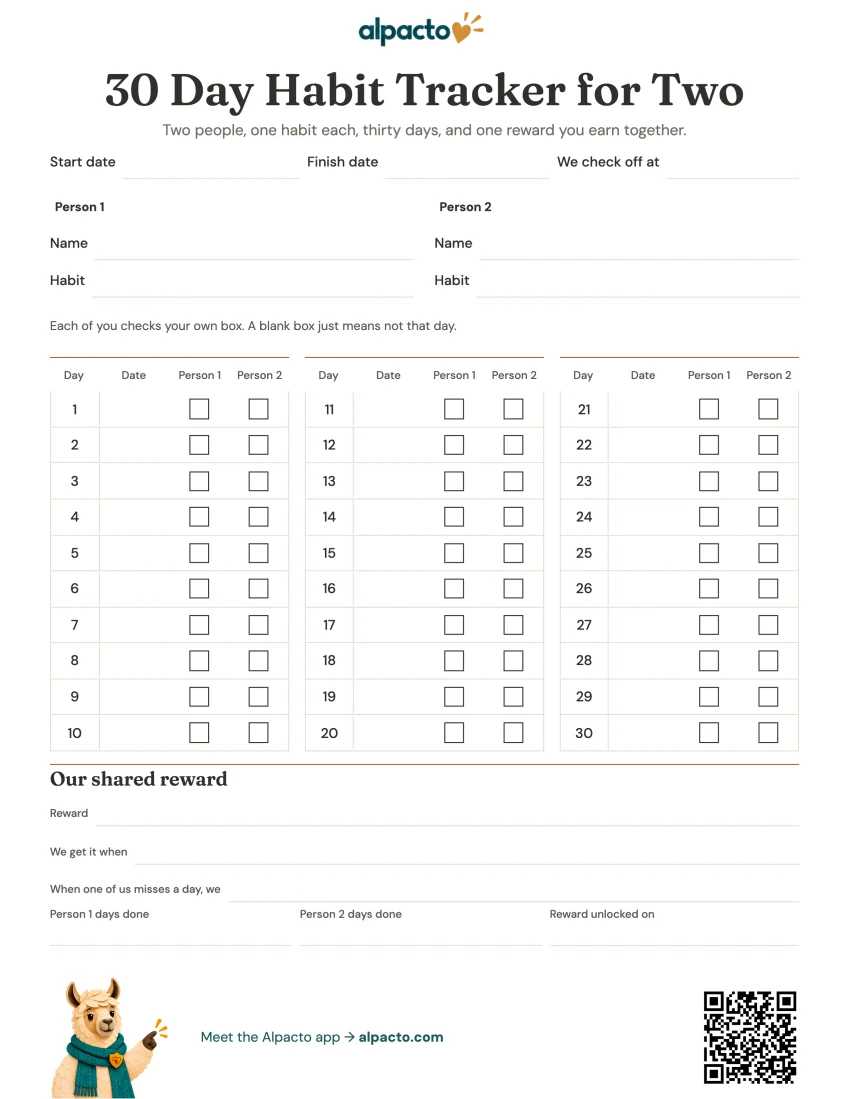
The 30 Day Habit Tracker for Two is one page. At the top: start date, finish date and “We check off at”, then Person 1 and Person 2, each with a name and one habit. Below are three tables of ten days with a box for each person, and a section called “Our shared reward” with the three lines from the table above.
Under the names it prints one rule: “Each of you checks your own box. A blank box just means not that day.” At the end you fill in how many days each of you did and the date you earned the reward.
If you track alone, the monthly habit tracker fits up to eight habits on a page.
Questions people ask
What is the role of an accountability partner?
Their job is to hear your progress report at the agreed time and ask what happened when it stalls. They do not coach you or grade your work. In a two-way setup you do the same for them.
What is another word for an accountability partner?
Accountability buddy and accountability friend mean the same thing. A body double or study buddy works next to you while you do the task, and an accountability coach does the checking for a fee.
What does the Bible say about having an accountability partner?
The Bible does not use this modern phrase. Ecclesiastes 4:10 in the King James Version comes close: “For if they fall, the one will lift up his fellow.” Partners and small groups of this kind are common in evangelical churches.
What are the 5 C’s of accountability?
There is no single standard list. One version, from the coaching company ITD World, lists five traits of a good partner: convinced, consensual, committed, courageous, comforting. In plain words, they believe in your goal, agreed freely, show up, tell you the truth and support you when it gets hard.
Is there a free accountability partner app?
Yes. Focusmate matches you with a stranger for video work sessions and is free for three sessions a week, with a paid plan for more (checked September 2026). For a habit with someone you already know, the printable tracker above is free, and Alpacto keeps the same agreement on both phones.
What is Accountabilibuddy from?
Accountabilibuddy comes from the South Park episode “Cartman Sucks”, first broadcast on March 14, 2007, according to Wiktionary. It is now a casual name for the role, and a Reddit community, r/Accountabilibuddies, uses it.
Can your spouse or partner hold you accountable?
Yes, and for habits at home the research is on your side: people are much more likely to change when their partner changes too. Keep it two-way, each with your own habit and your own box, so neither of you becomes the one who checks up on the other.
The same agreement, on both phones
In Alpacto a challenge is a goal with a finish line, a period you can see and a reward at the end. The pact is visible to both people, rewards come in coins or something you chose together, and coins stay inside Alpacto and are never money.