
Alpacto › Agreements › Contract with yourself
How to write a contract with yourself that someone else signs too
A contract with yourself is a written promise about one habit, with a start date, an end date and your signature. It holds better when a second person signs it and checks in once a week, and when the page already says what you do after a skipped day. The free habit contract below prints all of that on one sheet.
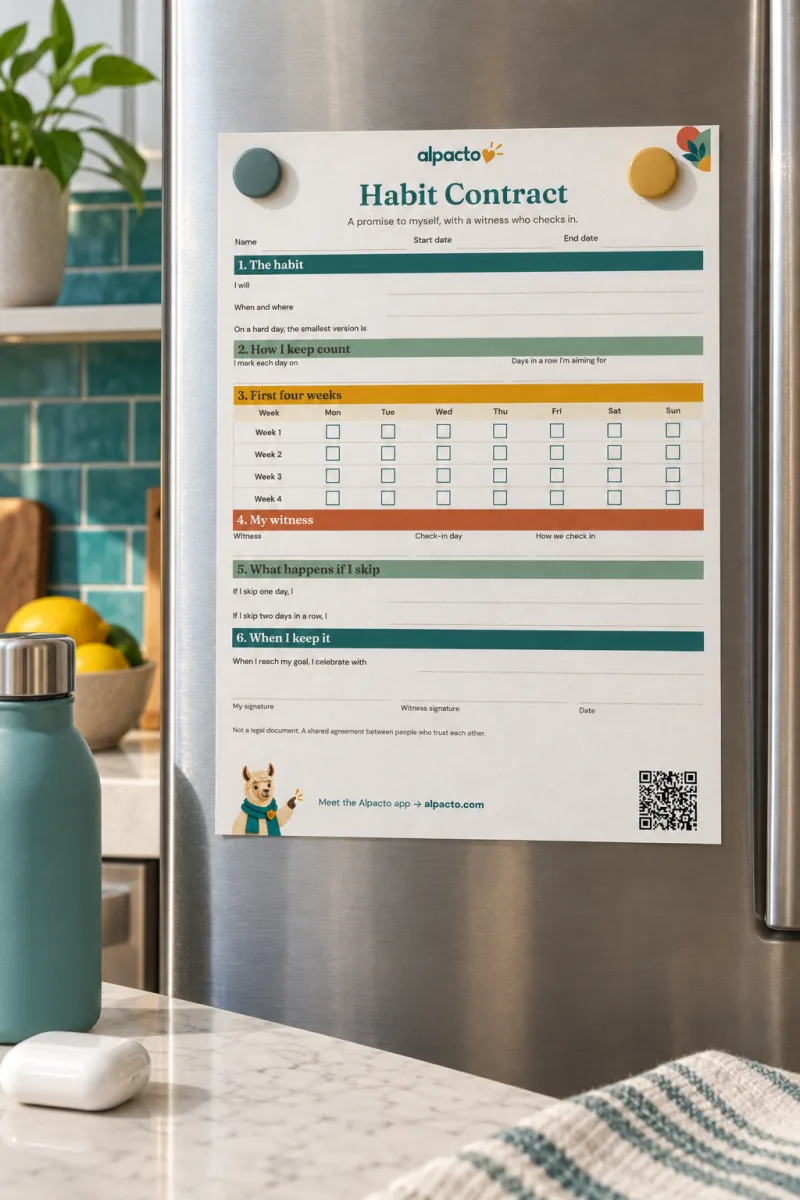
One habit, four weeks of boxes, two signatures at the bottom.
In short
Write down one habit with its time and place, plus the smallest version that still counts on a bad day. Pick a witness, agree on a weekly check-in, and decide in advance what you do after one skipped day and after two in a row.
A contract with yourself alone has nobody on the other side to notice a slip, which is why the Atomic Habits version adds one or two people who sign. Money penalties help, but few people accept them. This sheet uses a witness and a plan for skips instead, and it is free to print.
A promise to myself vs a contract with self: who notices the skipped day
Many of the pages that rank for this phrase describe a personal manifesto. Jesse Itzler’s contract is eight lines that start with “I’m going to”, and he ends with “It’s one thing to make promises to others; it’s another to make them to yourself.” Wit & Delight’s version has a mission statement and ten sections, from values to legacy, written by its author for herself.
Signed alone, a contract with self has one weak spot. The only person who can notice a breach is the person who broke it.
| A promise to myself | A contract signed alone | A habit contract with a witness | |
|---|---|---|---|
| What is written | Nothing, or a line in a journal | Values, goals, rules, one signature | One habit, dates, a box for every day, two signatures |
| Who notices a skip | You, if you want to | You, if you reread it | The witness, on check-in day |
| What happens after a skip | Decided in the moment | Often left out | Two lines, written before day one |
Research on goal tracking points the same way. A 2016 review of 138 randomized studies found that monitoring progress helped more when the results were reported to others or made public, and when they were physically recorded. A witness and a paper grid cover both conditions.
What the Atomic Habits habit contract actually says
The form most people search for comes from chapter 17 of James Clear’s Atomic Habits. His bonus PDF defines it as “a verbal or written agreement in which you state your commitment to a particular habit and the punishment that will occur if you don’t follow through.” Then one or two people sign it with you.
The example in the same PDF is Bryan Harris, a Nashville entrepreneur who in early 2017 logged his food by 6 a.m. the next day and weighed himself daily. He texted a photo of the scale to Stacy Harris, who co-signed, and his trainer checked the food log. Slipping meant dressing up for work for the rest of the quarter, and a missed day of logging cost him $200 paid to the trainer.
One detail is easy to miss: his next two contracts built misses in. The spring version allowed “6 pass days” and the summer one “3 pass days”.
Money on the line helps, but few people sign
In the CARES trial, smokers deposited their own money for six months and got it back only after passing a nicotine test. Those offered the contract were 3 percentage points more likely to pass at six months, and the effect held in surprise tests at 12 months. In a savings study in the Philippines, balances rose 81 percentage points against the control group after a year.
Most people offered these contracts said no. So our sheet has no line for money: the cost of a skip is telling your witness on Sunday.
Who said yes to a commitment contract
How to write a contract with yourself in six sections
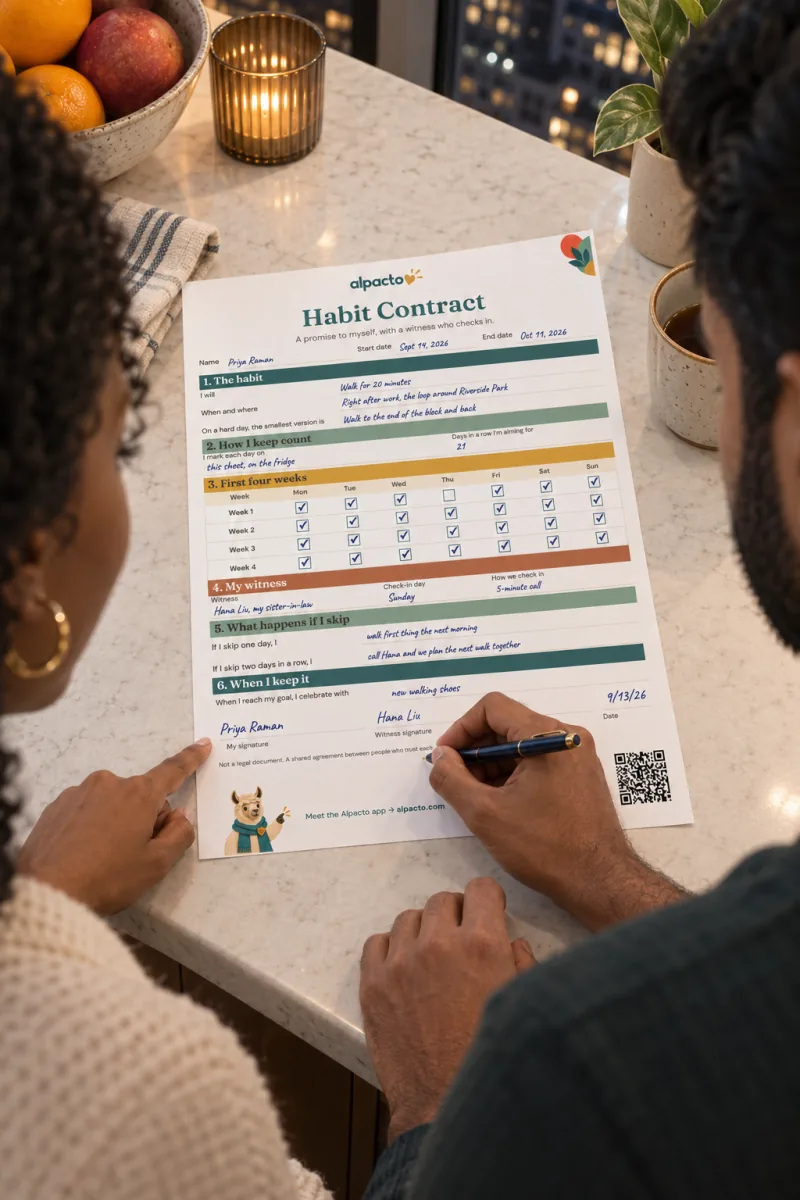
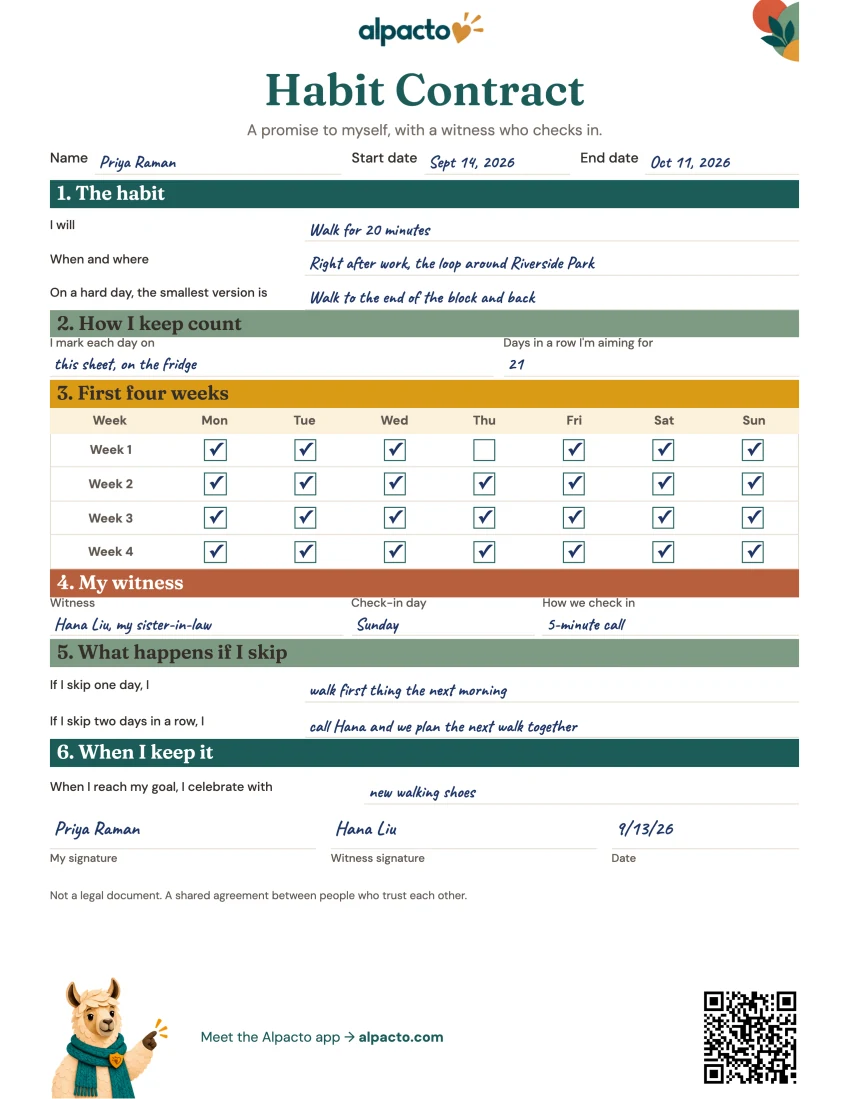
These are the six printed sections of the sheet, in order. The last column is the filled-in example that comes with the template, written for a made-up walker named Priya.
| Section | What to write | From the example |
|---|---|---|
| 1. The habit | One habit after “I will”, a time and place, and “the smallest version” for a hard day | Walk for 20 minutes, right after work; on a hard day, to the end of the block and back |
| 2. How I keep count | Where you mark each day, and how many days in a row you aim for | This sheet, on the fridge; 21 days |
| 3. First four weeks | One tick per day, Monday to Sunday, 28 boxes | 27 of 28 ticked |
| 4. My witness | A name, a check-in day and how you check in | Hana Liu, her sister-in-law; Sunday; a 5-minute call |
| 5. What happens if I skip | One line for a single skipped day, one for two in a row | Walk first thing the next morning; call Hana and plan the next walk together |
| 6. When I keep it | What you celebrate with when you reach the goal | New walking shoes |
A self contract example, filled in
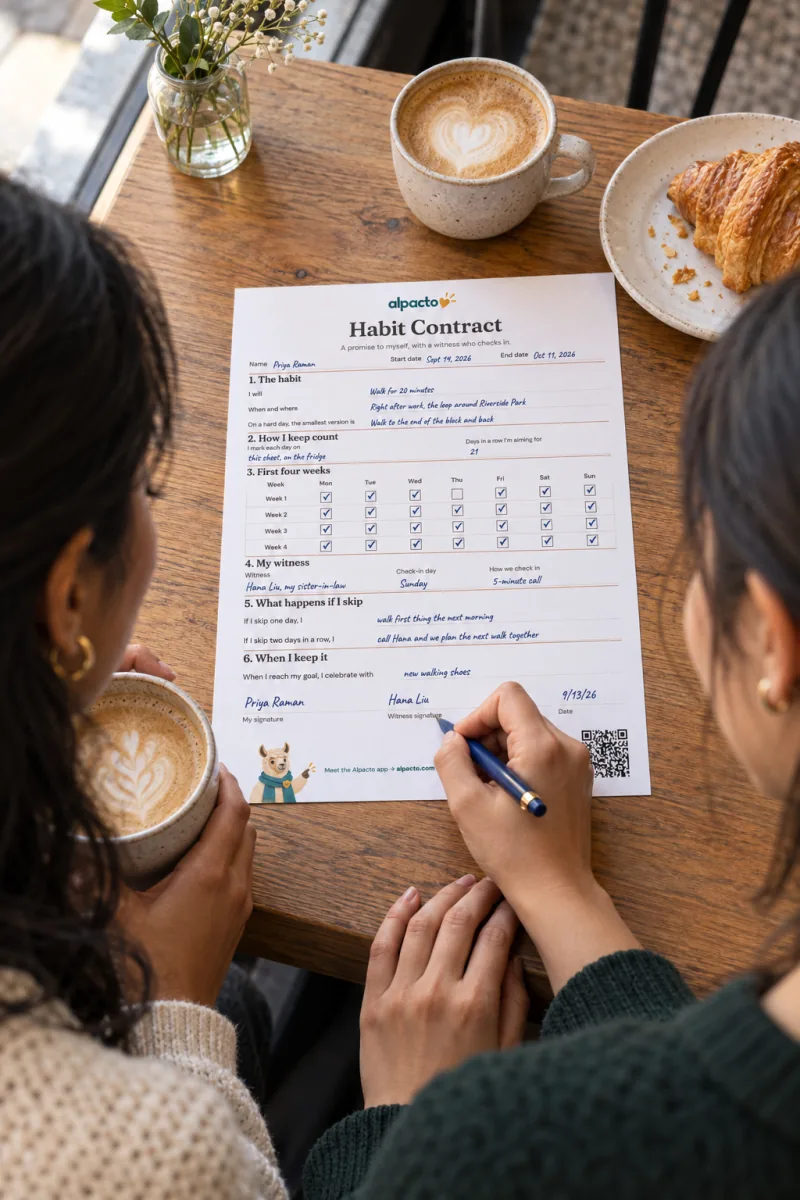
Priya and Hana signed on Sunday, September 13, 2026, the day before the first box. Priya skipped the Thursday of week one, ticked the Friday, reached 21 days in a row on Thursday, October 8, and had 24 by the end date.
The smallest version does most of the work: a walk to the end of the block still earns a tick, so a sick day does not break the count.
Why you break promises to yourself, and the two lines that catch a skip
Two patterns repeat in the threads: the contract is too big, or one skipped day quietly turns into quitting. One r/getdisciplined user drafted a five-clause contract with a fine for every minute of YouTube, and one reply said “you might want to consider starting smaller.” Two years later someone asked “How did it go?”, and the thread has no answer.
In a 12-week study of 96 volunteers, a daily habit took 18 to 254 days to become automatic. The authors add: “Missing one opportunity to perform the behaviour did not materially affect the habit formation process.” Four weeks is a first block, then, and one blank box does not end it.
So the sheet asks for three answers before day one, while nothing has gone wrong yet:
- “On a hard day, the smallest version is”: the floor that keeps a bad day from going blank.
- “If I skip one day, I”: a step you can take tomorrow morning.
- “If I skip two days in a row, I”: the moment you call in your witness.
Nothing on the page says fail or penalty. A blank box stays blank, and the next tick starts a new count.
Free habit contract template: Letter and A4
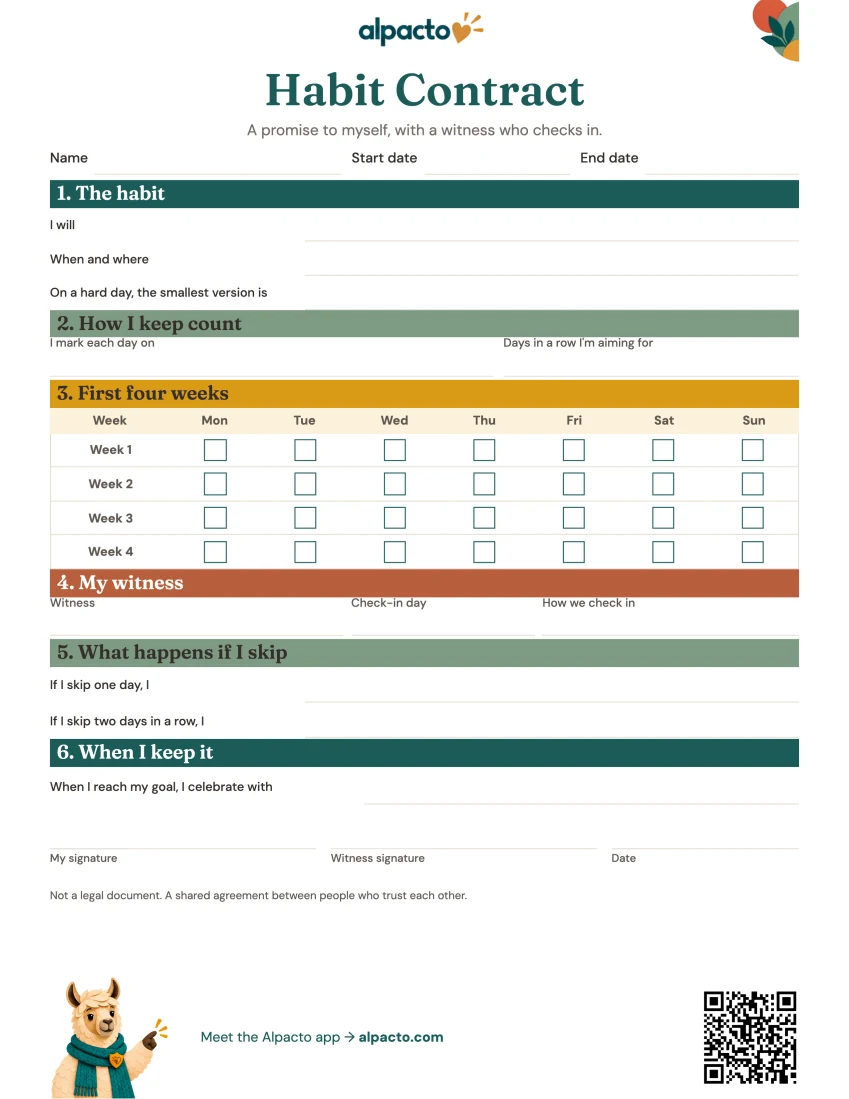
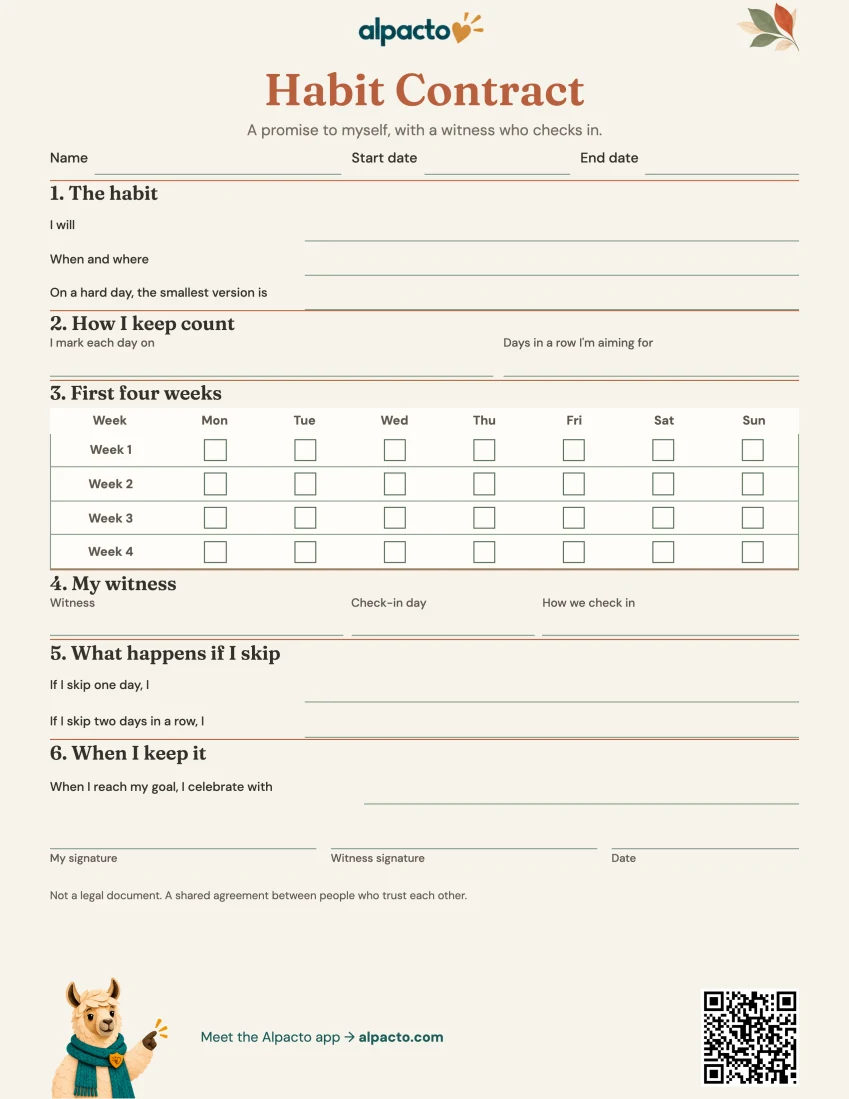
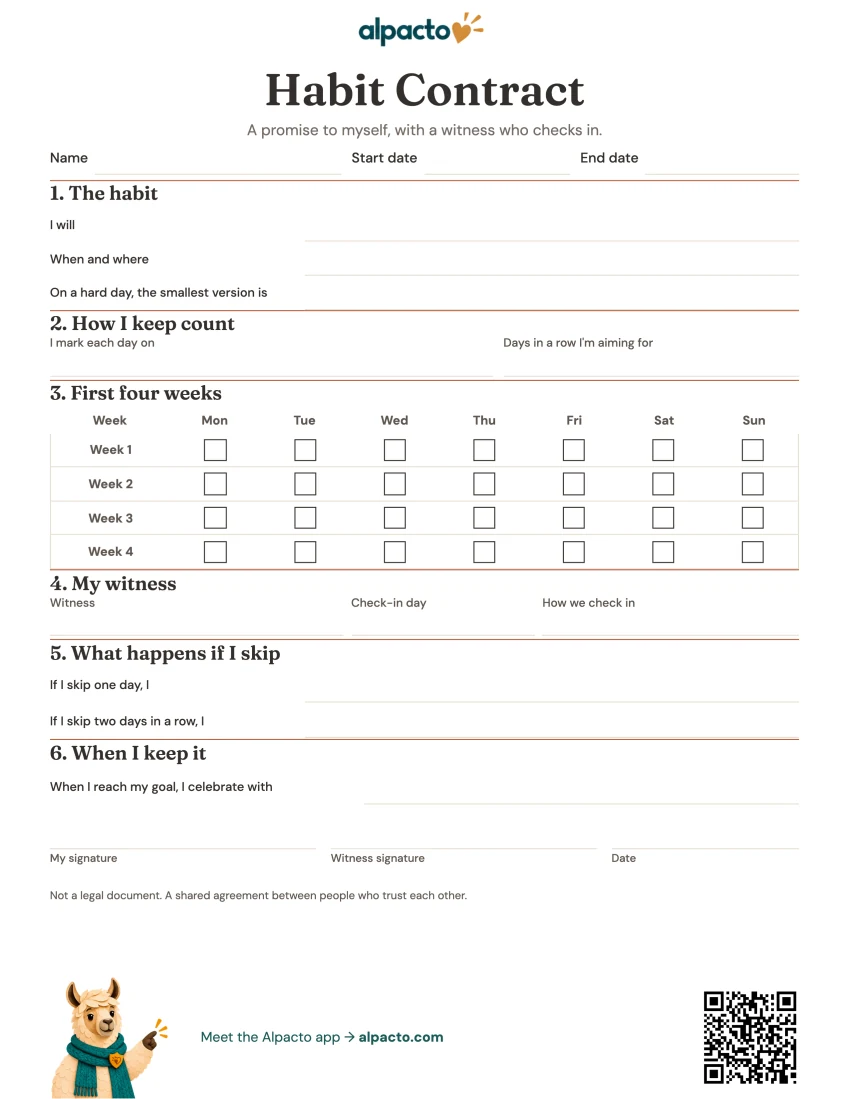
One page in three designs, the same six sections in each. At the bottom it prints: “Not a legal document. A shared agreement between people who trust each other.”
If you want to track more than one habit, the monthly habit tracker fits eight on a page.
Questions people ask
What is a self contract?
A self contract is a written promise you make to yourself about a goal or habit, usually signed and dated. The habit contract version adds a second person who signs and checks in, plus a rule for what happens when you skip.
Is a contract with yourself legally binding?
No. An English appeal court, quoted by the law firm A&O Shearman, said an individual “cannot make a contract with himself which could have any conceivable legal effect”. It works on your word and your witness, and our sheet says so in print.
Can you give me an example of a personal contract?
Yes: I will walk for 20 minutes, right after work, on the loop around Riverside Park; on a hard day, to the end of the block and back. That is section one of the filled-in example above, with a witness, a Sunday check-in and new walking shoes as the reward.
How do I keep a promise to myself?
Make it small enough to keep on your worst day, and tell one person who will ask about it on a fixed day. Write down in advance what you do after a skipped day, so a single miss has a next step instead of a verdict.
What promises should I make to myself?
One at a time, and one you can check with a tick: a walk, ten pages, no phone in bed. Promises about who you want to be are hard to break and hard to keep, because nobody can tell which it is.
What is a health contract with yourself?
A contract with yourself about one health habit, such as a daily walk, water with every meal or a set bedtime. Health habits suit this sheet well, because they happen daily and a witness can see or hear about them each week.
The same contract, with your witness on the other phone
In Alpacto a routine is a repeating habit with a shared rhythm, visible check-ins and a streak. One person does the thing and the other confirms it, so your witness becomes the other side of the pact. Coins stay inside Alpacto and are never money.