
Alpacto › Couples & Chores › Splitting bills
How to split bills in a relationship: three ways, and the page you both sign
How to split bills in a relationship comes down to three methods: half and half, a share of each income, or one set of bills each. Each works under a different condition. Below is the arithmetic for an income-based split on real numbers, and a one-page agreement with the shares, the personal money and the review date written down.
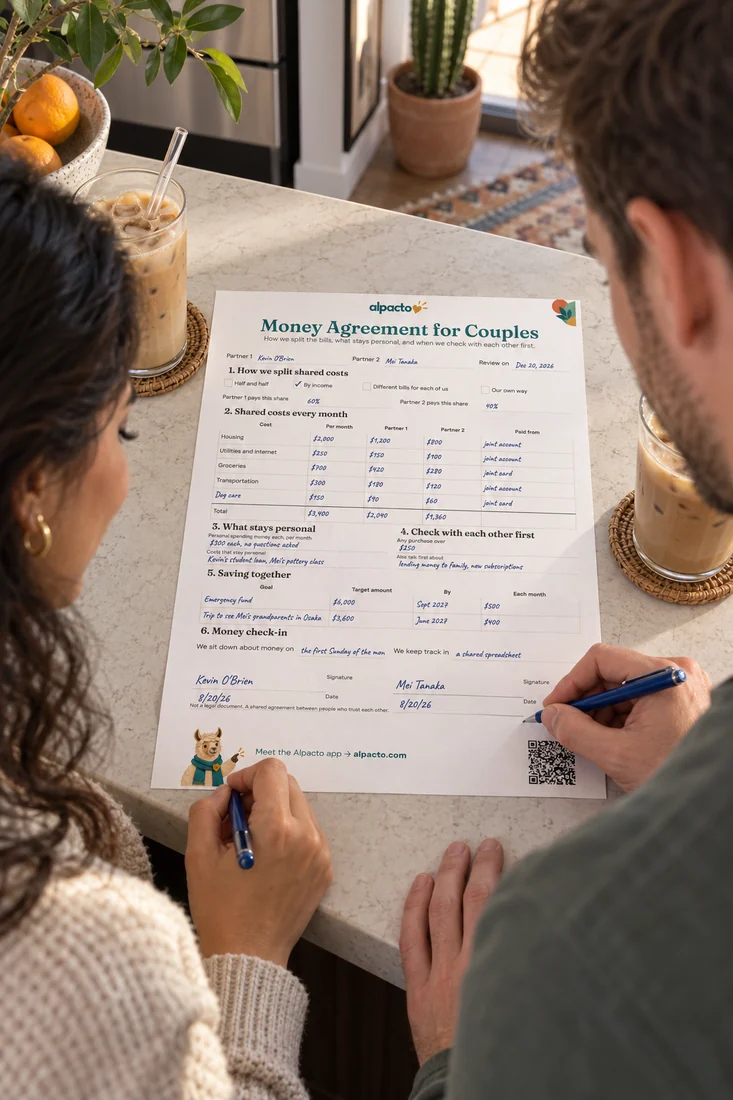
One page: the shares, the monthly costs, the personal money, the date you look again.
In short
Pick the method first, then fill in the numbers. Half and half is the simplest and only feels fair when the two incomes are close. An income-based split has each of you paying the same percentage of what you earn, so the dollar amounts differ and the strain does not.
Separate bills, one taking rent and the other groceries and utilities, is the easiest to run and the easiest to drift out of balance. Whichever you pick, write it on one page with three more things: the personal money nobody comments on, the ask-first amount, and the date you look at all of it again. The agreement sheet has a line for each.
How should bills be split in a relationship: three ways that hold
Couples split bills in one of three ways: half and half, in proportion to each income, or one set of bills each. Half and half suits close incomes, an income-based split suits a gap, and separate bills are the easiest to run but drift out of balance. The argument is usually about which one you are in, not the money.
Add the shared costs, divide by two. It runs itself and holds while your incomes are close: the same $1,350 is a third of one paycheck and more than half of the other. Pew puts marriages with roughly equal earnings at 29%, so for most couples this is the method to check before assuming it.
Each of you pays the same percentage of what you earn. The dollar amounts differ, the share of the paycheck does not, and neither of you is choosing between the electric bill and a haircut. It costs one calculation when either income changes, and it needs both incomes on the table.
One takes rent, the other takes groceries, utilities and the phone plan. It is easy to run and easy to read from a bank app, but it drifts: groceries rise faster than rent. The person holding the variable bills takes on more every year, so put a number on each bill at the start and check it at the review.
How to divide bills in a marriage is the same question with more shared history. One habit holds either way: write down which costs count as shared before arguing about the share. Rent, utilities, groceries and transportation are on the sheet by name; a gym membership or a car only one of you drives goes on the personal line.
When one of you makes more, the split worked out
When one partner earns more, each of you should pay the same percentage of take-home pay toward shared costs. Add both incomes, divide each income by the total to get the two shares, then apply those shares to every shared bill.
Take two take-home incomes, $3,600 and $2,400 a month, and $2,700 of shared costs. Added together the incomes are $6,000, so the shares are 60% and 40%. Applied to the shared costs, that is $1,620 and $1,080.
The point is what happens to the paycheck. Under half and half, each pays $1,350: that is 38% of the larger income and 56% of the smaller one. Under the income split, both pay 45% of what they earn.
Two decisions make this number honest. Use take-home pay, after tax and after anything withheld, because that is the money that pays rent. And agree what a bonus or a second job does before it arrives: either it counts and the shares move, or it does not count and stays personal.
Debt, before anyone says fair
Student loans and a car payment from before you met are usually personal, and a couple who decides otherwise should write it on the sheet rather than let it happen quietly. The split covers what you buy together; what one of you owes from before is a separate line and a separate conversation.
Joint account vs separate: what actually has to be shared
You do not need a joint account to split bills fairly. Couples choose one joint account, separate accounts only, or a joint account for shared bills with personal accounts on the side. The account setup is a separate decision from the split, and mixing the two is why the conversation stalls.
Everything in, everything out. Nothing to transfer and nothing to reconcile; in exchange, every purchase is visible to both of you, which suits couples who already talk about money and irritates everyone else.
Each pays the bills assigned to them from their own account. Nothing changes at the bank, and the split lives entirely in what you agreed. It needs the bill list to be written down, or the person paying the variable bills carries the increases alone.
Both transfer their share on payday into one account that pays the shared bills, and what stays in the personal account is nobody’s business. This is the setup the sheet is built around, because it makes the share a number you move once a month instead of a running negotiation.
A 2018 working paper, summarized by UCLA Anderson Review, asked married people to rate their relationship from 1 to 7. Those who pooled all their money scored a median 6.10, against 5.82 for joint plus separate accounts and 5.46 for fully separate ones. UCLA Anderson Review, February 6, 2019.
Two lines keep the personal side from becoming a grey area. The first is personal spending money: one amount each, the same for both or not, spent without a word to the other. The second is the ask-first line, the amount above which a purchase gets a conversation before it happens rather than a defense after.
The one-page money agreement you both sign
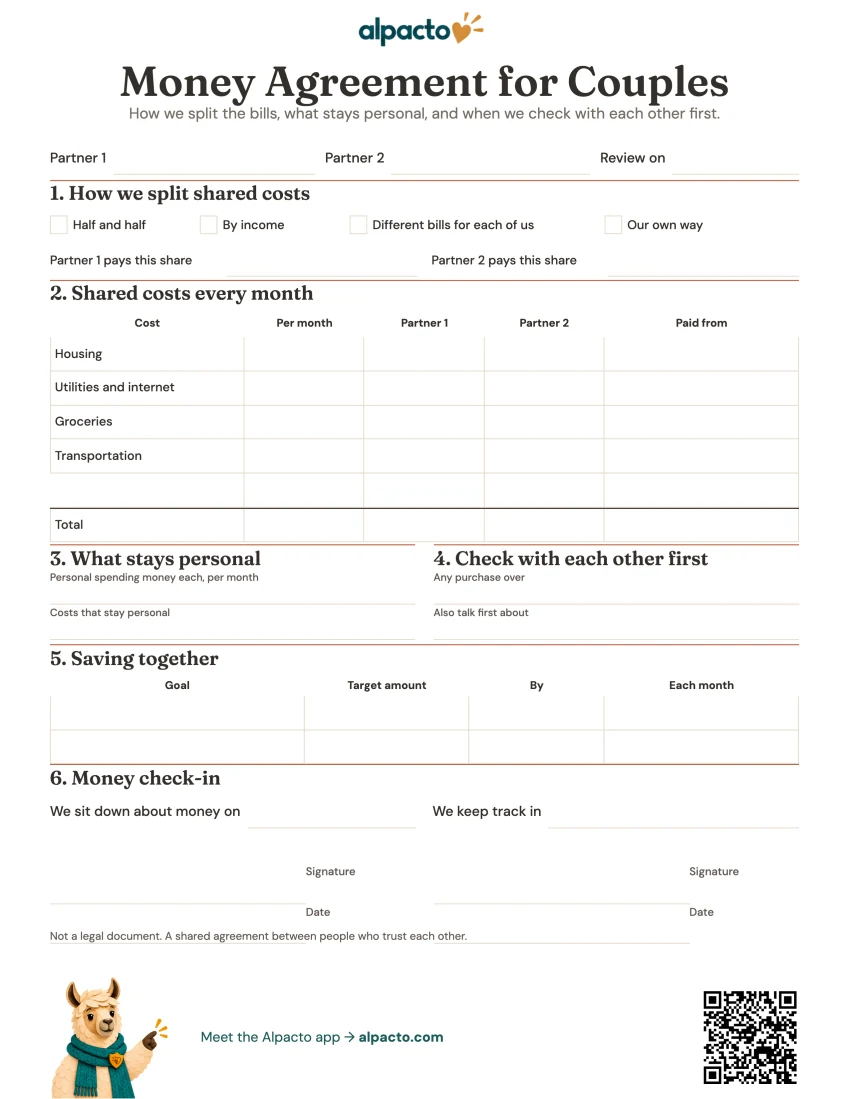
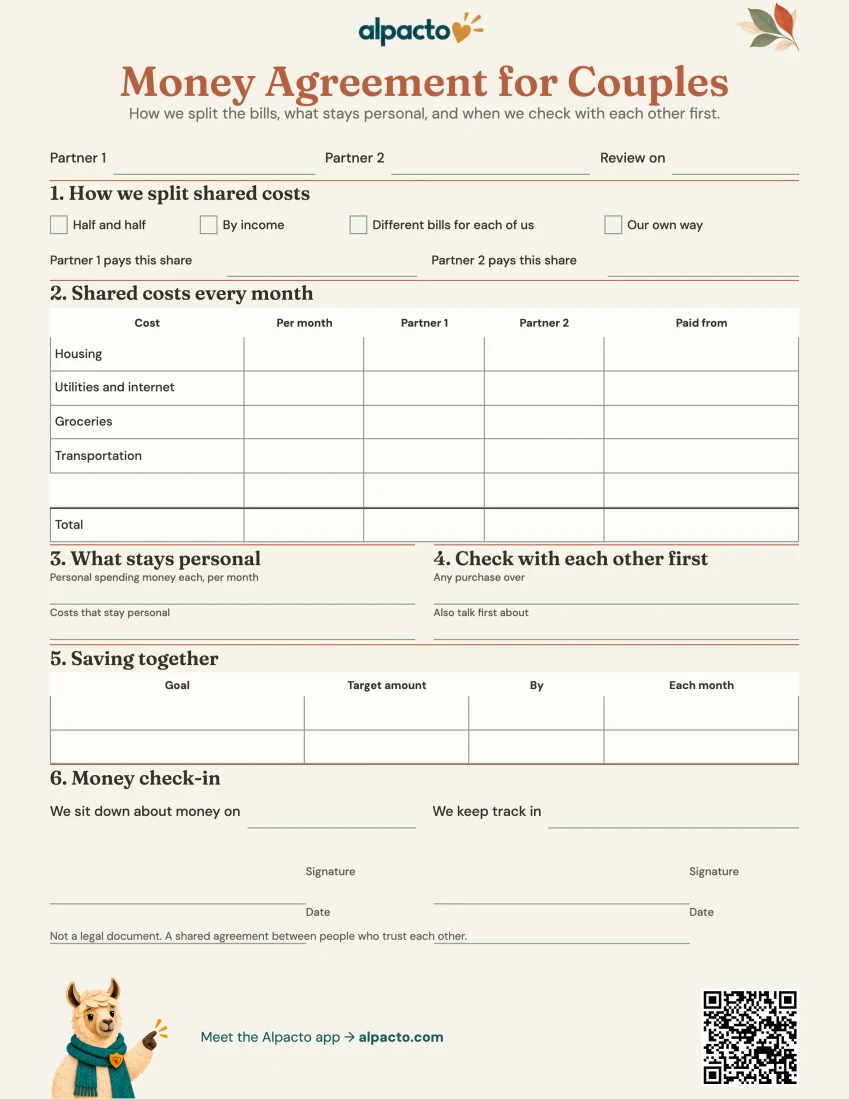
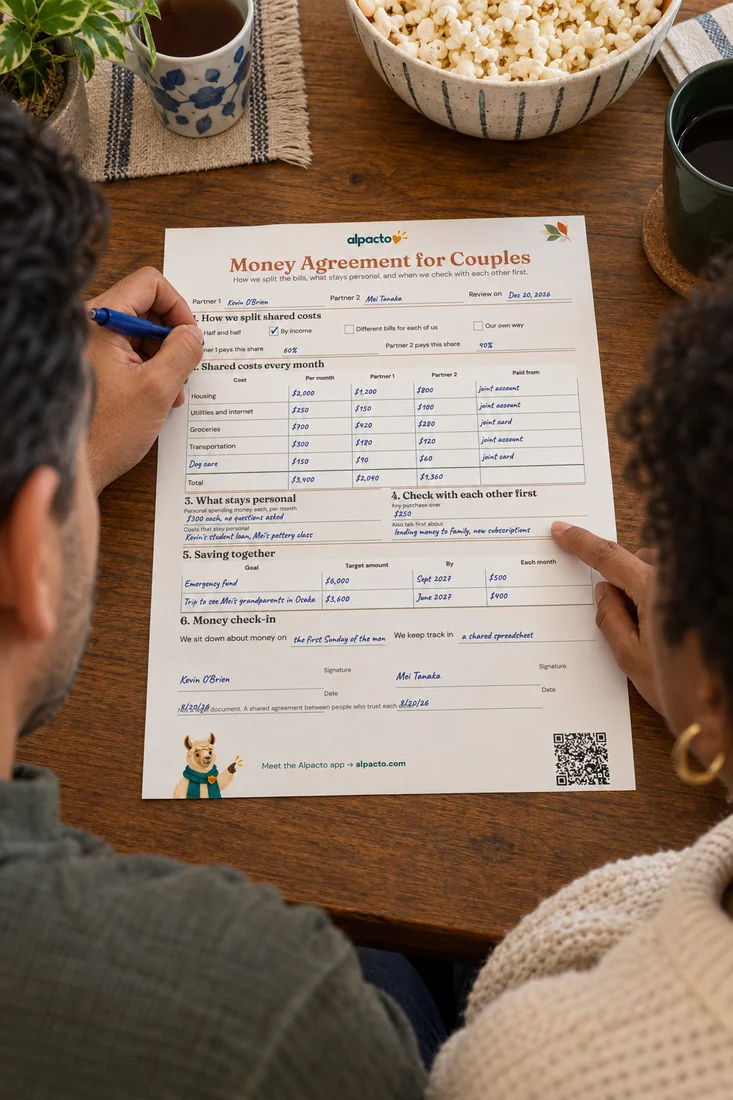
The money agreement for couples is a one-page sheet with six sections: the split, the monthly costs, personal money, the ask-first line, shared savings goals and a check-in. You fill it in together in one evening, then both sign and date it. Section 1 is the method and the two shares.
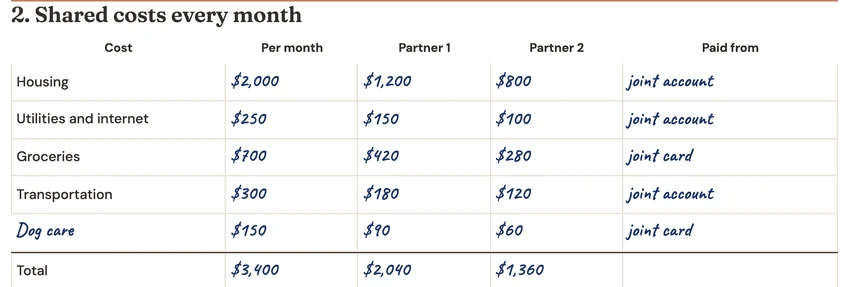
Section 2 is the monthly costs: four printed rows (housing; utilities and internet; groceries; transportation), one blank row of your own, and a total. Section 3 is what stays personal: the monthly amount each, and the costs that never come out of the shared pot. Section 4 is the ask-first line and the topics you always talk about first.
Section 5 is what you are saving for, with a target, a date and an amount per month. Section 6 is the check-in: the day you sit down about money, and where you keep track. A signed page is harder to reinterpret in March than a remembered conversation.
How to split bills in a relationship when the money changes
Review your bill split every three to six months, and sooner after a raise, a lost job, parental leave, a move or a big new recurring cost. At the review you change numbers, not the agreement: the shares if an income moved, the ask-first line if it has stopped fitting, the savings amount if it never gets transferred.
Write the review date on the sheet the day you fill it in. How to split bills in a marriage after one of you goes on leave is the same arithmetic on smaller numbers: the share of a reduced income is still a share. The couple that recalculates it in one evening avoids the version where one person funds everything and mentions it a year later.
Keep the old sheets. Three of them side by side show what actually happened to your costs better than any app screen, and they take up less room than a shoebox.
Questions people ask
How should bills be split in a relationship?
Split bills with the method you both agree to out loud: half and half, a share of each income, or one set of bills each. Pick on incomes: close incomes make halves painless, a gap of a third or more makes percentages the only version that leaves both of you with money left over.
Is it better to have joint or separate accounts?
Neither is better; they solve different problems. One joint account removes transfers but makes every purchase visible, and separate accounts do the reverse at the cost of a written bill list. A joint account for shared costs with personal money beside it gives you both, which is the setup the sheet assumes.
How do you split bills when one person makes a lot more?
Give each person the same percentage of their take-home pay. With $3,600 and $2,400 coming in and $2,700 of shared costs, that is $1,620 and $1,080 — 45% of each paycheck, against 38% and 56% under an even split. Write the percentages on the sheet, not just the dollar amounts, so the next raise updates them.
Is it fair to split bills 50/50 if one partner makes more?
Only when the gap is small, because equal dollars take a bigger share of the lower paycheck. With incomes of $3,600 and $2,400 and $2,700 of shared bills, each pays $1,350: 38% of one paycheck and 56% of the other. If you still want halves, the higher earner can cover the difference from personal money instead of the shared pot.
Should the higher earner pay more of the rent?
Yes, under an income-based split. The higher earner pays a larger share of rent and every other shared bill, in the same proportion as income. With a 60/40 split, that is $1,620 of a $2,700 total for one partner and $1,080 for the other.
Who pays what when one partner stays home?
The shared costs come out of the household income, and the person at home keeps the same personal spending money as the person earning. Household work is work that saves the household money, and a split that leaves one adult asking for $20 is the arrangement that produces the argument two years later.
How often should we redo the split?
Every three to six months, plus whenever an income changes, someone goes on leave, or a new recurring bill lands above your ask-first line. The review is short: shares, personal amounts, savings, the ask-first line. If the review shows spending is the problem, try a month on a no spend challenge sheet.
Is there a spreadsheet for this?
We publish a printable agreement rather than a spreadsheet. The arguments couples have are about the method, the personal money and the ask-first line, and those are decisions to write down and sign. For the monthly arithmetic, any spreadsheet you already use will do; the sheet holds the rules it should follow.
The same agreement, without the reminding
In Alpacto the monthly check-in is a routine the two of you share. A purchase above the ask-first line becomes a pact: what counts as done, by when, and what it is worth in coins. One of you marks it done, the other confirms, and the app holds the reminder.