
Alpacto › Couples & Chores › The Fair Play method
Fair Play cards: what is in the deck of 100, and how to deal it.
Eve Rodsky’s deck turns housework into 100 task cards, and the rule is that whoever holds a card owns it from noticing to done. This page counts what is in the deck, suit by suit, and gives the price of the deck and the book. It then walks one round and shows three ways to play, one of which costs nothing.
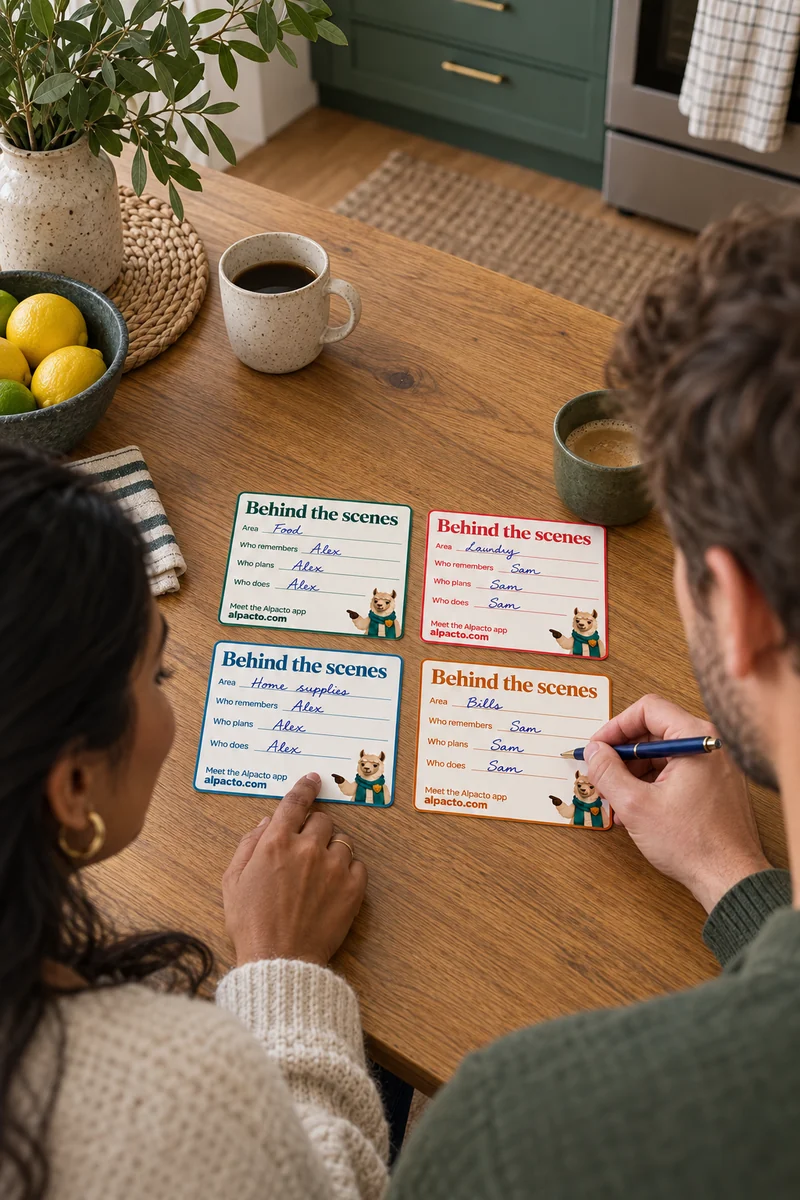
The deal is the easy part. What you write down after it is the part that lasts.
In short
The Fair Play method is Eve Rodsky’s system for dividing household work: every job gets a card, and whoever holds it does the noticing and the planning as well as the doing. Deal only the cards your home really uses, look at the two piles without arguing about them, then trade until both of you can live with the split.
The deck is a bought product, and all 100 cards can also be read free on the Institute’s site. Where couples get stuck is rarely the split. Before the cards go back in the box, write down what done means on the card you argued about and set a date to re-deal.
What the Fair Play method is, and what you are buying
The Fair Play method divides household work by cards. Each of the 100 cards names one job, and the partner who holds a card owns that job from noticing it through planning it to finishing it, rather than helping when asked. The deck lists the jobs, and Eve Rodsky’s book explains the rules.
Eve Rodsky wrote Fair Play in 2019 after interviewing, in her publisher’s words, “more than five hundred men and women from all walks of life”. The subject was the unpaid work that keeps a home running. The card deck followed in October 2020.
What separates the fair play method from a chore list is one word: ownership. Holding a card means running the job end to end, which Rodsky shortens to CPE. Without the deck, a chart that gives each area one owner and a backup keeps the same idea.
“Fair Play is based on full ownership of the cards in your hand – from conception, to planning and execution (CPE)”Eve Rodsky, on her own site
So a card is never do the dishes tonight. It is the dishes, indefinitely, including noticing that they have piled up.
The need is measurable. On an average day in 2025, 87 percent of women and 75 percent of men did household activities, and on those days women spent 2.8 hours on them and men 2.1. Source: Bureau of Labor Statistics, American Time Use Survey, released June 25, 2026.
The fair play card deck is a product with a price. The publisher lists the deck at $25.00 and the paperback at $20.00, both checked September 17, 2026. Neither purchase is required to run the system at home.
Six suits and 100 tasks: what is in the Fair Play cards
The Fair Play deck holds 100 household task cards in six suits. Home, Out, Caregiving and Magic have 22 cards each, Wild has 10, and Unicorn Space has 2, one for each person (counted on the official browser, September 17, 2026).
The Fair Play Policy Institute, which publishes the cards online, describes the system as “a gamified system with 100 household tasks, and a figurative card game you play with your partner”. The suits in the 100 cards of Fair Play are nowhere near the same size. Wild is kept for the upheavals that rearrange a year: moving, a new job, serious illness, a death.
Twenty-nine of the 100 carry a Daily Grind mark for work that returns every day, and twelve of those sit in the Home suit. Another 35 cards name a child in the title, from diapering to teacher communication. A couple without children sets about a third of the deck aside before the first deal (same count).
Cards per suit in the deck of 100
The four rules, and how one round of the fair play card game goes
A Fair Play round takes six steps. You pull the cards your home uses, deal them as things stand, compare the piles, trade, write a standard of care on each moved card and set a re-deal date. Four rules from Eve Rodsky frame the round.
Rodsky gave the four rules in her own words in a 2019 interview, and they are worth reading before anyone touches a card.
| Rule | What it asks of you |
|---|---|
| All time is created equal | An hour of one person’s day is not worth less than an hour of the other’s, whatever they earn |
| Reclaim your right to be interesting | Both of you are entitled to time for your own interests, and both of you have to claim it |
| Start where you are now | Split the home you have this month, not the one you meant to have |
| Establish your values and standards | Decide which jobs matter here, then agree what counts as done for each |
Here are the six moves in order.
- Pull the cards your home actually uses. A home with no pets, no lawn and no children loses a large part of the deck on this step alone.
- Deal them as they are today. Not as they should be. Each of you takes the cards you already hold.
- Look at the two piles and say nothing yet. The size difference is the finding, and arguing about it now ends the game early.
- Trade. Move cards one at a time, by who has the time and who cares about the result, not by who did it last.
- Write a minimum standard of care on every card that changed hands. One sentence that both of you can check.
- Set a date to re-deal. A month is enough to find out which cards were taken out of politeness.
Step five is the one couples skip, and the deck itself shows how short a standard can be. The Cleaning card asks “Will our home be reasonably clean and safe for our family?”, and the Dishes card asks whether they are “Clean dry and put away on a regular basis?”
Where the Fair Play deck stops working
The Fair Play deck usually fails in one of three ways: the cards never get dealt, one card hides a whole job, or a card is held but not done. These failure modes run through the buyer threads in r/FairPlayLife and r/workingmoms, and each has a fix that takes minutes.
The deck never gets dealt
The first one is no round at all. A reader described a partner who understood the idea and still would not sit down:
“He seemed to understand the premise of it. But he was scared of the cards and we never did them.”r/FairPlayLife, quoted word for word
A hundred cards on a table looks like a verdict. Deal the 29 everyday Daily Grind cards only, and leave estate planning and holiday cards for another evening (the deck marks them for you).
One card hides a whole job
A common sticking point is the Cleaning card, because it is one card in the Home suit while Dishes, Laundry and Garbage each get their own.
“Yeah, that’s the card that derailed my husband and I. The book did say to customize so personally, I would be dividing this card to multiple cards.”r/workingmoms, quoted word for word
The complaint holds up against the card itself. Its execution list covers bed making, counter tops, vacuuming, toilet bowls and shower tile, then adds carpets, drapes, dusting, windows, defrosting the fridge and the outdoor grill (Cleaning card, official browser).
The card’s own advice is to “Re-deal this card often, as it’s a biggie”. Split it by room before you deal it, and the argument about who owns “cleaning” disappears.
A card is held but not done
Ownership on paper is not ownership in the kitchen. One player described the re-deal that exposed it:
“my husband was not doing some of his cards at all (as they had become obsolete) but crowing every week about how many cards he had”r/FairPlayLife, same discussion
Counting cards is not the score. A card someone does not believe in comes back within a week: “my husband doesn’t care if we decorate for the holidays. So it is never a card he would take…” (r/FairPlayLife)
So let each person refuse a card openly at the deal. Drop the job or lower the standard, rather than hand it over for show.
And one thing that is not obvious
Eight of the cards come as pairs, one per person: Adult Friendships, Grooming and Wardrobe, Self-Care and Unicorn Space. The last of those carries an instruction: “Both you and your partner must take this card!” Time for your own interests is treated as a household job, and nobody can hold it for two.
Three ways to use the Fair Play cards without buying the deck
You can use the Fair Play cards without buying the deck in three ways. You can read all 100 cards free on the Institute’s site, copy the ones you need into a sheet, or print a blank set and write your own. Nothing in the method depends on owning cardboard.
Here are the routes, in order of how close each stays to the original:
- Read the real cards online. The Institute publishes all 100, and each card opens to show its Conception, Planning and Execution and its minimum standard of care. That is the closest thing to an official fair play card list, and it asks for no account (fairplaypolicy.org/the-cards).
- Copy the ones you need into a sheet. Players pass copies around for exactly this reason: “There’s also a Google spreadsheet with everything for if you want to do the thing without the physical cards.” (r/workingmoms)
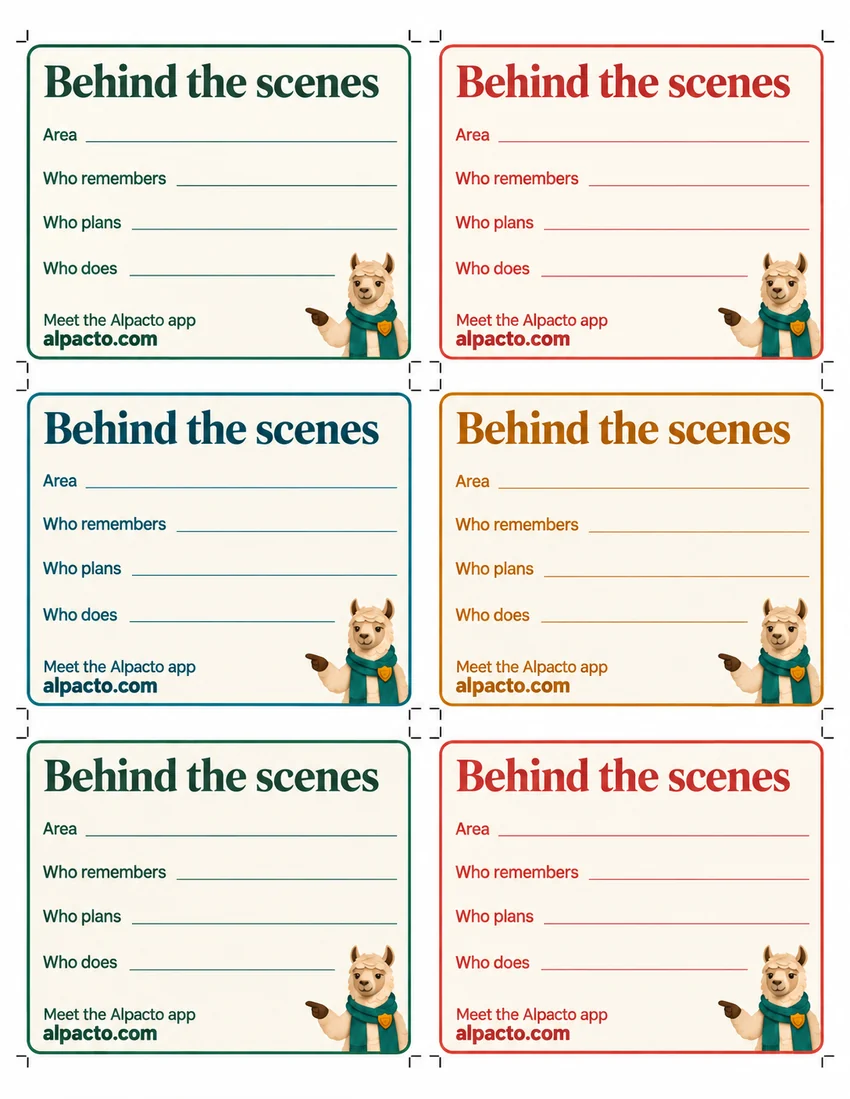
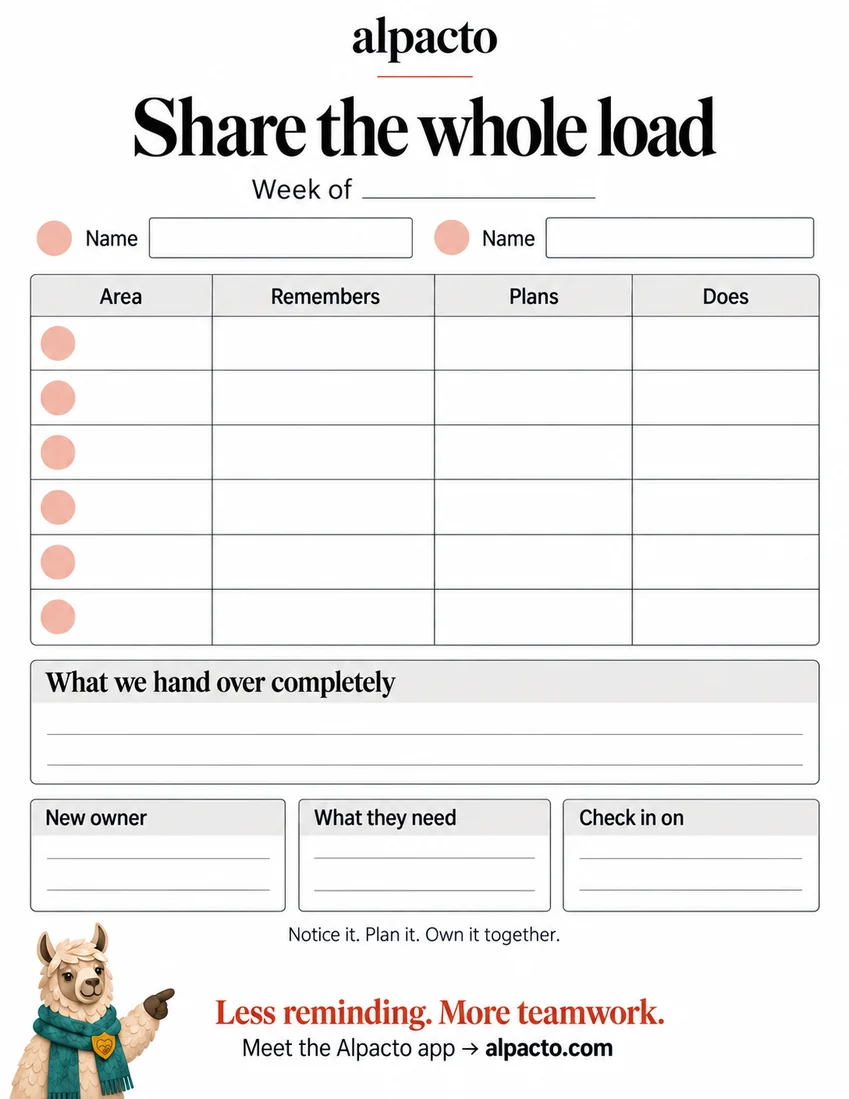
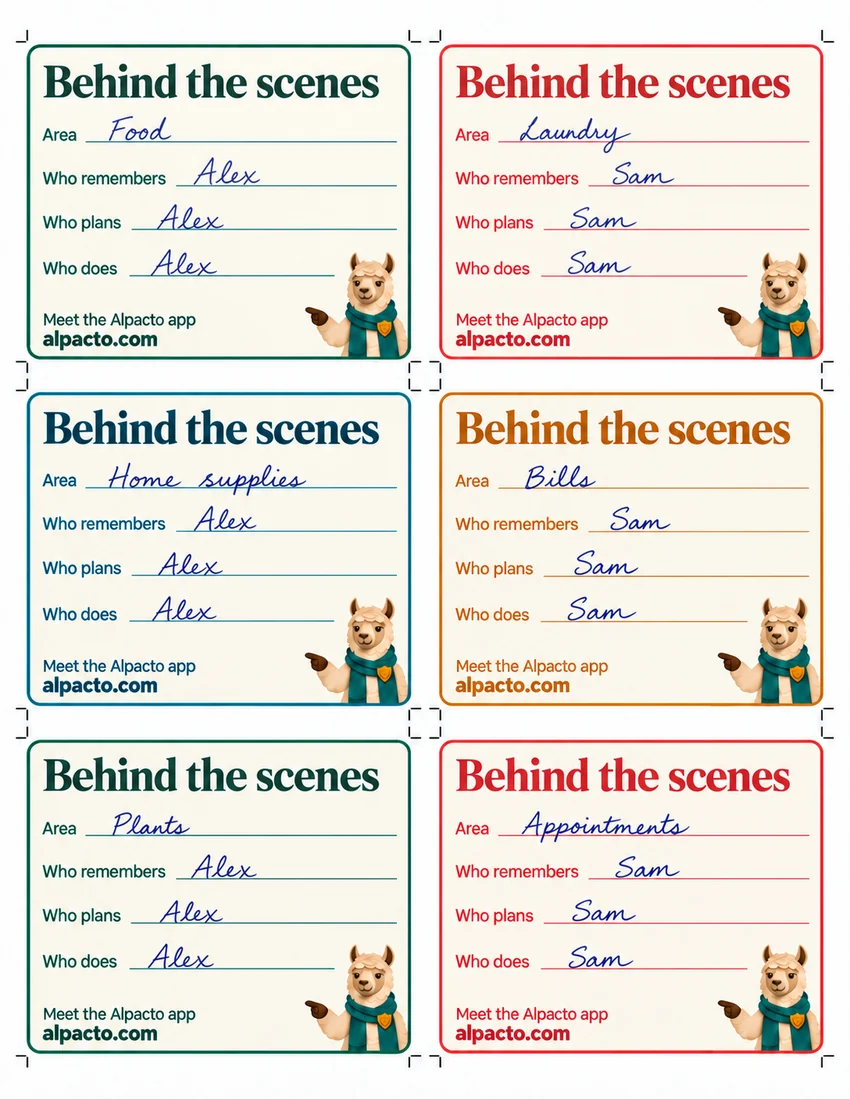
- Print a blank set and write your own. The sheets below are ours, not Rodsky’s, and they are built differently on purpose. One card per area of your home, with a line for who remembers it, who plans it and who does it.
Three things to write down before the cards go back in the box
Before the cards go back in the box, write down three things. You need a checkable standard of done for the card you argued about, a date to re-deal, and a limit on reminders. Together they turn an evening of sorting into something either of you can point at later.
- A standard of done for the card you argued about. One checkable sentence, in the shape the deck uses: is the home reasonably clean, are the dishes put away.
- A date to re-deal. Put it in both calendars, so neither of you has to remember it. Without a date, the person who used to own a card keeps quietly watching it, and the handover is only half made.
- A rule about reminders. Agree how many times a card can be mentioned before it goes back on the table. Nagging becomes a number instead of a character flaw.
If the cards showed that one person does all the noticing, the underlying problem has a name and a page of its own: the mental load. If the sticking point is one job that somehow always gets done badly, that has a name too, weaponized incompetence.
To split the visible jobs by minutes rather than by cards, the chore split calculator does that arithmetic. The chore chart for couples then gives the same agreement a place on the fridge.
Questions people ask
What is the Fair Play method for dividing household tasks?
The Fair Play method is a system by Eve Rodsky in which each household job is a card, and the partner holding a card owns it from conception through planning to execution. A deck of 100 cards lists the jobs. You deal the cards your home uses, trade until the split works, and agree what counts as done.
How does the Fair Play method work?
You deal the cards your home really uses as things stand today, compare the two piles, and trade cards one at a time. Then you write a minimum standard of care on every card that changed hands and set a date, about a month out, to re-deal. The six steps are laid out above.
How many Fair Play cards are there?
There are 100, in six suits, counted on the official card browser on September 17, 2026. Home, Out, Caregiving and Magic hold 22 cards each, Wild holds 10 and Unicorn Space holds 2.
Twenty-nine of the hundred are marked Daily Grind, the jobs that come back every day.
Are the Fair Play cards worth it?
The $25 Fair Play deck is worth it only if the sorting actually happens. Since all 100 cards are readable free online, buy it when a physical object on the table is what gets you both to sit down. Skip it when one of you will go through the list on a screen anyway.
Is there a free printable list of Fair Play cards?
The publisher does not sell a printable list. The full set is free to read on the Institute’s site, card by card, but printable decks sold elsewhere under that name do not come from the publisher. To print something tonight, use a blank set like ours and write your own household’s jobs on it.
Does the fair play deck of cards work if you don’t have kids?
Yes, the Fair Play deck works without children, with about a third of it removed. Thirty-five of the 100 cards name a child in the title, so a couple without children plays a deck of roughly 65. What is left is what childless couples argue about anyway: cleaning, meals, money, travel, extended family and the two Unicorn Space cards.
Fair Play book and cards: which one should I buy?
The book carries the reasoning and the four rules; the deck carries the tasks and nothing else. If you take only one, take the book: it changes how the conversation goes, and the card titles are published free online anyway.
Is there a Fair Play cards app or spreadsheet?
There is no official Fair Play app. Players make their own spreadsheets and pass copies around, which is the usual workaround. The official site lists a book, a deck, a documentary, a podcast and a curriculum, and no app, so check any paid app using the name against it first.
What does minimum standard of care mean in Fair Play?
A minimum standard of care is the one sentence that settles whether a card was done, written before anyone is annoyed. The deck phrases it as a question the cardholder can answer honestly, such as the Cleaning card’s “Will our home be reasonably clean and safe for our family?”
The same ownership, without anyone keeping score
In Alpacto a card becomes a pact between two people: the job, what counts as done, by when, and what it is worth in coins. You mark it done, the other person confirms, and the pact holds the reminder so neither of you has to.