
Alpacto › Couples & Chores › Handing a job over
Weaponized incompetence: how to hand a job over instead of arguing about it.
One of you does a job badly, or asks so many questions about it, that the other stops asking at all. That pattern ends with a written standard of done and one owner, not with a better reminder.

The job comes back to one person until somebody writes down where it ends.
In short
Weaponized incompetence is doing a task poorly, or claiming you cannot do it, so that the other person takes it back. It can be deliberate, and it can also be a skill nobody ever handed over properly. You do not need to know which one you are living with to fix it.
Write three lines that say what done means for one job, show that job once from start to finish, then let the other person do it three times without hovering. Check the result against those three lines. The card sheet below puts that on paper.
What weaponized incompetence means, and where it came from
The weaponized incompetence meaning used in clinics is narrower than the version that travels on social media. Cleveland Clinic describes a pattern aimed at the future, not one bad evening.
“It’s where one person consciously or unconsciously does a task poorly in an attempt to avoid doing that task again in the future.”Susan Albers, PsyD, psychologist, Cleveland Clinic
Two things sit in that sentence. A job is being priced out of somebody’s week, and the person doing it does not have to be aware of the plan.
The pattern is older than the phrase. Nina Augustine ran focus groups on the term for a 2025 honors study and reported that “the assumed meaning of weaponized incompetence is not within the psychological literature”. Her own definition is “an intentional performance of incompetence to avoid accountability, shift labor, and maintain personal comfort”.
The office version has a longer paper trail. Chris Argyris called it skilled incompetence in Harvard Business Review in 1986: “Managers use practiced routine behavior (skill) to produce what they do not intend (incompetence).”

Weaponized incompetence examples, in both directions
The jobs people name make a short list: cleaning, laundry, groceries, cooking, childcare, schedules, money. Weaponized incompetence in relationships takes three recognizable shapes there, and each is easier to fix than to prove.
The question that hands the job back. Which detergent, which shelf, what time the dentist closes. Every answer is short, and together they mean the planning never moved.
“Like how do they not see the house and see what to clean…”A commenter in the r/Mommit thread “Spousal chore chart”
The job that stops halfway. The dishes are washed and the counters are sticky; the laundry is clean and stays in the machine overnight. Nobody wrote down where the job ends, so both of you are honestly right.
“One of us forgets to update it for two days, or my wife and I disagree on whether ‘tidying the room’ actually counts when there’s still stuff under the bed.”A dad describing his chore chart in r/daddit
The one bad result that closes the subject. A sweater comes out of the wash two sizes smaller, a form is filed late, and the job crosses the table for good.
None of the three belongs to one gender. The person who cannot work the dryer and the person who has never once booked a check-up are running the same play, and the fix is the same both ways.
Hours a day, on the days people did it, US, 2025
Can weaponized incompetence be unintentional?
Yes, and the sources that define the term say so first. Psychology Today, which gives strategic incompetence as the other name, starts with the plainest explanation.
“Sometimes a necessary skill, tool, or piece of knowledge is missing.”Psychology Today, Basics
Thriveworks answers the same question and adds the line that matters for what you do next.
“Yes, weaponized incompetence can start unconsciously due to learned patterns or societal conditioning. It becomes problematic when someone continues the behavior after being made aware of its impact.”Thriveworks, relationships library
That turns an unanswerable question into a checkable one. You cannot audit what was in someone’s head last Tuesday. You can watch what changes after the standard is written down and the job is shown once, with no takeover halfway.
It also explains why lists of weaponized incompetence signs are weaker than one run of the handover. A single ruined shirt proves nothing, and Psychology Today says the same: the consistent pattern counts, the isolated incident does not.
| What you see after one showing and three written lines | What it tells you | What to do next |
|---|---|---|
| Nothing is written down yet | The test has not been run | Write the three lines together before the next attempt |
| The second hand-in needs fewer questions than the first | The gap was knowledge, and it is closing | Finish the three hand-ins and close the card |
| The same lines get asked about every time | The standard is vague, or the area is too big for one card | Reword the lines, or split the area in two |
| The lines are met while you are in the room and missed when you are not | Skill is not the thing that is missing | Say what you will stop covering, and name the date you will look again |
Write down what done means before you split the work
Eve Rodsky built the Fair Play method around owning a whole card: whoever holds it also notices when the job is due and plans it.
“Fair Play is based on full ownership of the cards in your hand – from conception, to planning and execution (CPE)… including our minimum standard of care which is sunscreen and a helmet.”Eve Rodsky, author of “Fair Play”
Rodsky interviewed over 500 people for that book. She puts the weight on the first two letters: “The deepest resentment lives in the ‘C’ and ‘P’ because therein lies the bulk of the mental and emotional weight.” Noticing and planning are the part that gets handed back.
Three lines is the whole standard. Done means three statements a stranger could check: “Darks, lights and towels washed apart”, “Lint trap cleared every load”, “Folded and put away the same day”.
The area, not the errand. Whoever takes the laundry takes noticing that it needs doing, deciding when, and doing it. A card that says “help with laundry” hands the noticing straight back.
Check the card, line by line
If a line is not on the card, a different result is not a failure. Sorting by color when you sort by fabric is a preference, and preferences go on the card before the handover or not at all.
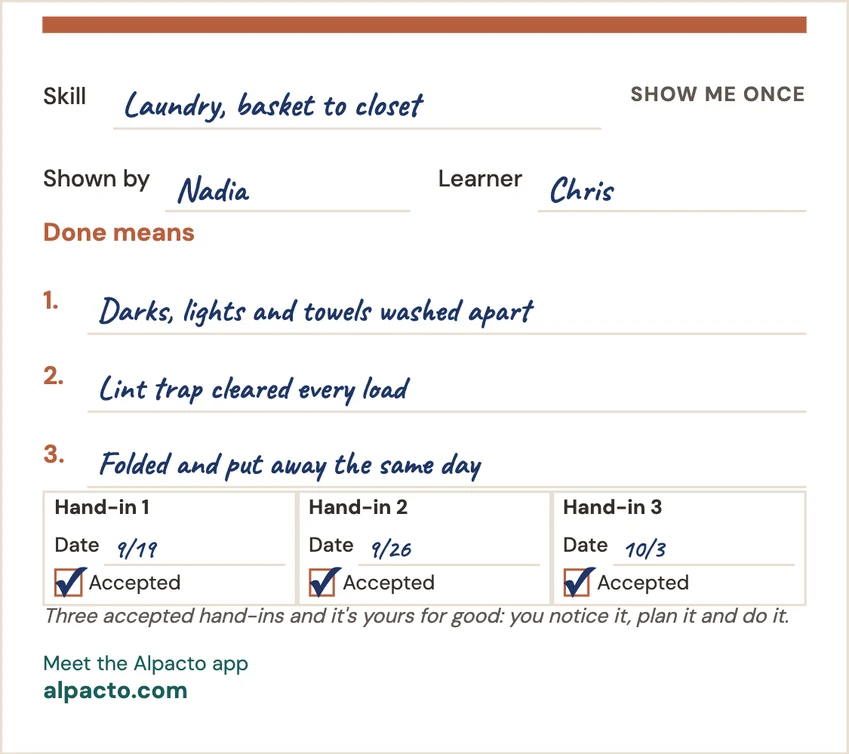
Show me once: hand the skill over in three hand-ins
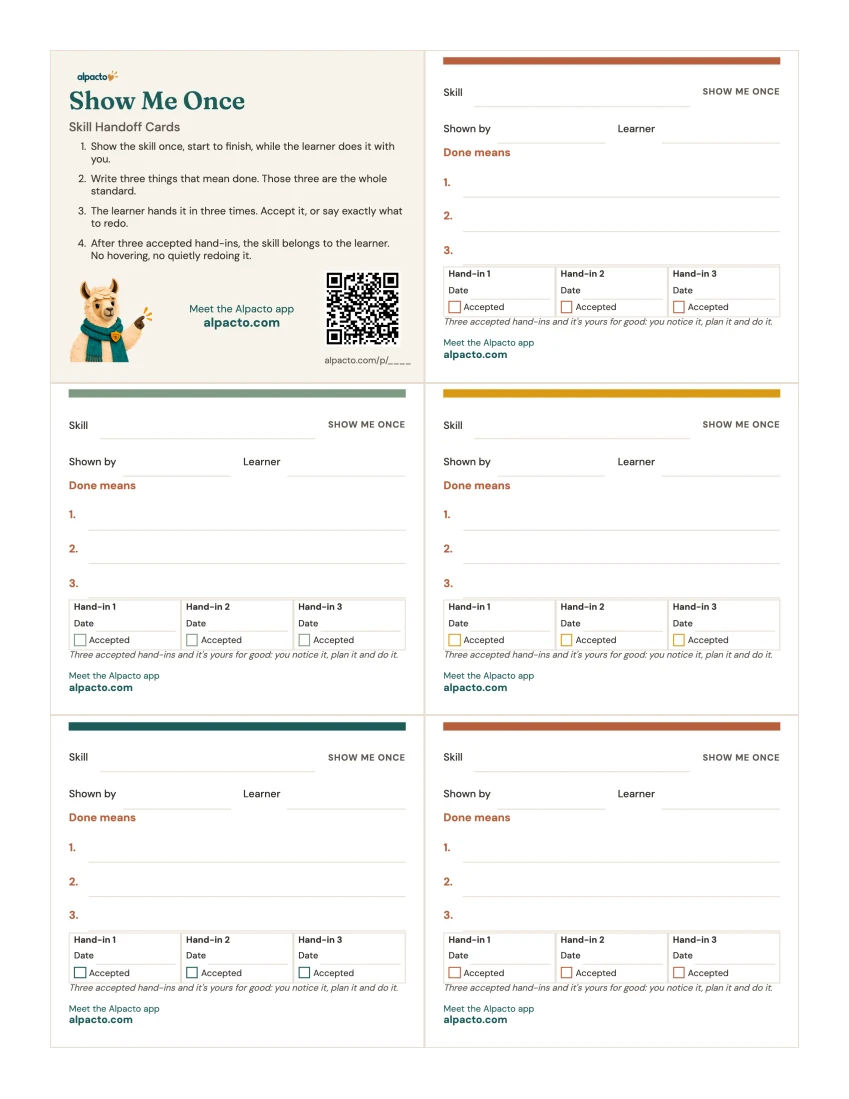
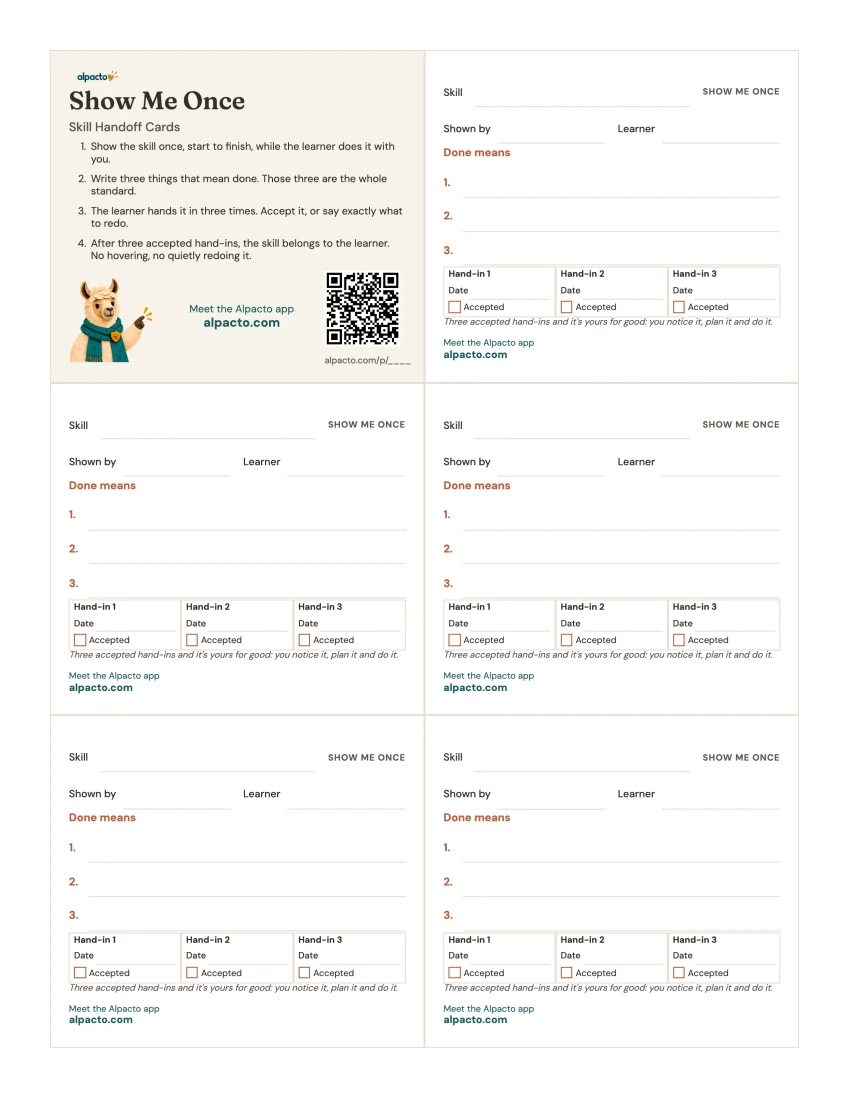
The sheet is six cards on one page: a cover card with the rules and five blank skill cards. One card holds one skill, and it has an end, which is why it outlives a chart on the fridge.
- Show the skill once, start to finish, while the learner does it with you.
- Write three things that mean done. Those three are the whole standard.
- The learner hands it in three times. Accept it, or say exactly what to redo.
- After three accepted hand-ins, the skill belongs to the learner. No hovering, no quietly redoing it.
A blank card has a line for the skill and a line each for who showed it and who is learning. Below that sit three numbered lines for “done means” and three boxes with a date and an “Accepted” tick. The printed line at the foot reads: “Three accepted hand-ins and it’s yours for good: you notice it, plan it and do it.”
The filled example runs both ways on purpose. Laundry and school lunches go one direction; the monthly bills and the car go the other. A sheet where every card points at the same person is a report card, and those get thrown away.
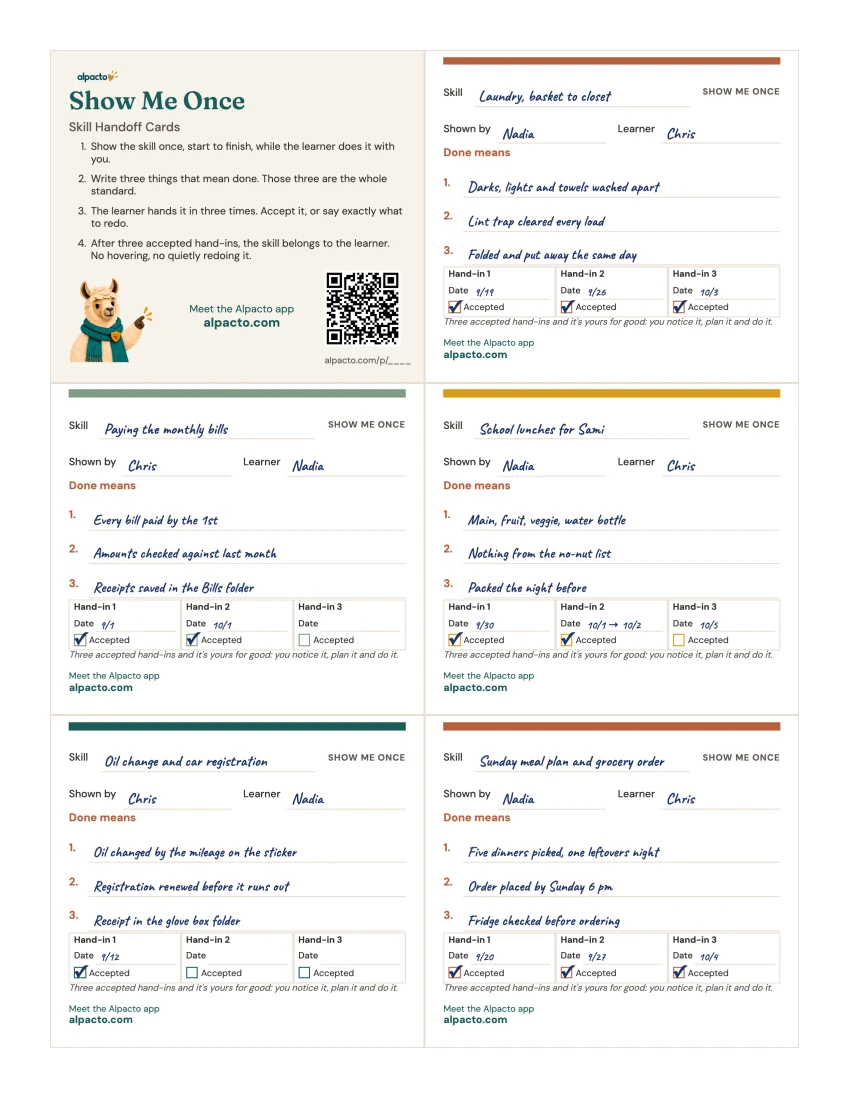
Filled example
The filled-in example is shown here.
What to say when the job comes back again
Ask for a handover of one job. Either of you can open it, and the wording is nearly the same:
- “I want to hand over the laundry completely, not the next load. Can we write down what done means, tonight, in three lines?”
- “Show me once and write down what counts as done, and the job is mine from then on.”
Then set a day to look at the card together. Ten minutes is enough: what was handed in, what was accepted, what needs rewording. The card has an end, so the review has one too.
If three hand-ins pass and the lines are met only while somebody is watching, say two things out loud. Name what you will stop covering, and name the date you will both look at this again. Cleveland Clinic also lists counseling as a reasonable next step when the pattern holds.
The one thing worth keeping to yourself is the term. In your own head it names a pattern; across the table it lands as a verdict no clinician or dictionary has agreed on. “Here is the card and here are the three lines” starts a different evening.
Questions people ask about weaponized incompetence
What is weaponized incompetence?
It is doing a task poorly, or claiming you are unable to do it, so that someone else takes it over for good. Cleveland Clinic describes doing a task poorly “in an attempt to avoid doing that task again in the future”, and notes it can be conscious or unconscious.
Can weaponized incompetence be unintentional?
Yes. Thriveworks writes that it “can start unconsciously due to learned patterns or societal conditioning” and “becomes problematic when someone continues the behavior after being made aware of its impact”. So the useful question is what changes after you write the standard down and show the job once.
What are other names for weaponized incompetence?
Strategic incompetence is the synonym Psychology Today gives, and people also say weaponized ignorance in relationships. The Western Washington University study treats strategic ignorance as a related but separate idea, so the names are not exact equivalents.
Is it the same as ADHD or executive dysfunction?
No, and a partner is not in a position to decide that either way. A diagnosis comes from a clinician, while the handover above needs none: the standard goes on paper, the job is shown once, and whatever support helps gets written into the card.
How to explain weaponized incompetence to a child
Do not use the term with a child. Give them one whole job, show it once, write two or three lines of what done means, and keep the review short. The American Academy of Pediatrics advises to “praise your child’s effort in each task, not the outcome”, and warns that badgering or scolding does not build responsibility.
Is this a form of abuse?
It can be, and that judgment is not made from a web page. Thriveworks writes that the behavior “can be a form of emotional manipulation and psychological abuse, particularly when it’s deliberate and ongoing”. If that is your read of your own home, a licensed therapist is the right person to talk to.
What if we agree on a handover and nothing changes?
Then you have your answer without arguing about motives. Reword the lines once in case they were vague, and run three more hand-ins. If the lines are still met only under supervision, decide what you will stop covering and when you will both look at it again.
The same handover, without anyone doing the reminding
In Alpacto a job becomes a pact you both wrote: what counts as done, by when, and what it is worth in coins. One of you marks it done and the other confirms, so the check-in is part of the deal rather than a message somebody has to send.