
Alpacto › Couples › How to improve communication in a relationship
How to improve communication in a relationship: a sentence rewriter and 6 exercises for two
To improve communication in a relationship, describe one specific moment, say how it affects you and ask for one concrete change, instead of describing what your partner is like. Below is a helper that rewrites a blaming sentence into that shape, and six exercises for two people with a built-in timer.
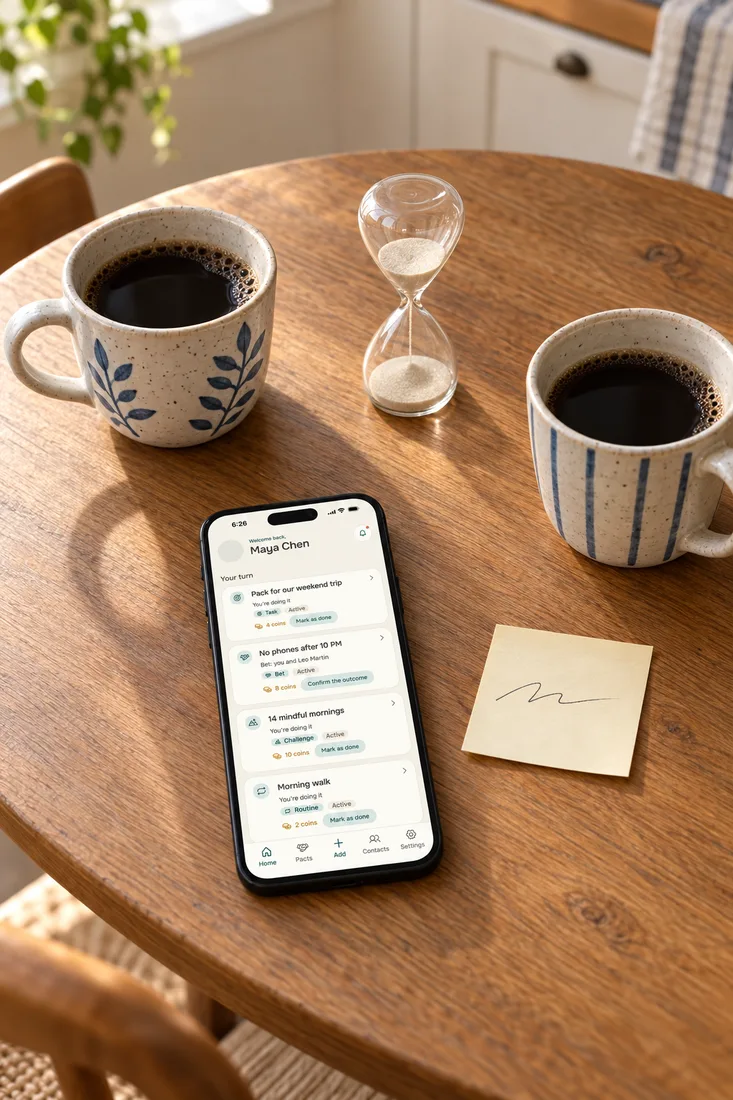
One sentence, one timer, two people.
In short
Talking more does not improve communication skills in a relationship. Changing the shape of what you say does: one moment, one feeling, one request. The rewriter below does that for any sentence you type.
The six exercises take 2 to 25 minutes each and never touch the fight you are in. For fights themselves, use the fair fighting rules.
Say it so it lands: turn a blaming sentence into a request
Choose what the sentence is about, type what you would say when annoyed, then fill in four short boxes. You get one rewritten sentence and a check for words that start a fight. Everything stays on this page.
Or start from a common one:
3. Say it in four parts
Your sentence
Fill in the four boxes to see your sentence.
What to avoid: check
- Type a sentence above and the check runs by itself.
The words the check looks for, and why
- always, never, every time. Almost nobody always or never does something, so your partner answers with the one exception. Name the last real time instead.
- you should, you need to. An order starts a defense. Turn it into a question that begins with Could we.
- why don’t you, why do you. It sounds like a question and works like an accusation. Say what happened and what you want.
- you’re so, you’re such, and labels. A label attacks the person, and a complaint describes the thing. Gottman Institute research calls attacks on character criticism.
- you make me. It puts your feeling in your partner’s hands. Say how the moment landed on you.
- whatever, obviously, as usual. These tell your partner you are done listening.
- again, how many times. They pull in every earlier fight. Stay with this one moment.
- everything, nothing, nobody. Same problem as always and never: too big to be true.
- A feeling box with “you” in it. “I feel that you don’t care” is a judgment wearing an I. A feeling is a word about you: tired, hurt, worried, left out.
- A request that starts with stop. Say what you want instead of what you want gone, and the other person has something to say yes to.
- You never help around the house.
- Why do I have to ask you to do everything?
- You’re so irresponsible with money.
- You always spend without telling me.
- You never want to spend time with me.
- You’re always working.
- You always take your mother’s side.
- You should tell your parents to stop.
- You’re always on your phone.
- You care more about your phone than about me.
- You’re late again, as usual.
- You never tell me where you are.
How to communicate better in a relationship: why the shape of a sentence matters
The Gottman Institute separates a complaint from criticism. A complaint is about a specific thing that happened, and criticism is an attack on your partner’s character.
Its example of a complaint is:
The criticism version starts with “You never think about how your behavior is affecting other people.” (Gottman Institute)
Another Gottman Institute article gives the short form: instead of “You never listen to me,” try “I feel unheard when…” It says this reduces defensiveness. (Gottman Institute)
Why an I-statement can still fail
An I-statement fails when it keeps the blame and only changes the first word. “I feel like you are selfish” has an I in it and an accusation inside, so the rewriter flags a feeling box with “you” in it.
It also fails when it asks for nothing. “I feel lonely” is honest, and “could we put Thursday evening on the calendar” is something your partner can say yes to.
Communication exercises for couples: six with timers
Do these on an ordinary evening, with phones silent and a topic that is not the current argument. Press Start and follow the phase names on the clock. Each card says where the idea comes from.
1. Two-minute turns
- Pick a mild topic: your week, a worry about work, a plan.
- The speaker talks for two minutes. The listener does not answer, advise or fix.
- The listener starts with “What I heard is…” and ends with “Did I get it?” The speaker says yes or adds what is missing.
- Swap.
Ready
2:00
2. Stress-reducing conversation
- Talk about something outside the relationship: work, traffic, an insurance call.
- The listener takes your side and listens to understand, not to give advice.
- Say “we” where it fits: you are on the same team against the problem.
Ready
5:00
3. Hint to request
- Each of you picks one thing you usually hint at, such as “It’s getting late” when you mean “please do the dishes”.
- Say it as a plain request with a time: “Could you do the dishes before 9?”
- The other answers yes, no, or “how about…” and nobody sulks over a no.
Ready
1:30
4. Validate first
- Share one frustration that is not about your partner.
- The listener’s first sentence is “That makes sense, because…” and must name a real reason.
- Only then may the listener say what they think. Validating is not agreeing.
Ready
2:00
5. Specific thank-yous
- Name three things your partner did this week, with the day: “Thank you for taking the trash out on Tuesday before I asked.”
- No “but” and no trade. The other person says “thank you” and nothing else.
Ready
1:00
6. Practice the pause
- Pick a word to stop a talk, and a small disagreement with no stakes, such as where to eat.
- One of you says the word. Both separate for 20 minutes, the figure the Gottman Institute gives, and do something calming alone.
- Come back and restart the topic.
Ready
20:00
How to improve communication in a relationship between the exercises
Pick the time before you need it
Heavy talks go better at a time you both chose, not in the doorway. Ask first: “Is tonight good to talk about the weekend plans?” If not, name a time within a day.
Keep a weekly check-in
Our relationship check-in questions page has 63 questions and an agenda builder, so we do not repeat them.
Have the fight rules ready
Pick your time-out word and return time on the fair fighting rules page while you are calm, then print the sheet.
If the same fight keeps coming back
A topic that returns every month usually hides a job nobody owns. Look at the mental load or how to split chores fairly before you decide the problem is how you talk.
Questions people ask
How do you fix poor communication in a relationship?
Poor communication in relationships is a skill gap more often than a character flaw. Say one moment and one request instead of a verdict, and practice listening with a timer. If the same topic still blows up after a few weeks, a couples therapist can show you the pattern.
What are 7 ways to improve communication skills in a relationship?
These seven relationship communication tips are on this page:
- Describe a moment, not a character.
- Say one feeling and one reason.
- Ask for one specific thing.
- Listen for two minutes before answering.
- Say back what you heard.
- Validate before you disagree.
- Take a break that ends in a return.
What is the 5 5 5 rule in relationships?
We could not open a source with a clear, research-based definition, so we do not repeat its numbers. The exercises above use timed turns with known lengths, and each card says which ones are ours.
How to fix an unbalanced relationship?
First find where the imbalance is: who talks, who plans, who does. A talk about chores or the mental load, with named owners for each job, usually moves things faster than a talk about feelings. Our default parent page has a check for parents.
How to effectively communicate with your partner when you are angry?
Stop the talk and take a break before you say the sentence. The Gottman Institute suggests 20 minutes alone doing something that soothes you, then returning when you feel ready. Run the rewriter after the break, not during it.
From a request to a pact
The last box of the rewriter asks for one specific thing. In Alpacto that kind of request becomes a pact between two people. One promises, the other accepts, and both see what was agreed and what is still owed.