
Alpacto › Challenges & games › Love language quiz
Love language quiz for couples: 20 pairs, two charts and a sheet to print
This free love language quiz is built for two: each of you picks between 20 pairs of everyday moments. You get a bar chart of the five love languages for each partner, the places where you differ, and three small things to do for each other this week. It takes about five minutes per person, and nothing you pick leaves this page.
Free love language quiz for couples: take it one after the other
Type two names, then answer 20 pairs one partner at a time on this screen and pass the phone. On two phones, each of you takes it alone and types the other’s five scores at the end. Every pair is scored, so each language ends with 0 to 8 points and the five add up to 20.
For each pair, pick the moment that would mean more to you on an ordinary week. If both are nice, take the one you would miss more. There are no wrong answers.
Took the quiz on another phone? Type those five scores instead
Use the scores printed under that phone’s result, in the order Words, Acts, Gifts, Time, Touch. They add up to 20.
For each pair, pick the moment that would mean more to you on an ordinary week. If both are nice, take the one you would miss more. There are no wrong answers.
Took the quiz on another phone? Type those five scores instead
Use the scores printed under that phone’s result, in the order Words, Acts, Gifts, Time, Touch. They add up to 20.
The 5 love languages, and what each one looks like at home
The five love languages are Words of Affirmation, Acts of Service, Receiving Gifts, Quality Time and Physical Touch. Chapman, a Baptist pastor, described them as five ways people tend to give and feel care, and he argued that partners often feel loved through different ones. The Wikipedia entry on the book lists them the same way.
Words of affirmation love language
Spoken or written appreciation. At home it is a text that says what you noticed, thanks for a small thing, or an apology said plainly. The usual miss is assuming your partner knows, so nothing gets said.
Acts of service love language
Taking a job off the other person’s plate. At home it is dishes done before they see them, the appointment booked, the car filled. The usual miss is doing the task once and expecting credit instead of owning it, which is the mental load problem in small.
Receiving gifts
A small object that proves you were remembered. Price hardly matters, attention does: their coffee order, a souvenir, a flower on a Tuesday. The usual miss is dismissing it as materialistic.
Quality time love language
Undivided attention. At home it is phones in another room, a walk with no destination, a date night that stays on the calendar. The usual miss is sitting in the same room while both of you scroll.
Physical touch love language
Closeness through the body in ordinary moments: a long hug at the door, a hand on the back, legs touching on the couch. The usual miss is touching only when it is meant as an invitation.
Twenty small actions, four for each love language
This is the list the quiz draws from. Your sheet shows three of them for each partner, taken from the other person’s top language. If you would rather pick by hand, read them here and choose the one that fits your week.
Words of Affirmation
- Send one text this week that names something specific your partner did and why it mattered to you.
- Thank your partner out loud for one routine thing, such as making coffee or taking out the trash, before they point it out.
- Leave a handwritten note where they will see it tomorrow: the bathroom mirror, the car, their laptop.
- Tell them to their face one thing you admire in how they handled something this week.
Acts of Service
- Pick one task your partner dislikes and do it from start to finish before they ask.
- Make the call, book the appointment or file the form they keep postponing.
- Take over one whole evening routine, from dinner to cleanup, so they can sit down.
- Refill, restock or repair one thing they use every day, such as the printer paper or the sticky drawer.
Receiving Gifts
- Bring home something small that is clearly theirs: their favorite snack, one flower, a pen that writes the way they like.
- Pick up a small thing on an errand because it made you think of them, and hand it over the same day.
- Wrap one small gift, even a cheap one, and write a line on it about why you chose it.
- Get or make something that goes with a plan they mentioned in passing, and give it before they ask.
Quality Time
- Put both phones in another room for 30 minutes and spend them on one thing together.
- Take a walk with no destination, ask about their week, and follow up one answer with a second question.
- Block one evening on both calendars and keep it, with no rescheduling for work.
- Do one errand together that you normally do alone, and talk on the way.
Physical Touch
- Hug for a slow count of ten when one of you comes home.
- Sit close enough to touch on the couch for one whole episode.
- Offer a five-minute shoulder or foot rub on the busiest evening of the week.
- Hold hands on a walk or while waiting in line.
How to use your love language quiz result together: a 20-minute weekly ritual
A result changes nothing until you do something with it, and one good evening does not last. This ritual takes about 20 minutes once a week and uses the printed sheet from the quiz.
- Look at both charts first. Each of you says what surprised you. Nobody argues with a score, and nobody tells the other what their score really means.
- Choose from the other person’s list. Each partner picks one of the three actions printed for them. The one doing it chooses, so it is a gift and not an assignment.
- Put a day on it. Write the day next to the action. “Soon” does not count, and the Soon Translator sheet turns it into a day you both initial.
- Ask one question the next week. Ask whether it felt like care. If not, change the action, not the person.
- Every fourth week, reach for the bottom of the chart. Pick an action from your partner’s lowest language. People often feel loved in more than one way, and the research below does not support betting on a single one.
A small written trade works well here: one action, one day, one reward you agreed on. IOU cards and love coupons are printable versions of that idea, and the questions to ask your partner give you something to talk about while you do the review.
Does the 5 love languages test have research behind it?
Only partly, and the findings point in different directions. A 2025 study of 696 adults, 70% of them married, tested Chapman’s central claim that hearing your partner’s primary language predicts a happier relationship. The authors report that the claim was not supported, and that Words of Affirmation and Quality Time predicted perceived love and satisfaction better than a person’s own primary language did.
A 2022 study of 100 heterosexual couples found something else: partners who expressed love the way the other preferred to receive it reported higher relationship and sexual satisfaction. So matching may help, and a single primary language may be too blunt an idea.
That is why the quiz here gives you a conversation and three things to try, not a verdict about who your partner is. Treat the chart as a starting guess and let the weekly question decide what stays.
Questions people ask about love language tests
What is my love language?
Your love language, in this model, is the one with the most points on your chart. If two are tied, both count. Take the quiz above, then check it against real life: which of the actions on your list would you actually miss if it stopped?
What are the 5 main love languages?
They are Words of Affirmation, Acts of Service, Receiving Gifts, Quality Time and Physical Touch. Each has examples and a common miss in the section above.
Is it 5 or 7 love languages?
Chapman’s model has five. Lists of seven come from other authors and other quizzes, so check which model a test uses before comparing results.
What is the most accurate love language quiz?
No love language quiz is validated as a clinical instrument, ours included. If you want the quiz that belongs to the book, it is the one on 5lovelanguages.com; the studies above are what to read about whether the model itself holds up.
What are the 5 love language tests?
There is one official quiz from the book’s publisher, and many unofficial ones that use the same five names. This page is an unofficial five love languages quiz, written from scratch, with 20 pairs per person and a result for two.
What love language are most men?
There is no reliable answer. We found no study we trust that splits the five languages by gender, and the 2025 study above found that Words of Affirmation and Quality Time predicted satisfaction for its whole sample. Ask your own partner instead of a statistic.
Which is the hardest love language?
It is usually the one farthest from what comes naturally to you. The “where you differ” panel in your result points at it: the largest gap between your two charts is the language where one of you needs to practice.
What is the 7-7-7 rule for couples?
It is a popular rule of thumb, not a research finding: a date every 7 days, a night away every 7 weeks, a longer trip every 7 months. The date night jar has 60 ideas for the first of those.
Can we take the quiz on two phones?
Yes. Each of you takes it alone, writes down the five scores printed under the result, and one of you types the other’s scores in the box under the questions. The comparison and the sheet then work the same way.
Is my result saved or sent anywhere?
No. The answers stay in this page while it is open, nothing goes to a server, and closing the tab clears them. Print the sheet if you want to keep it.
What are 21 juicy questions for a couples quiz?
You will find 120 of them, in several categories, in questions to ask your partner. The couple questions game prints 48 of them as cards.
From one action on the sheet to a pact
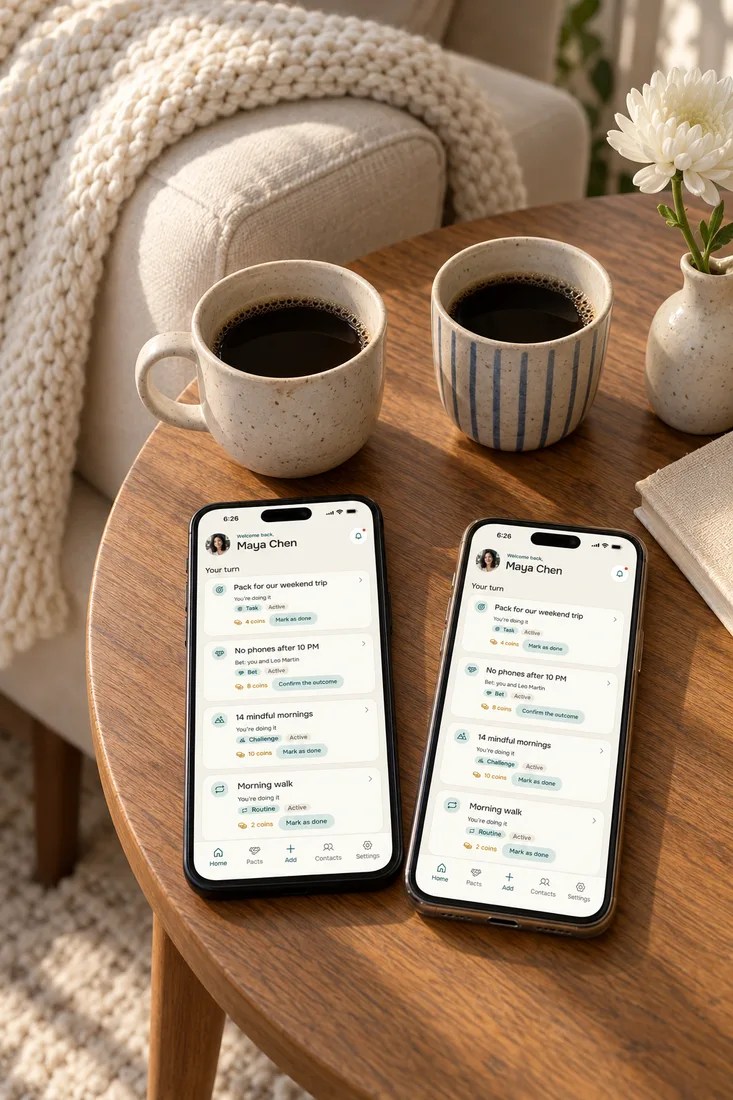
Pick one of the three actions and make it a pact in Alpacto: one of you promises, the other accepts, and you both see what was agreed and what is still owed. The week’s action stops depending on anyone remembering it.