
Alpacto › Free printables › Kids › Screen time chart
An earn screen time chart with a weekly limit that stays put
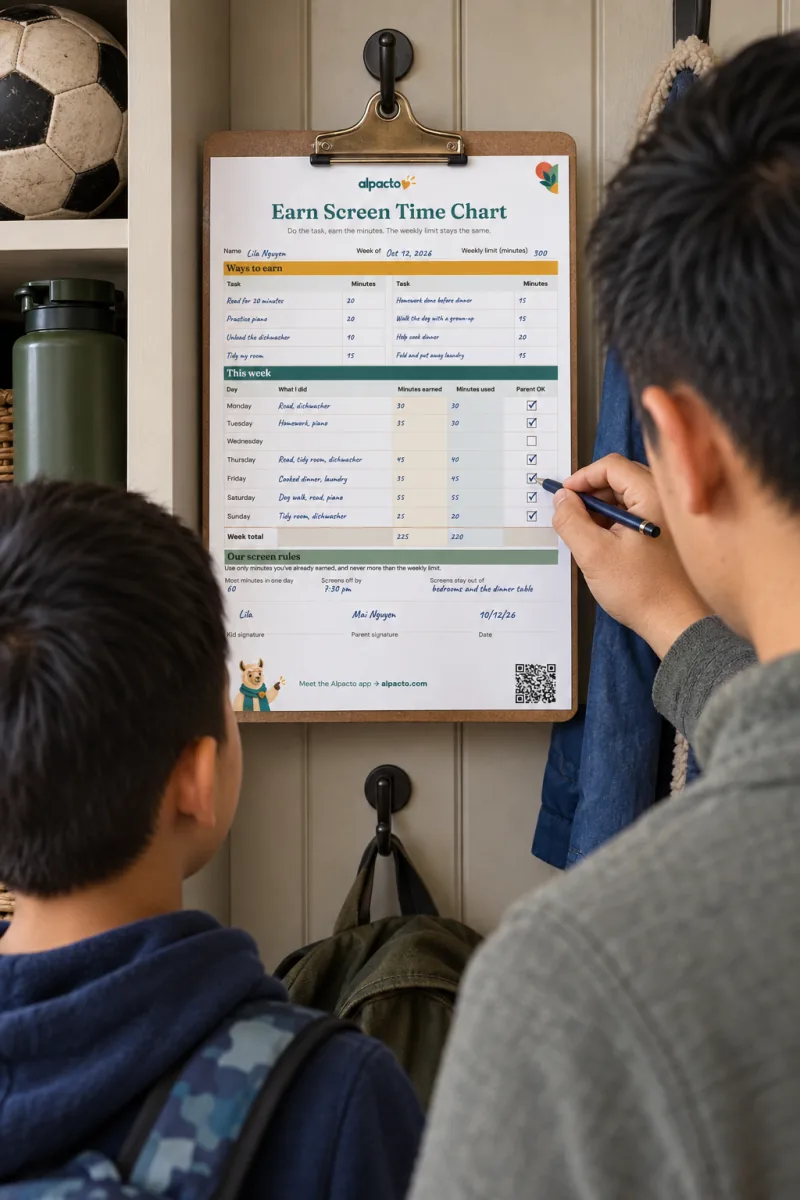
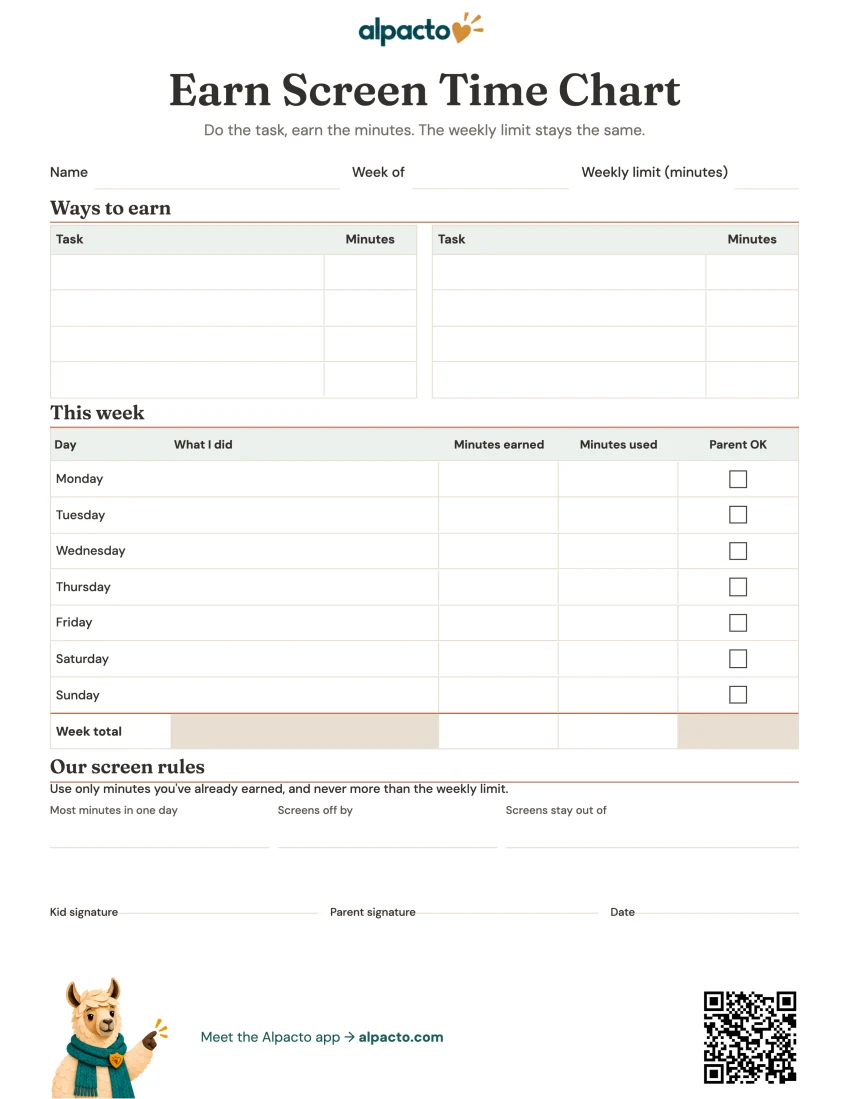
This earn screen time chart turns chores into minutes: the child does a task from the list, writes down the minutes and spends only what is already earned. The weekly limit goes in once, at the top, before the first task, so no amount of chores can push screen time past it.
- Sheet
- One page, one week, Monday to Sunday
- Paper
- US Letter and A4, portrait
- Versions
- Blank, and a fillable PDF with 53 fields; the filled-in example is shown below
- Designs
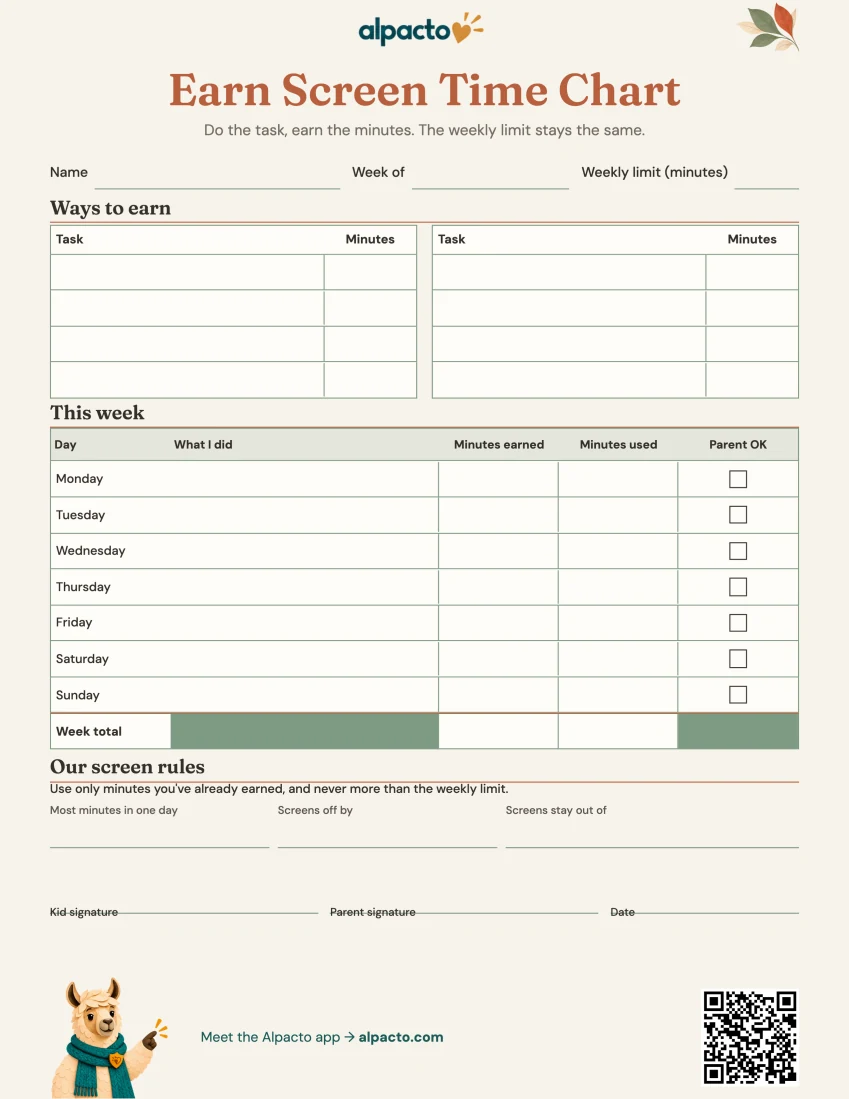
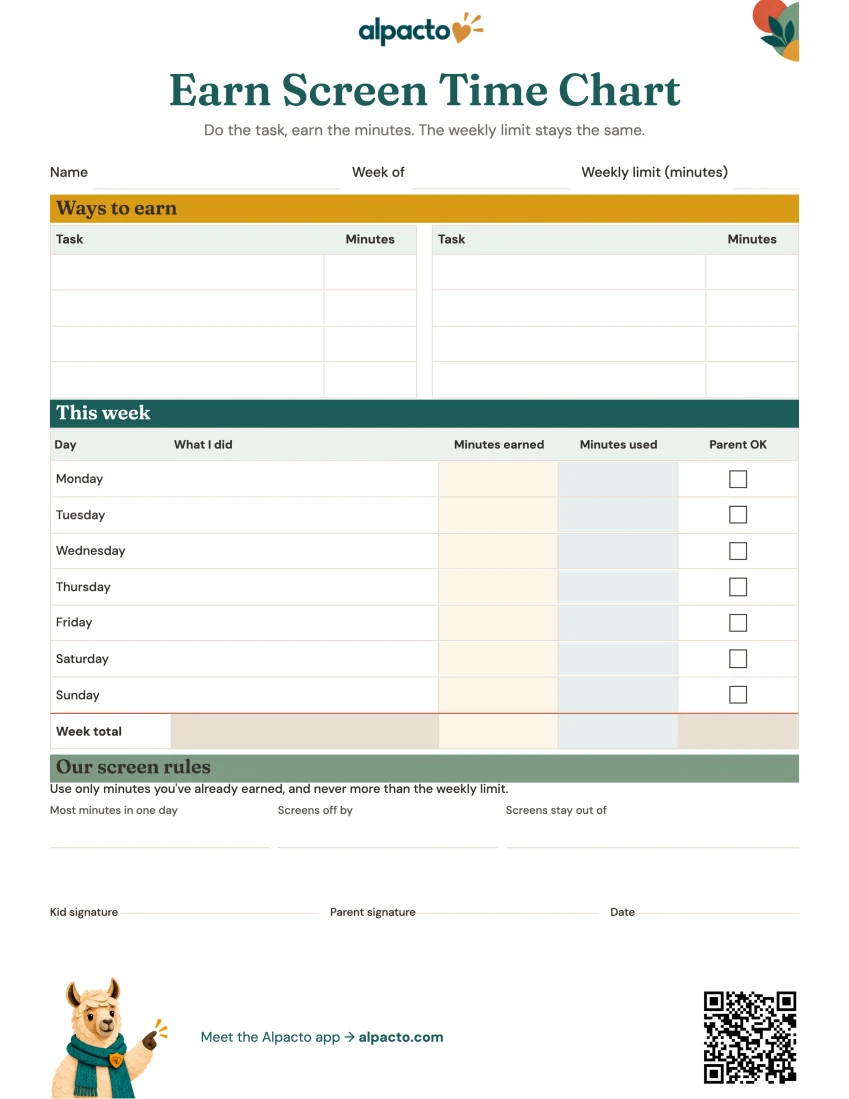
- Minimal, warm and color
- For
- Kids about 6 to 12 and the grown-up who ticks Parent OK
In short
Write the weekly limit first, then up to eight tasks with their minutes. Each day the child logs minutes earned and used, and a parent ticks Parent OK.
The rule printed on the sheet: “Use only minutes you’ve already earned, and never more than the weekly limit.” A day with no tasks stays blank, and there is no line for taking minutes away.
What is on this earn screen time chart
Name, Week of, Weekly limit
The limit, in minutes, written once for the week.
Ways to earn
Two short tables, Task and Minutes, eight rows in all.
This week
One row a day plus Week total: What I did, Minutes earned, Minutes used, Parent OK.
Our screen rules
The printed rule and three blanks: Most minutes in one day, Screens off by, Screens stay out of.
Kid and Parent signature
Both sign under the rules, with one date.
Is a reward chart for screen time a good idea?
Pediatric sources pull both ways.
| Why it can work | What to watch for |
|---|---|
| The AAP says school-age kids, 5 to 10, are “receptive to setting up and following rules.” | Seattle Children’s: “Avoid using screen entertainment as a reward or as a way to calm or soothe a child.” |
| The limit is set once, so the child isn’t bargaining every evening. | In a 2018 study of 62 children aged 1.5 to 5, parents who used screens to control behavior had kids with more screen time. |
| The child keeps the count; the parent only checks it. | That study was a single snapshot, and its authors say the cause may run the other way. |
Sources: HealthyChildren.org (AAP), Kids & Screen Time: 5 C’s Questions for School-Age Children; Seattle Children’s, Screen Time and Digital Media Use; Tang et al., BMC Obesity, 2018.
The sheet is built around that risk: earning more tasks never lifts the weekly limit, and nothing is taken away. If screens are already the main fight at home, try a reward chart for kids with a reward that isn’t a screen.
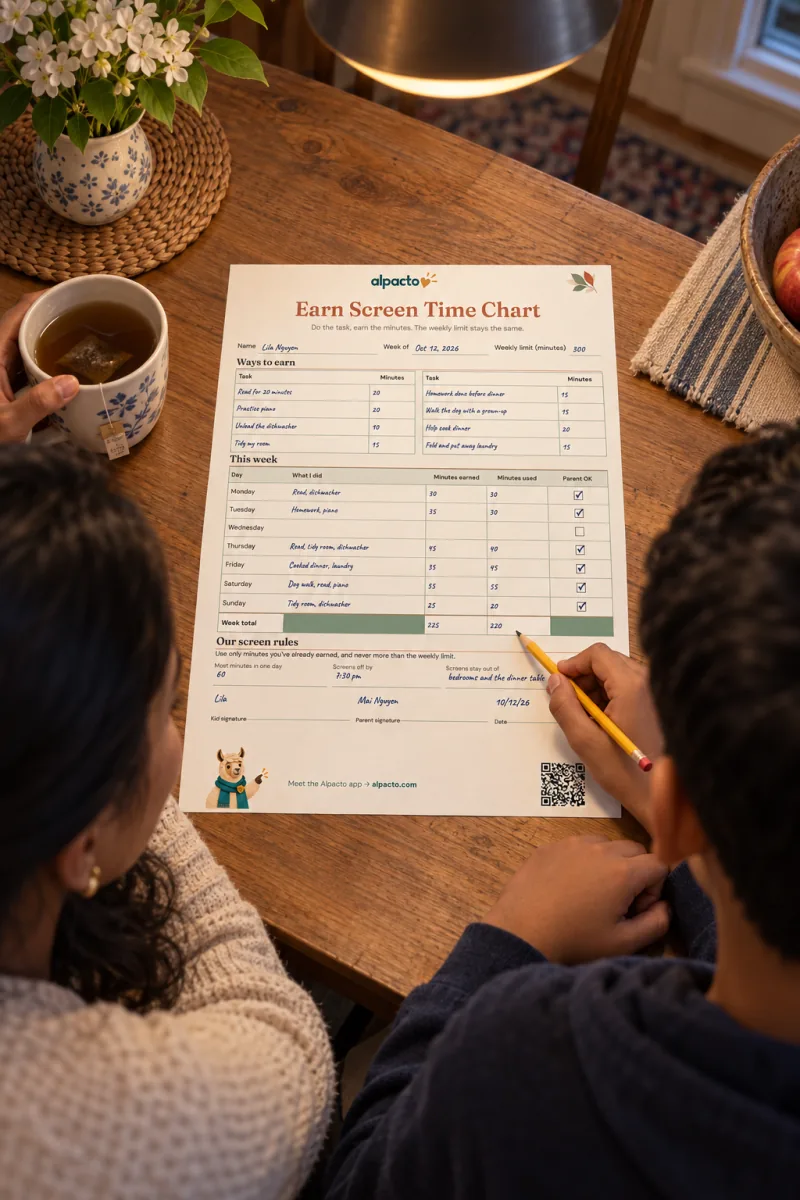
The child adds up the Week total.
How to set up a chore chart to earn screen time
- Write the Weekly limit before anything else. In the example it is 300 minutes.
- Fill Ways to earn together, a task and its minutes: in the example, 10 for Unload the dishwasher, 20 for Practice piano.
- Fill the three rule blanks. The AAP suggests screen-free zones: “Bedrooms and mealtimes are great places to start—especially an hour before bed.”
- Sign it together, child first, and hang it where the tablet charges.
Source: HealthyChildren.org (AAP), Helping Kids Thrive in a Digital World: AAP Policy Explained (2026).
A chore chart for kids to earn screen time should take a minute each evening: the child writes the task and minutes, the parent ticks the box.
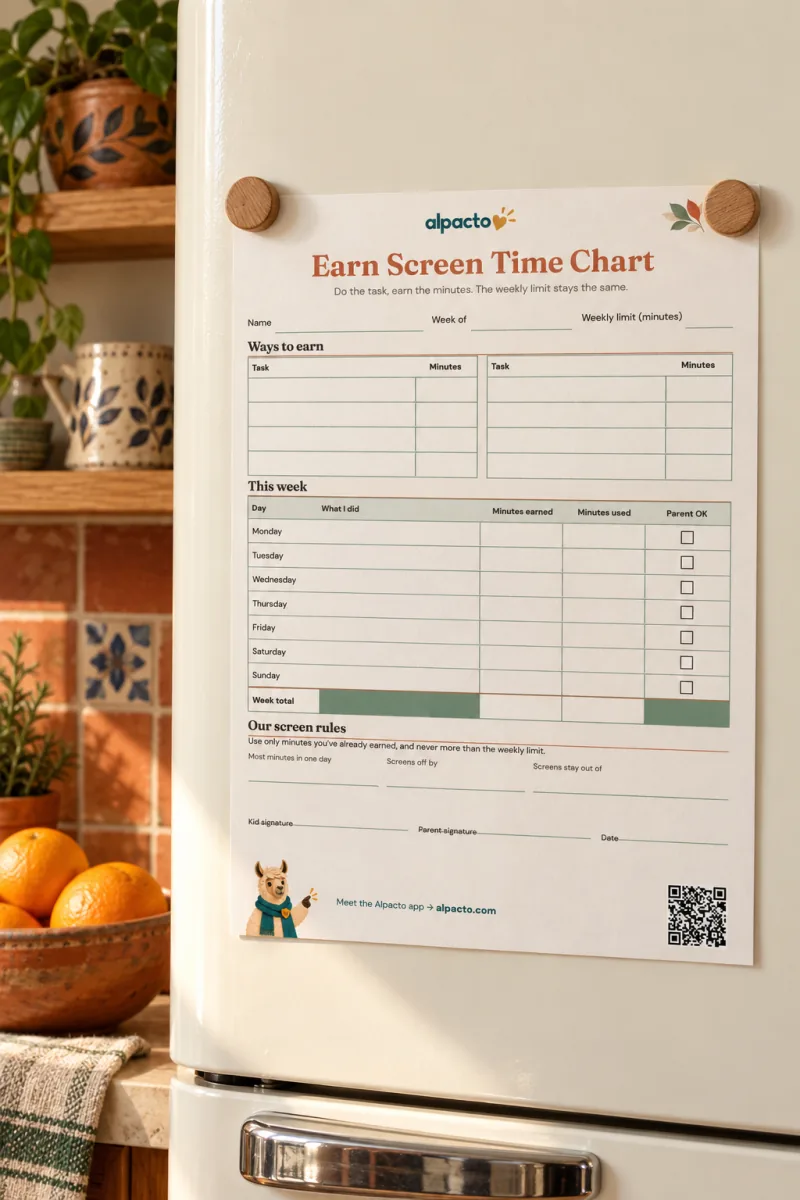
Blank, warm design, before the limit is written in.
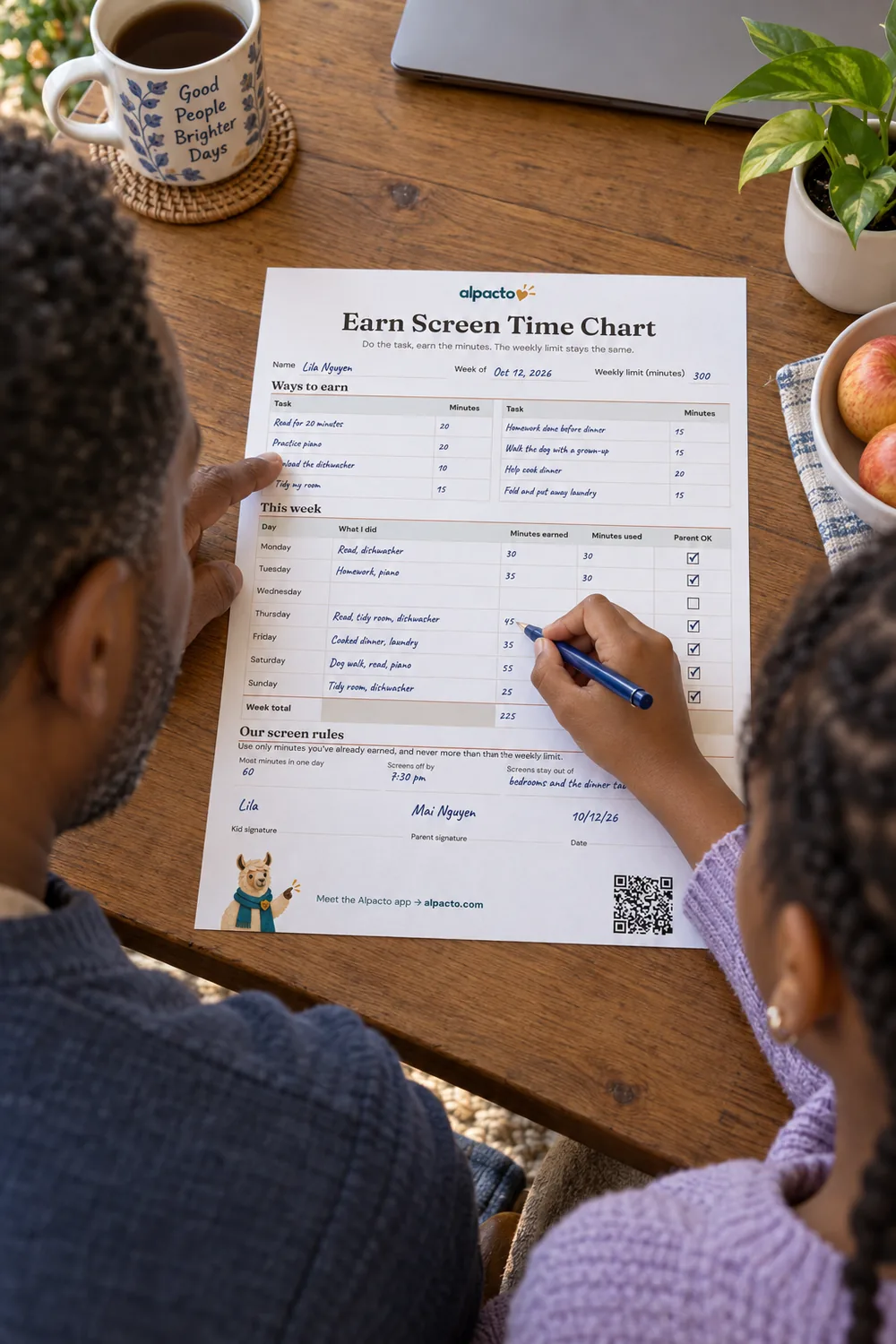
Lila’s week: 225 minutes earned, 220 used
Lila’s rules: 300 minutes a week, 60 a day at most, screens off by 7:30 pm, none in bedrooms or at the dinner table. Her chore chart for earning screen time, day by day:
| Day | What I did | Earned | Used | Still to spend |
|---|---|---|---|---|
| Monday | Read, dishwasher | 30 | 30 | 0 |
| Tuesday | Homework, piano | 35 | 30 | 5 |
| Wednesday | (blank) | 5 | ||
| Thursday | Read, tidy room, dishwasher | 45 | 40 | 10 |
| Friday | Cooked dinner, laundry | 35 | 45 | 0 |
| Saturday | Dog walk, read, piano | 55 | 55 | 0 |
| Sunday | Tidy room, dishwasher | 25 | 20 | 5 |
| Week total | 225 | 220 |
On Friday she used 45 minutes after earning 35: the extra 10 were left over from Tuesday and Thursday, so the rule holds. Wednesday stays blank, with no Parent OK. Her busiest day, 55, stays under the daily 60.
The sheet’s example; Lila Nguyen is invented. The last column isn’t on the sheet: it is earned minus used, added up day by day.
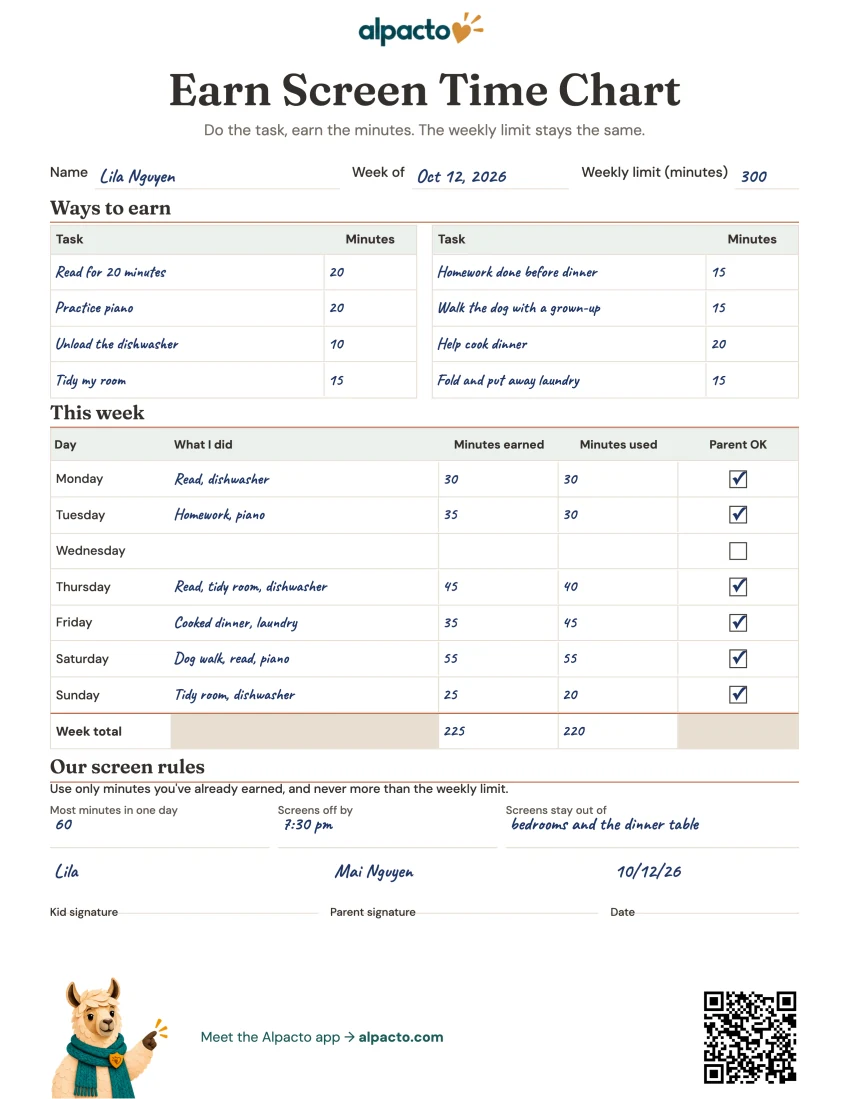
The filled-in example, minimal design.
Download the sheet
Each screen time chart printable here is free, no email: three designs, Letter and A4, blank or fillable.
How many minutes to put on the earn screen time chart in week one
The sheet asks for a weekly limit before it asks for a single task, so that number is the first decision. Start from what your child uses now. Check the settings screen on the tablet or console for last week’s total, and set the limit at or a little below it.
A limit far under the current habit turns the first week into an argument about the limit.
Then price the tasks so that a normal week lands under the limit with room to spare. Lila’s example uses 10 to 20 minutes a task and ends the week at 225 of 300.
Add up what a typical week of tasks would earn. If the answer is far above the limit, the limit never matters. If it is far below, the child cannot reach it however hard they try.
Decide before the first day what happens to unused minutes. The sheet does not carry them forward by itself, and the week total at the bottom is where they stop. Say aloud whether Sunday’s leftovers disappear or count toward next week, and jot the answer in the margin beside the weekly limit.
Expect week one to be uneven. A child may spend everything on Monday and have nothing left by Thursday.
Do not rescue them midweek. The printed rule, use only minutes you have already earned, does the teaching, and a short Thursday says more than a lecture on Sunday.
If chores for minutes ever becomes the only reason chores happen, pair it with a family routine: put daily jobs on the family chore chart and keep this sheet for extras. The allowance by age guide covers how other rewards compare.
Questions people ask
How many minutes should each chore earn?
Enough that an ordinary week lands under the weekly limit. On a chore chart for screen time like Lila’s, tasks earn 10 to 20 minutes, and six busy days came to 225 of her 300.
What is a healthy amount of screen time per day by age?
The AAP no longer gives one number: its guidelines “do not give a set screen time limit that applies to all children and teens.” Its 2026 policy, which replaces the old one, suggests screen-free bedrooms, meals and the hour before bed. The daily number is yours to set.
What is the 3-6-9-12 rule for screen time?
A French guide by psychiatrist Serge Tisseron, 2008, not an AAP rule: no screens before 3, no device of their own before 6, internet with an adult from 9, alone after 12.
What is the 30 30 30 rule for screen time?
It is an eye break, not a daily limit: every 30 minutes, look away for 30 seconds at something at least 30 feet away (NICHQ).
What are the 5 Cs of screen time?
The AAP’s five questions: Child, Content, Calm, Crowding Out and Communication. Crowding Out asks “What does media get in the way of?”; the three rule blanks are where you answer it.
Can I take earned minutes away?
The sheet has no place for it: no minus column and no line for lost minutes. If a rule is broken, reread Our screen rules together and change a blank for next week.
Other free printable sheets
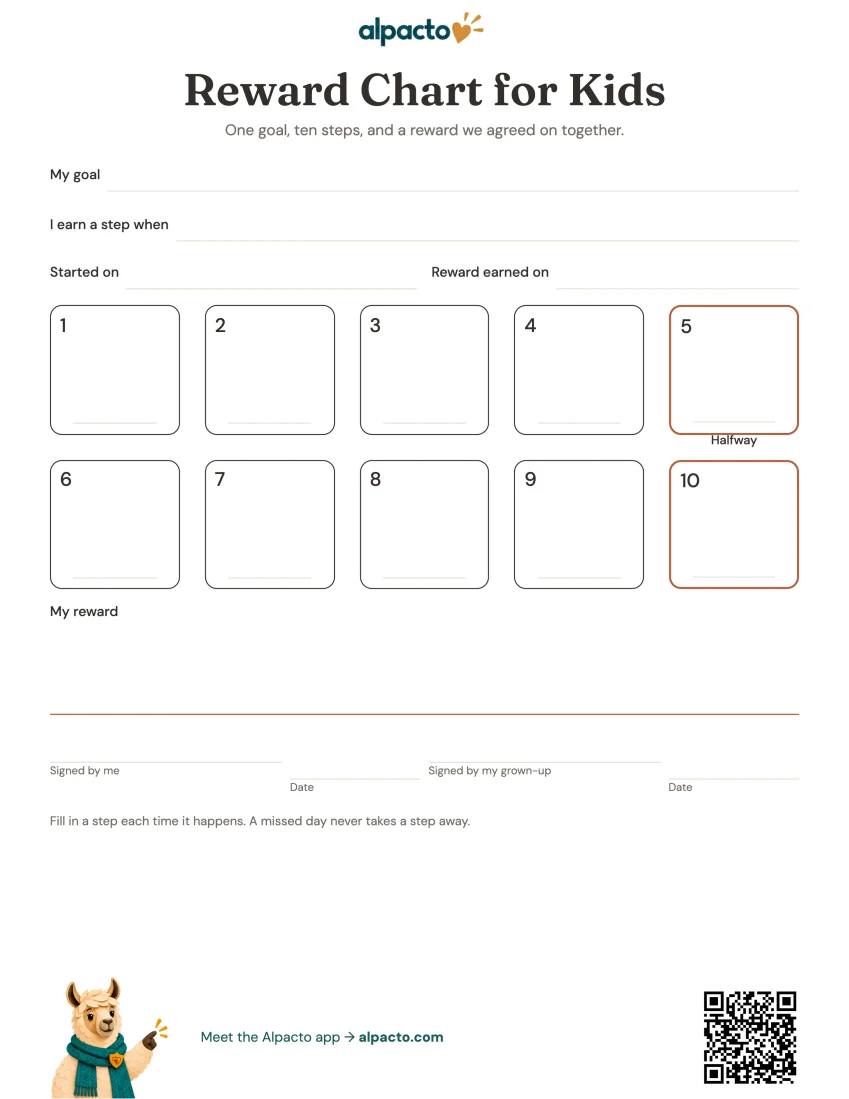
Save this chart to Pinterest
Pin it now and the sheet is there when you sit down with your child to write the weekly limit and the list of tasks. Blank or fillable, three designs, US Letter and A4.
When the deal moves to a phone
Alpacto is our own app, and accounts start at 13, so a younger child’s minutes stay on this sheet. For an older kid, each task on the list can be a task pact the parent confirms, with a reward from a catalog you made together. Coins stay inside the app and are never money.