
Alpacto › Kids › Allowance by age
Allowance by age: how much US families pay, and a chart your kid keeps
A fair allowance by age is 50 cents to a dollar a week per year of your child’s age, the range Scholastic Parents cites. Give the money a real job to do. Below are the averages from three open surveys, what each age can pay for, and a free chart in two versions.
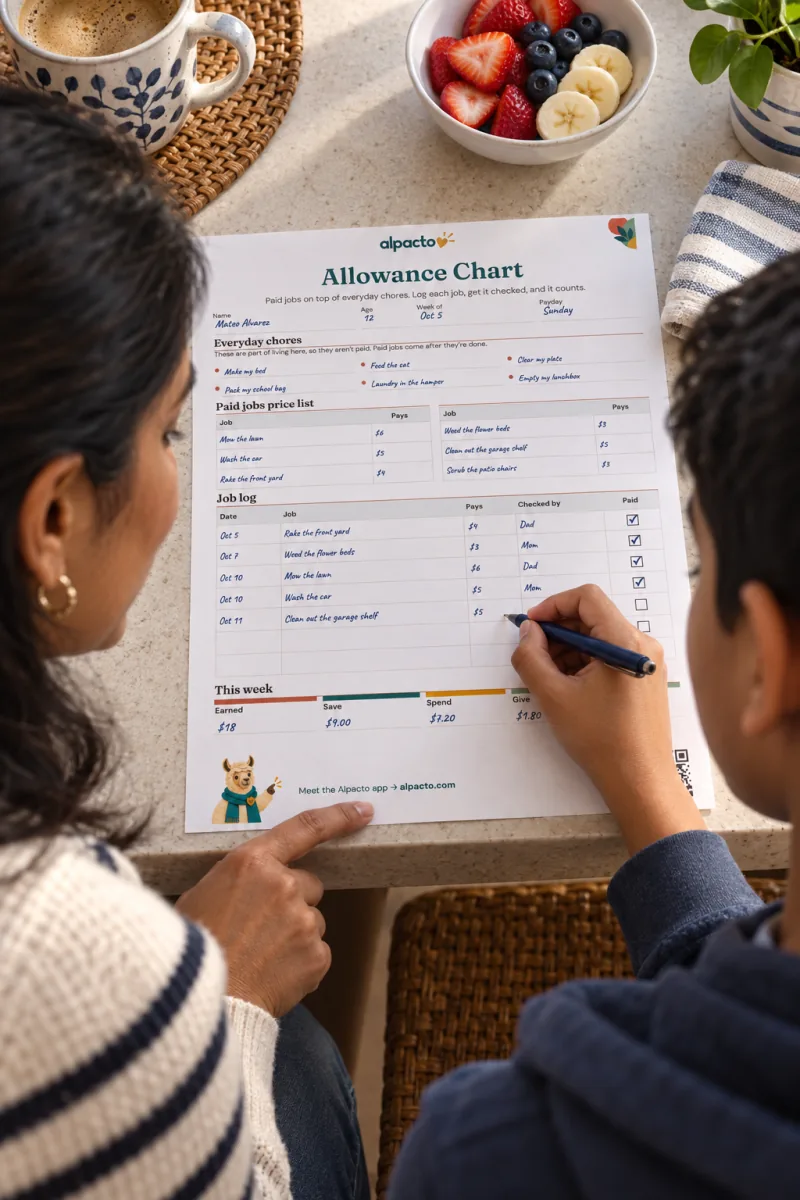
He writes the job, she checks it, and it counts on payday.
In short
A good allowance is 50 cents to a dollar a week for each year of your child’s age, starting around age 5 or 6. A 10-year-old gets $5 to $10 a week. Greenlight families paid $6.79 at 7 and $13.13 at 14, so the range fits most kids.
That range matches what Greenlight families actually paid from 7 to 14 (2025 data). From 15 the averages climb faster, as teens start paying for more of their own life. Hand over one real expense with each raise, so the money has a job.
Decide once whether allowance is fixed or earned. The chart below comes in both versions: a set amount split into save, spend and give, or paid jobs on top of everyday chores that stay unpaid.
Weekly allowance by age: the averages from 5 to 17
In 2025 Greenlight data, the average weekly allowance for US kids rises from $6.18 at age 5 to $21.47 at age 17. Greenlight is a debit card and app that families use to pay allowance. Treat the numbers as a reference point, since they come from app families.
The line rises slowly until 12 and then bends upward. In the same data, between 5 and 12 the average grows about 60 cents a year; between 14 and 17 it grows $2 to $3.60 a year.
The next section shows why other surveys land higher.
Average weekly allowance, US, 2025
Why the average allowance by age depends on who you ask
Surveys disagree on the average allowance because each one asked a different group of parents. Three recent ones give $13.15, $19.39 and $37 a week, and none of them is wrong. The list below shows exactly who each survey asked and when.
- Greenlight, 2025: what its own users paid through the app, kids 5 to 19.
- T. Rowe Price, 2022: 2,138 parents of kids 8 to 14, asked how much they give per child per week.
- Wells Fargo and Ipsos, 2025: 1,587 parents of kids 5 to 17, surveyed April 28 to May 8, 2025; the 71% who give an allowance average $37.
A few large payments also pull an average up. Among parents who give an allowance in the T. Rowe Price survey, 70% pay $20 a week or less and only 6% pay $51 or more.
A starting amount for each age, checked against the dollar-a-year rule
A starting allowance is 50 cents to a dollar a week for every year of age, the range the Scholastic Parents guide cites. A popular shortcut is the top of that range, a dollar a year, so $10 for a 10-year-old. The table puts both next to what families actually paid.
| Age | Average paid, 2025 | 50¢ a year | $1 a year |
|---|---|---|---|
| 5 | $6.18 | $2.50 | $5 |
| 6 | $6.44 | $3 | $6 |
| 7 | $6.79 | $3.50 | $7 |
| 8 | $7.22 | $4 | $8 |
| 9 | $7.86 | $4.50 | $9 |
| 10 | $8.53 | $5 | $10 |
| 11 | $9.35 | $5.50 | $11 |
| 12 | $10.37 | $6 | $12 |
| 13 | $11.59 | $6.50 | $13 |
| 14 | $13.13 | $7 | $14 |
| 15 | $15.26 | $7.50 | $15 |
| 16 | $17.89 | $8 | $16 |
| 17 | $21.47 | $8.50 | $17 |
Allowance by age, weekly, in US dollars. Average paid: Greenlight 2025 data. The 50¢ to $1 range: Scholastic Parents.
From 7 to 14 the real average sits inside the range, in its upper half. At 5 and 6 it runs slightly above it. From 15 on it passes a dollar a year, and at 17 by almost $4.50.
What the money should cover at each stage
The American Academy of Pediatrics suggests making the allowance matter by handing over areas the child pays for, such as some of their clothes or food out with friends. A raise works best with one of these attached.
- 5 to 7: small treats at the store and saving up for one toy. The AAP notes this ends the “Can I get it?” question in every store.
- 8 to 10: the snack after practice, a book fair, birthday gifts for friends.
- 11 to 13: a movie or food out with friends, plus their own game and app purchases.
- 14 to 17: some of their clothes and outings, then gas once they drive.
Fixed or earned: chores and allowance by age
Whether to tie allowance to chores is up to your family, and experts differ. Scholastic’s guide advises against tying the base allowance to regular chores or grades, but sees nothing wrong with extra money for extra tasks. The AAP calls chores “one way children can earn an allowance” and leaves the choice to you.
Families split three ways here. In the T. Rowe Price survey 64% give an allowance the child has to earn, 16% give it with no conditions, and 21% give none.
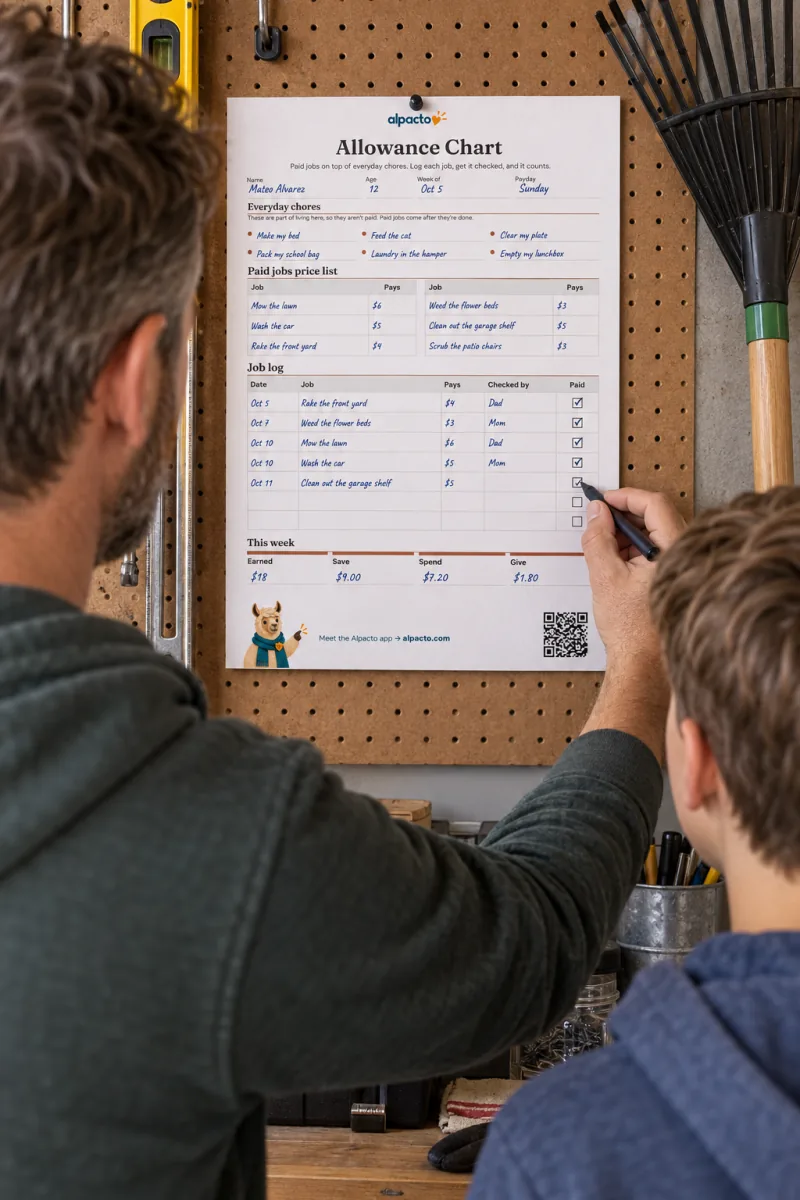
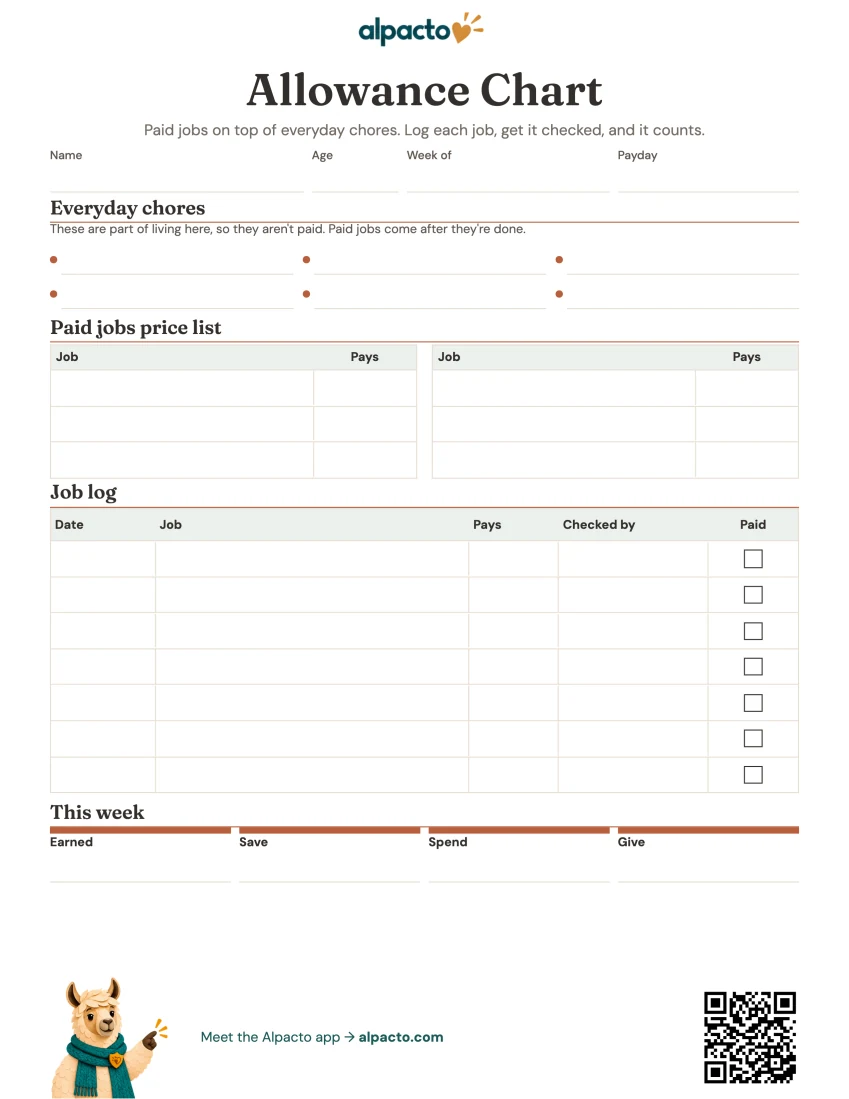
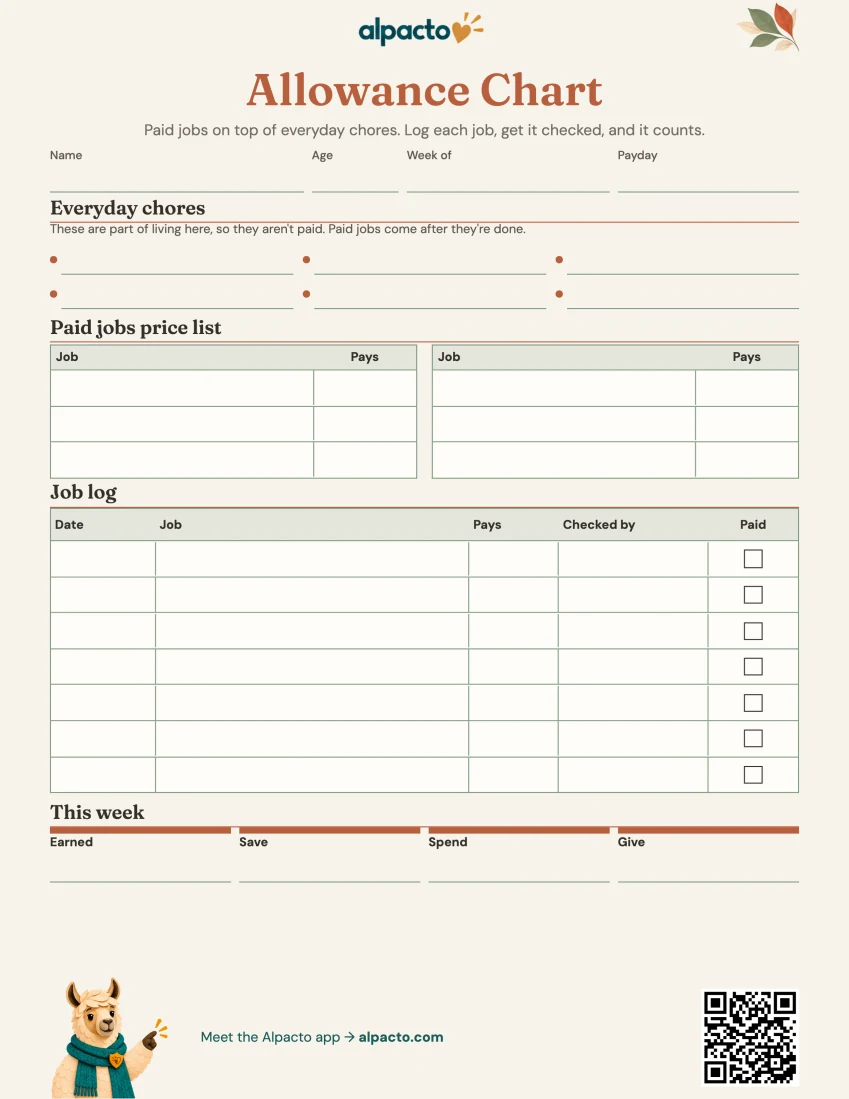
The paid-jobs chart settles it in one printed line: “These are part of living here, so they aren’t paid. Paid jobs come after they’re done.” Making the bed stays unpaid, washing the car has a price, and a job counts once a parent signs the Checked by column.
Save, spend, give: splitting every payday
The AAP suggests splitting every payday into three parts: save, spend and share. Save is set aside for a goal you agree on, spend is for personal use, and share is money to spend on others. Three labeled jars work for young kids; a notebook or a chart works once they can add.
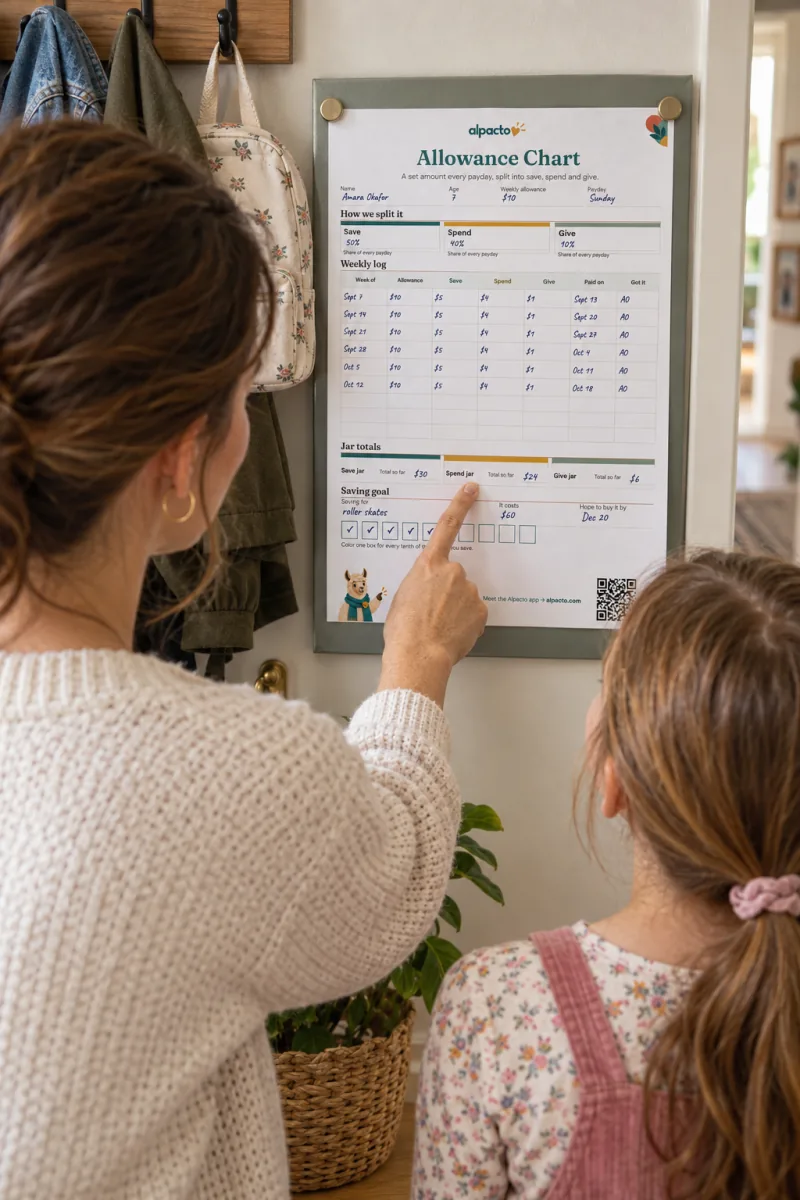
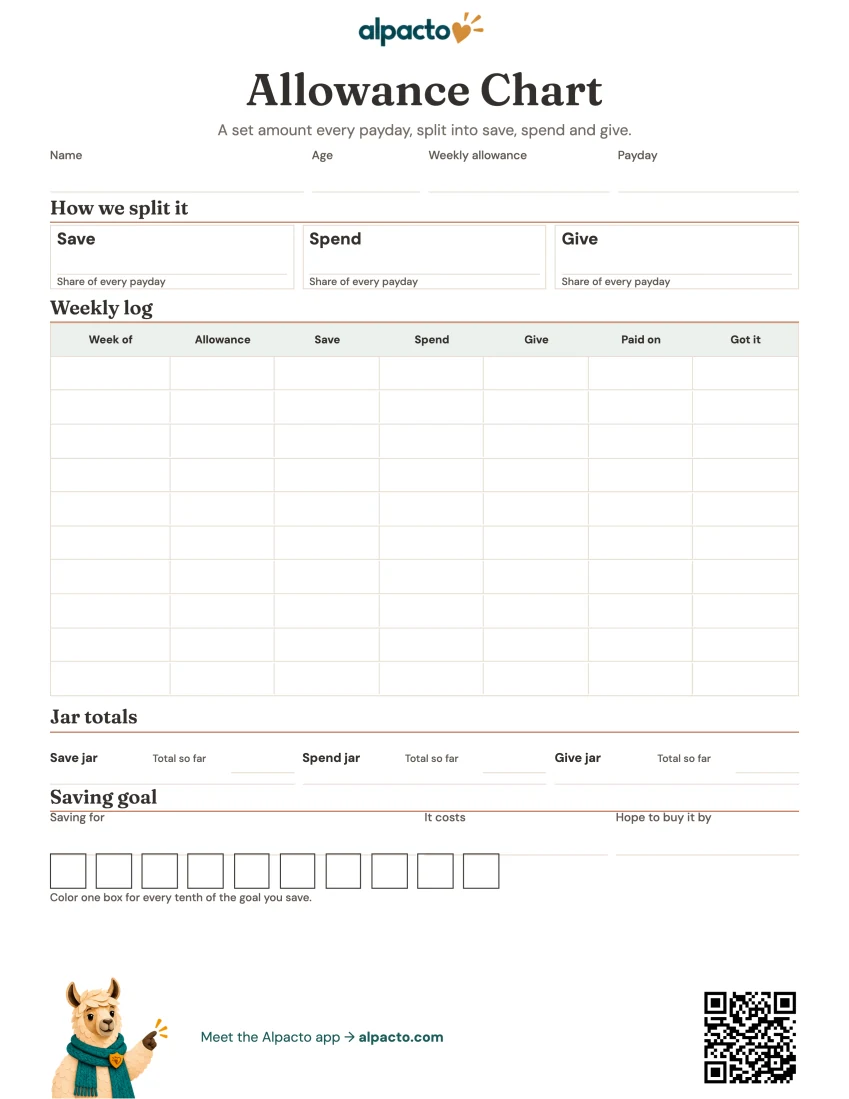
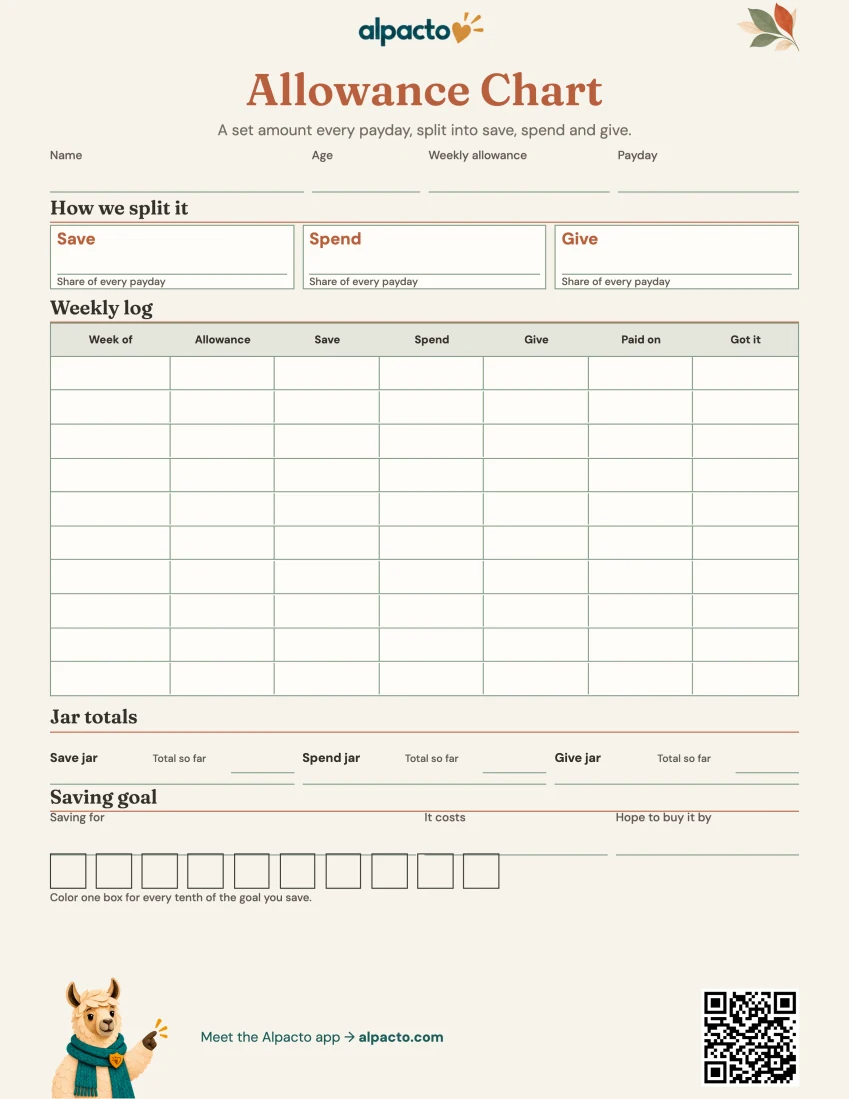
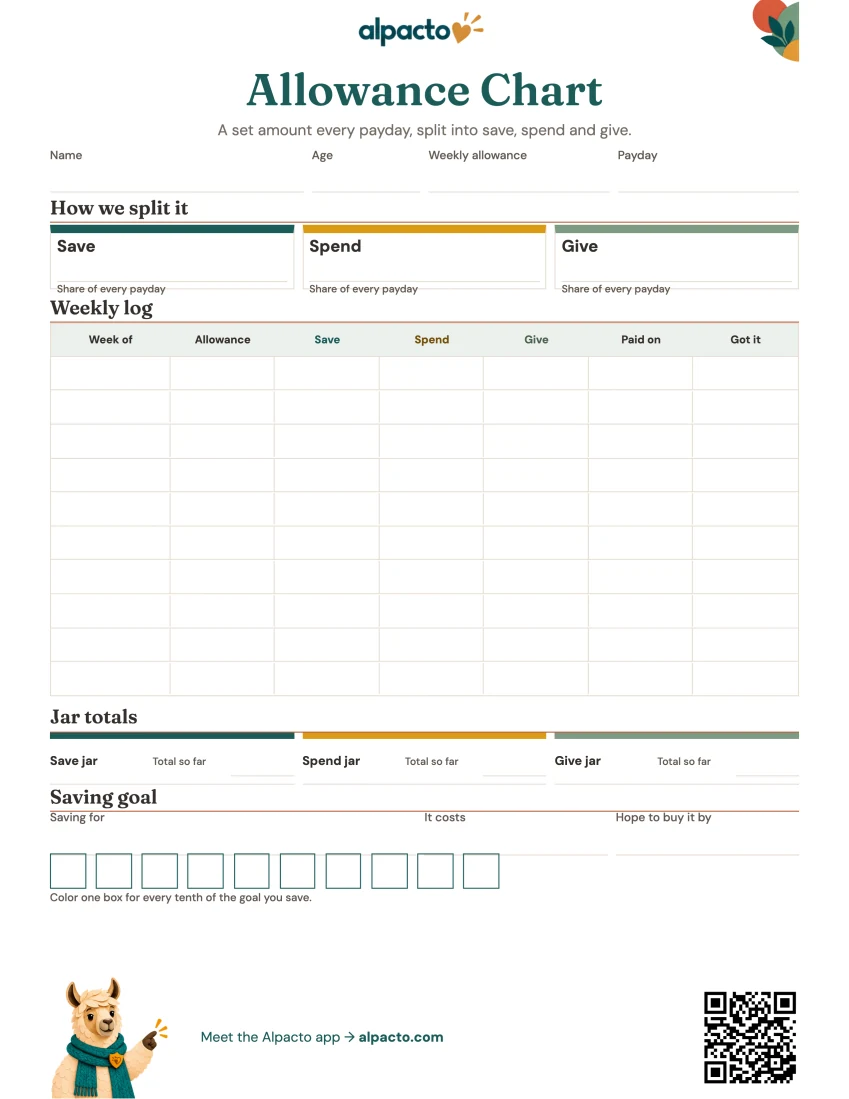
On the fixed chart the split is written once, under How we split it, as a share of every payday. The filled example printed with the chart shows a 9-year-old on $10 a week at 50, 40 and 10 percent: $5 saved, $4 to spend, $1 to give.
The Saving goal row gives the save jar a purpose: what it is for, what it costs, and ten boxes. The printed rule is “Color one box for every tenth of the goal you save.” For a bigger goal the AAP suggests extra projects around the house, or matching what the child earns toward it.
Print the allowance chart: two versions, three designs
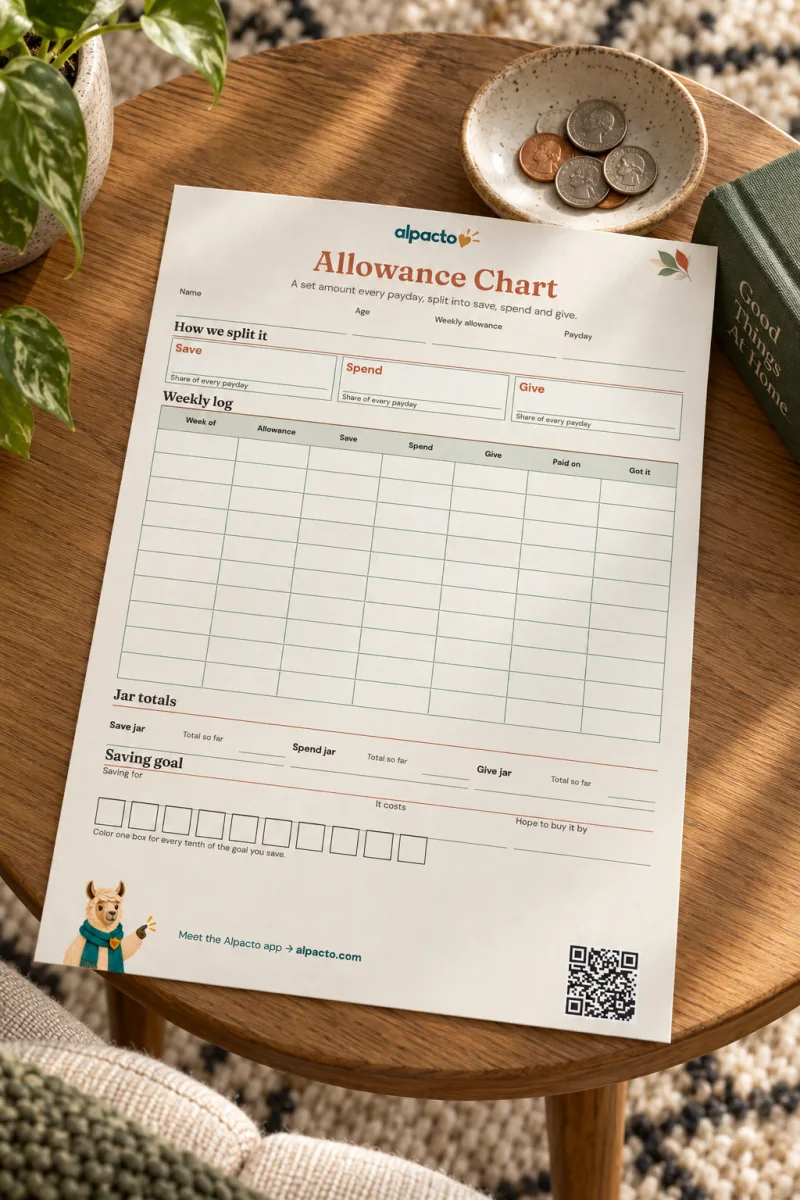
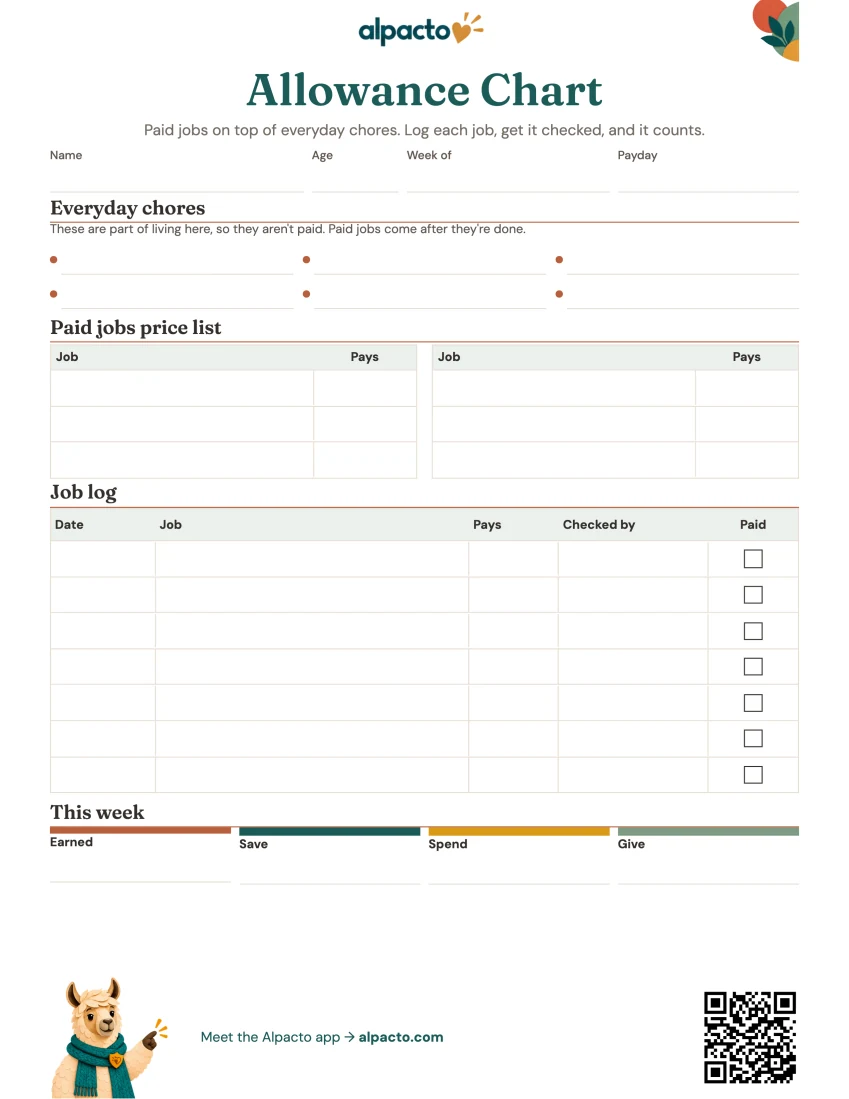
The free allowance chart is one page in two versions (fixed and paid jobs), each in three designs. The fixed chart holds ten weeks of pay, jar totals and a saving goal. The paid-jobs chart holds six everyday chores, a price list for six paid jobs, and a job log with seven rows.
For teens the paid-jobs version doubles as a teenage allowance chart: they fill in the prices with you and keep the log themselves. Both are a chore chart with allowance built in, and there are no fines or deductions anywhere on the sheet: a missed chore is an empty line. If the teen’s phone is part of the deal, the teen phone contract puts rules on both sides.
Fixed allowance: save, spend, give
Paid jobs on top of everyday chores
Questions parents ask
At what age should I give my child an allowance?
Around age 5 or 6, if the child is ready. Scholastic’s guide puts the start there, and Greenlight says many families begin at the same age; a child who cannot count coins yet can wait a year.
How much allowance should a 10 year old get?
A 10-year-old can get $5 to $10 a week by the 50-cents-to-a-dollar rule. Families using Greenlight paid $8.53 on average in 2025, so about $8 is a safe round number. At that age, hand over one expense too, such as the snack after practice.
Is $10 a week a good allowance?
Yes for a child of about 10 to 12: the 2025 Greenlight averages are $8.53 at 10 and $10.37 at 12. For a 6-year-old it is well above average, and for a 16-year-old well below.
Is $20 a week a good allowance?
It is close to the average for 16 and 17, which is $17.89 and $21.47 a week. In the T. Rowe Price survey of parents of 8 to 14-year-olds, 70% of those who give an allowance pay $20 or less.
What’s a good allowance for a 7 or 8 year old?
About $3.50 to $8 a week. Families using Greenlight paid $6.79 at 7 and $7.22 at 8, which sits near the top of the 50¢ to $1-a-year range.
What is a good amount of allowance for an 11 year old?
Around $5.50 to $11 a week. The 2025 average was $9.35, and 11 is a good age to hand over one expense, such as food out with friends.
What is a normal monthly allowance?
Around $57 a month, if you convert the $13.15 weekly Greenlight average. For a single age, multiply the weekly amount in the table by 52 and divide by 12.
What is the average teenage allowance?
Between $11.59 at 13 and $21.47 at 17 a week, by the 2025 Greenlight data; across ages 12 to 19 it averaged $18.11. A teen who takes over clothes or gas needs more than the average.
Should I pay allowance in cash or through an app?
Either works. In the 2025 Wells Fargo and Ipsos survey, 73% of parents who give a weekly allowance use cash and 24% use peer-to-peer payments. Cash makes the amount easy for a child to see, and a transfer is easier for you to track.
Is there an app for chores and allowance?
Alpacto keeps the agreement, not the money: a job becomes a pact with a deadline and a standard of done, the child marks it complete and you confirm it. Coins in the app are never money, so the pay still happens in cash or by transfer. Accounts start at 13, younger kids use a parent’s screen, and it runs on iPhone and Android.
For apps that pay a child in points or money, we compared seven reward chart apps for kids.
The job log, without a pen on the fridge
In Alpacto a paid job is a pact between you and your teen: what counts as done, by when, and who confirms it. The app keeps the record and the reminder; the allowance itself stays in your wallet.