
Alpacto › Kids › Chores by age
Chores by age: what kids can do from 3 to 13, and a chart for each age
Chores by age, per two professional bodies: toys and groceries away at two or three, the table and the pet from four or five, laundry and the bathroom by eleven or twelve. Below, the two lists side by side, and a free printable chart for ages 3–5, 6–9 and 10–13 with the jobs already on it.
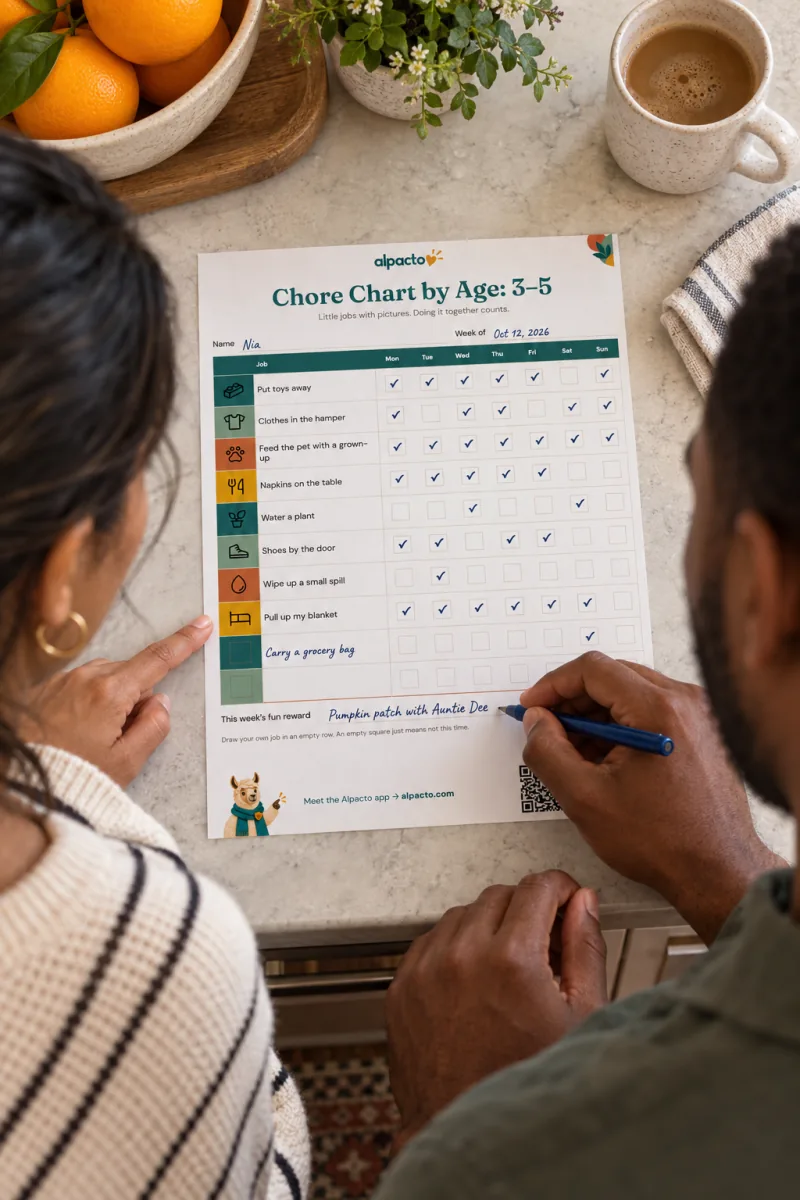
The 3–5 chart, filled in for one week in October.
In short
The American Academy of Pediatrics and the American Academy of Child and Adolescent Psychiatry both publish lists of age-appropriate chores, and on the same job they often disagree, sometimes by several years. Read an age as a range, not a deadline: if your seven-year-old cannot unload the dishwasher yet, the AAP list does not expect it until eleven.
Add one new job at a time, show it before you hand it over, and praise the effort, whatever the result. Pick the chart for your child’s age below: the jobs are printed, two or three rows are left for your own, and an empty square on it just means not this time.
The chore list for kids by age, as the AAP and AACAP give it
Kids can start chores at two to three, according to the AACAP, with toys and groceries put away. The AAP list begins at five, with beds and the table, and reaches laundry and the bathroom at eleven to twelve. The table shows every job on both lists, side by side.
Each row is one job: the age at which each organization first lists it, and where it sits on our charts.
| Job | AAP (HealthyChildren.org) | AACAP | On our chart |
|---|---|---|---|
| Put toys away | 5–7 | 2–3 | 3–5 |
| Put groceries away | 8–10 | 2–3 | 6–9, as help |
| Make the bed | 5–7 | 4–5, “maybe not perfectly” | 3–5 pull up the blanket; 6–9 the whole bed |
| Feed the pet | 5–7, fill the food dish | 4–5, help feed | 3–5 with a grown-up; 6–9 with fresh water |
| Set and clear the table | 5–7 | 4–5, help clear | 3–5 napkins; 6–9 set and clear |
| Water plants | 5–7, flowers | not listed | 3–5 |
| Empty wastebaskets | 5–7 | not listed | 6–9; 10–13 out to the curb |
| Rake leaves, weed | 5–7 | 10–11, yard work | 6–9 |
| Put own laundry away | 8–10 | 6–7 | 6–9 |
| Pack a school lunch | 5–7, make and pack | 7–9 | 10–13, made alone |
| Load or unload the dishwasher | 11–12, unload | 7–9 | 10–13 |
| Help make dinner | 8–10 | 7–9 | 10–13 |
| Vacuum | 8–10 | not listed | 10–13, one room |
| Walk the pet | 8–10 | not listed | 10–13, or scoop the litter box |
| Change the bed sheets | 11–12 | 10–11 | 10–13 |
| Clean the bathroom | 11–12 | 10–11 | 10–13, sink and mirror |
| Do the laundry | 11–12, wash and fold | not listed | 10–13, washer to drawer |
| Wash the car | 11–12 | 12 and up | not on the charts |
Chores by age as written in Age-Appropriate Chores for Children (AAP, updated February 2024) and Chores and Children (AACAP, updated June 2018). The AAP list starts at age five, so younger ages come from the AACAP only.
Where the two lists disagree, start with the younger age and watch. Packing a lunch appears at five to seven on one list and seven to nine on the other; unloading the dishwasher appears at seven on one and eleven on the other.
A few jobs on our charts appear on neither list: shoes by the door, sort the recycling, pack my backpack for tomorrow.
Ages 3 to 5: little jobs, done with you
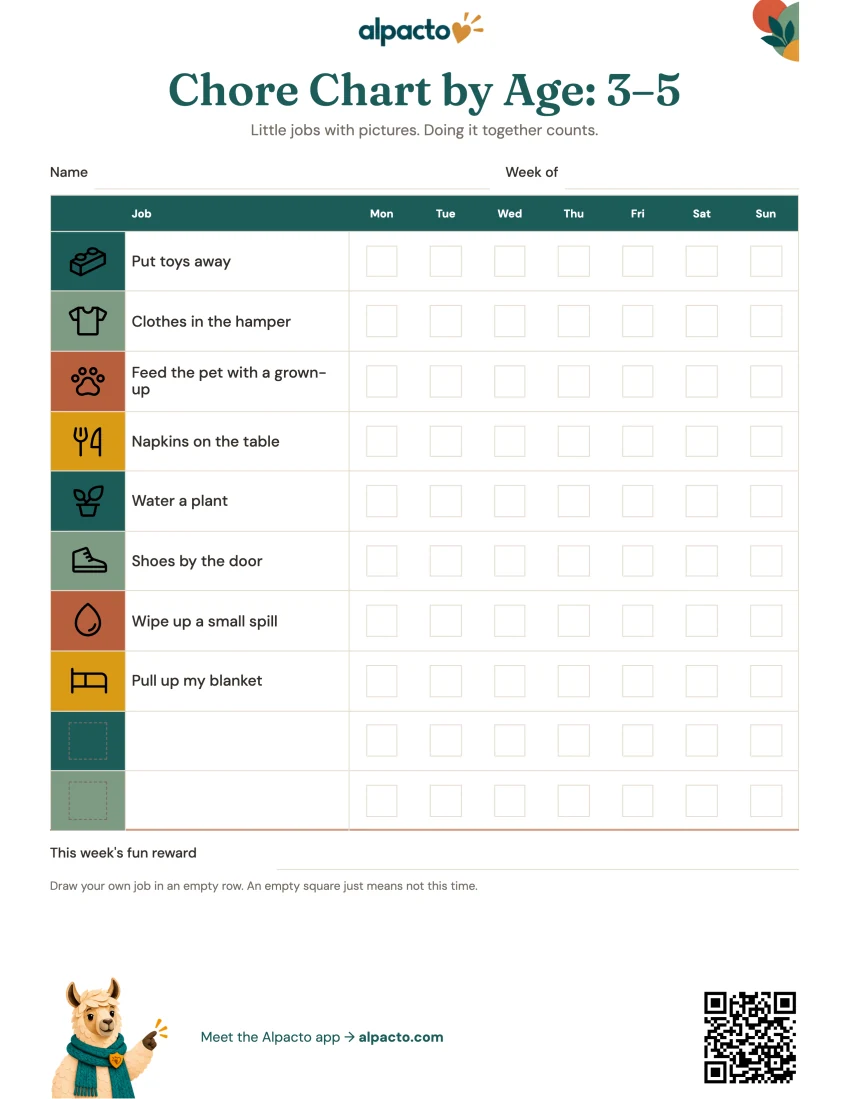
Children aged three to five can do small jobs next to you: put toys away, carry clothes to the hamper, feed the pet with a grown-up and set out napkins. The AACAP lists toys and groceries at ages two to three, and helping feed pets, making beds and clearing the table at four to five.
The AAP says only that most preschool age kids can start pitching in with simple tasks.
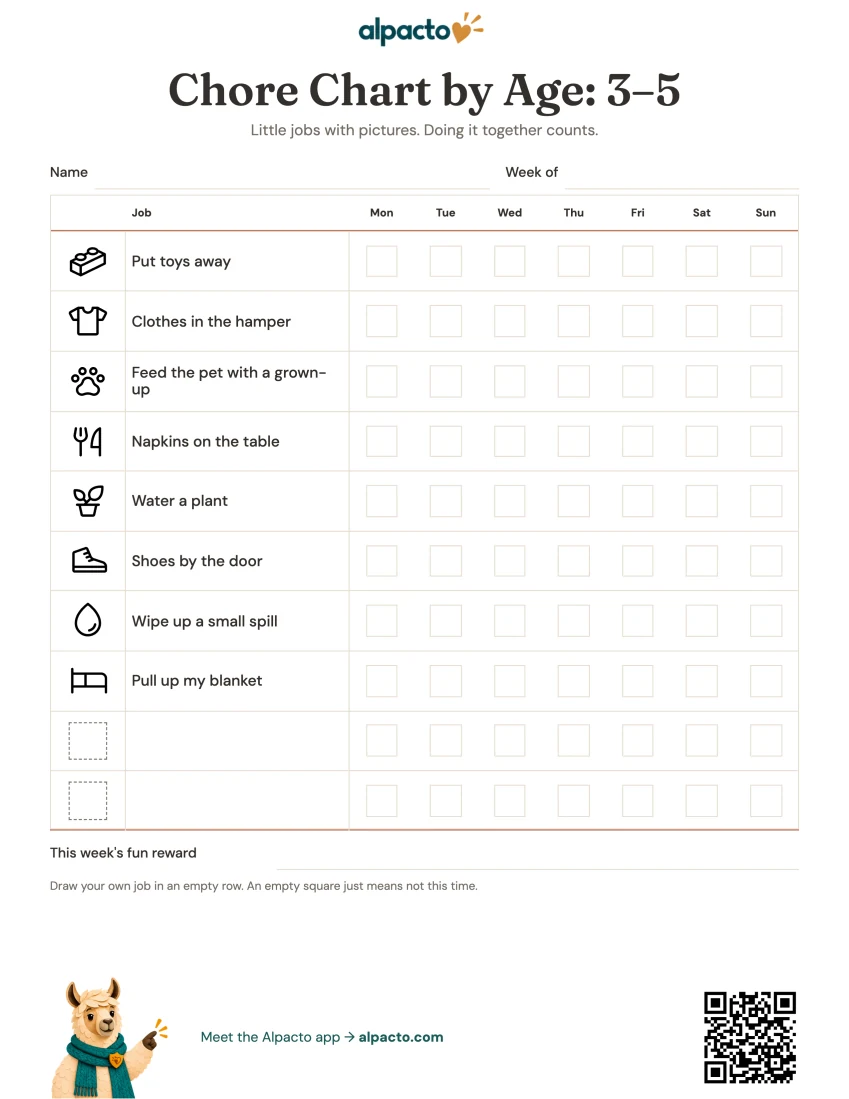
A chore chart for 5 year old children and younger has to work for a child who cannot read yet. So every printed job on this sheet has a large picture, and the subtitle says it plainly: “Little jobs with pictures. Doing it together counts.”
- Put toys away
- Clothes in the hamper
- Feed the pet with a grown-up
- Napkins on the table
- Water a plant
- Shoes by the door
- Wipe up a small spill
- Pull up my blanket
The last two rows are empty, with a dotted square where your child can draw a job of their own. At the bottom is a line for This week’s fun reward, and there is room for a sticker or a check in every day’s square.
Ages 6 to 9: real jobs, start to finish
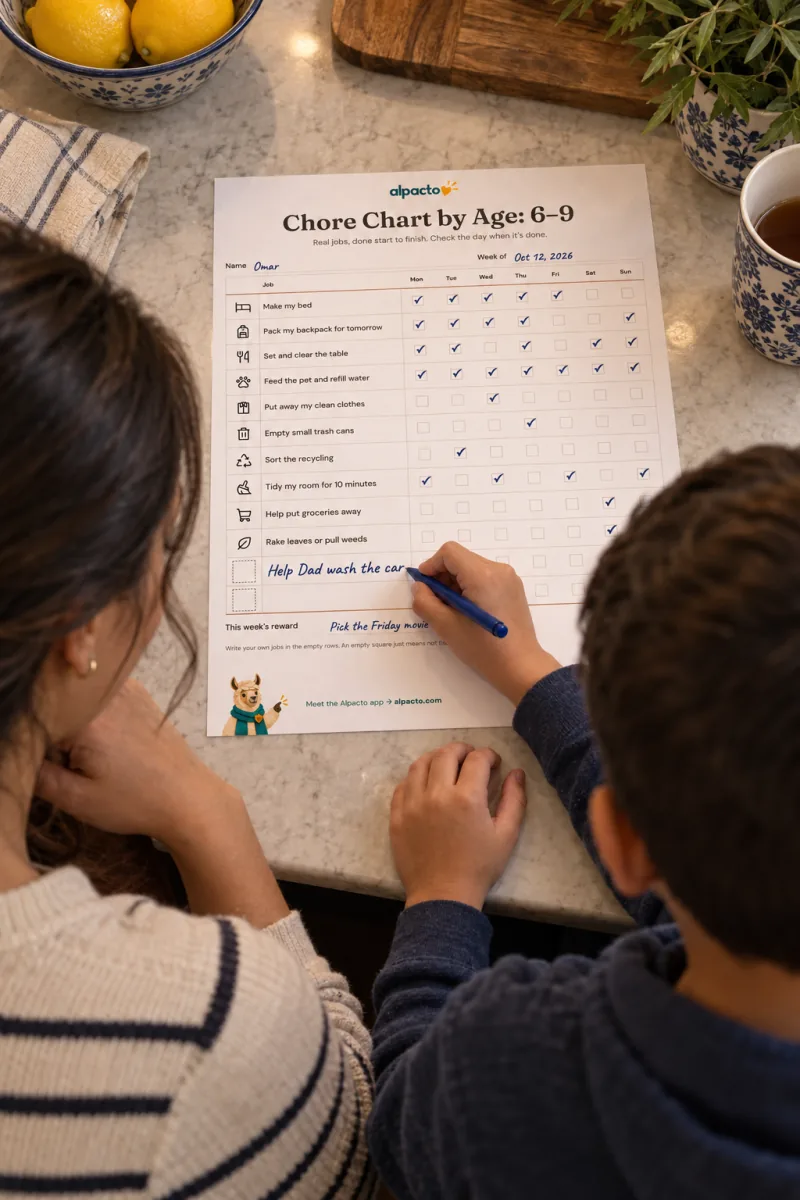
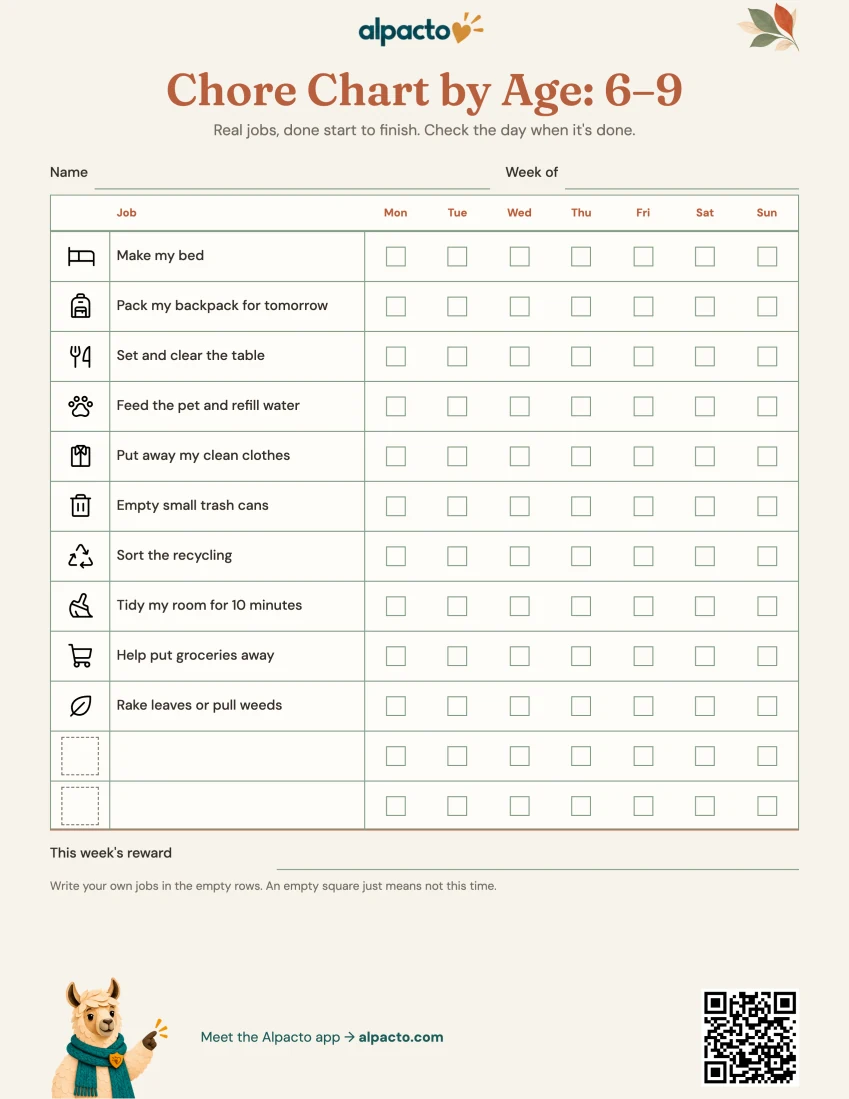
Children aged six to nine can do real jobs from start to finish: make the bed, set the table and feed the pet, and empty small wastebaskets. The AAP lists most of these at five to seven, and the AACAP adds laundry at six to seven and the dishwasher and packed lunches at seven to nine.
Five jobs on this sheet come straight from the AAP list for ages five to seven: the bed, the table, the pet dish, the wastebaskets, and leaves or weeds. The subtitle on this sheet sets the standard: “Real jobs, done start to finish. Check the day when it’s done.”
- Make my bed
- Pack my backpack for tomorrow
- Set and clear the table
- Feed the pet and refill water
- Put away my clean clothes
- Empty small trash cans
- Sort the recycling
- Tidy my room for 10 minutes
- Help put groceries away
- Rake leaves or pull weeds
“Tidy my room for 10 minutes” is a job with an end, which clean your room is not. Two empty rows sit below the ten printed jobs for your child to write in their own.
Ages 10 to 13: bigger jobs, and the child picks the day
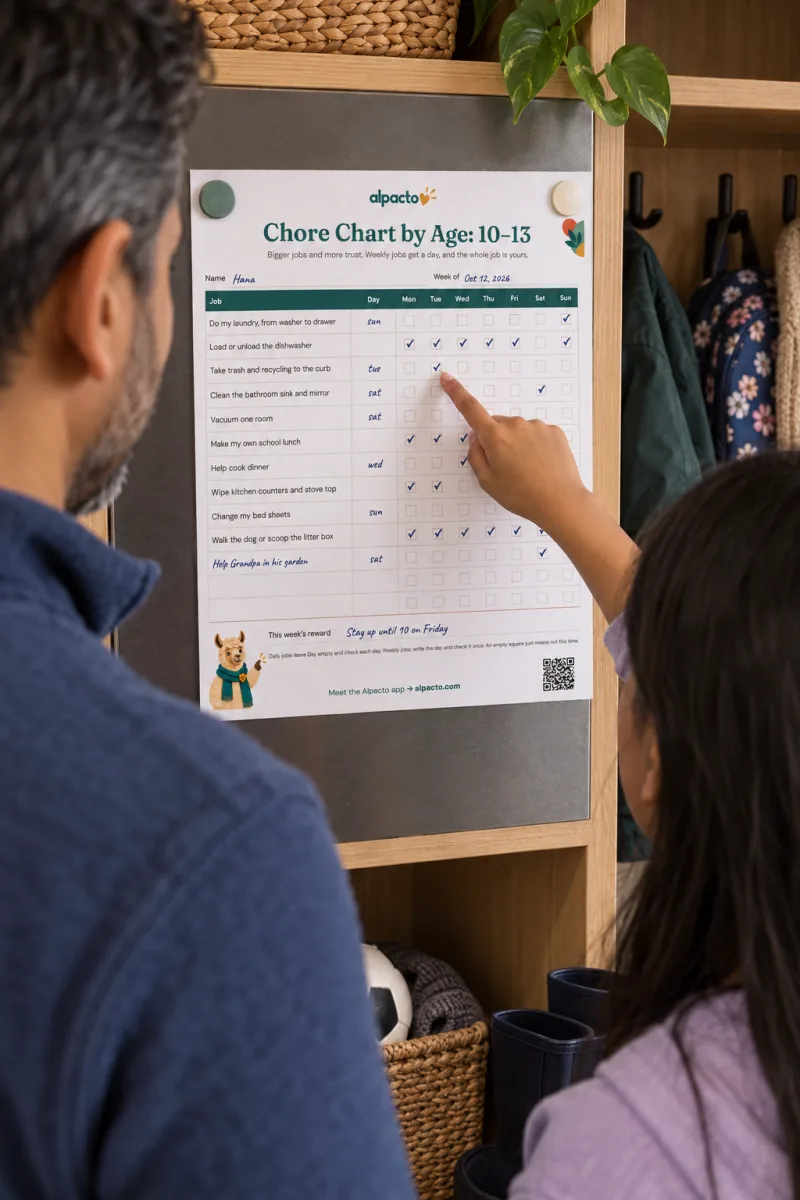
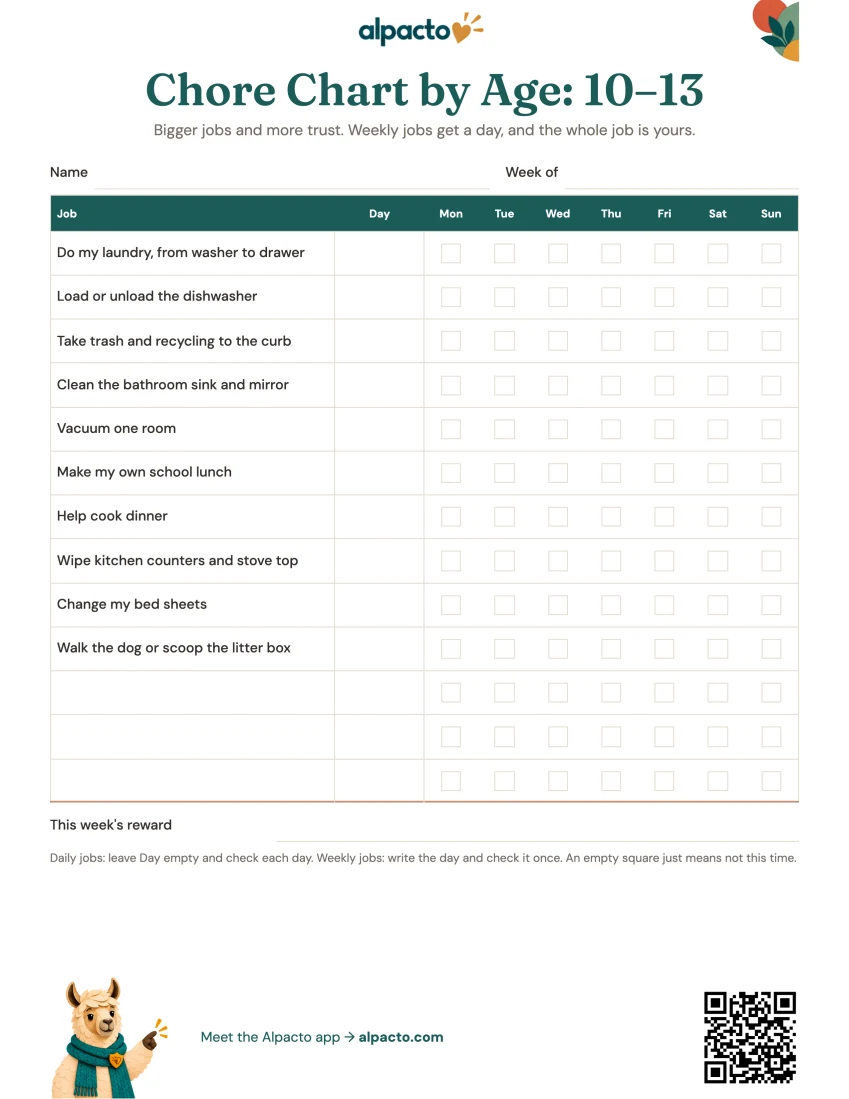
Children aged ten to thirteen can take over whole jobs: their own laundry, the dishwasher, the bathroom sink, one room to vacuum and their own school lunch. The AAP lists laundry, bed sheets and bathrooms at eleven to twelve, and the AACAP lists sheets and bathrooms at ten to eleven.
Both lists add the bathroom and the bed sheets here, and the AAP adds the laundry. Chores for 10 year olds at home and chores for 12 year olds at home look alike on paper; the difference is how much of each job is theirs.
- Do my laundry, from washer to drawer
- Load or unload the dishwasher
- Take trash and recycling to the curb
- Clean the bathroom sink and mirror
- Vacuum one room
- Make my own school lunch
- Help cook dinner
- Wipe kitchen counters and stove top
- Change my bed sheets
- Walk the dog or scoop the litter box
The subtitle says it: “Bigger jobs and more trust. Weekly jobs get a day, and the whole job is yours.”
The new column is Day, and the rule under the table reads: “Daily jobs: leave Day empty and check each day. Weekly jobs: write the day and check it once.”
Chores by age 14 and up
Teenagers can do chores for the whole house, such as cleaning the kitchen after meals, vacuuming, mowing the yard and clearing snow. The AAP says teens keep the chores they did as younger kids and add bigger ones, and the AACAP puts washing the car, grocery shopping and errands at age twelve and up.
For teenagers, the AAP adds jobs for the whole house. Its list is a ready set of chore ideas for 15 year olds:
- vacuuming shared spaces such as the living room and stairs
- washing and vacuuming the car
- mowing, spreading mulch and weeding
- clearing snow from walkways and the driveway
- cleaning the kitchen after meal prep
- feeding and grooming pets
- helping with younger siblings
- grocery shopping, once they have a driver’s license
“Just remember, if your teen can operate a smartphone, they can figure out how to use a washing machine, an oven and a dishwasher.”Shelly Flais, MD, FAAP, Household Chores for Teens, HealthyChildren.org
The same page makes the case against the busy-schedule excuse: “baseball practice doesn’t make anyone ‘too busy’ to take out the garbage without reminders from a parent.” The charts on this page stop at thirteen; for a teenager there is a separate chore chart for teens, or the 10–13 sheet with the bigger jobs in its three empty rows. Charts for adults, roommates and other households are in the chore chart list.
How many chores, and how to add a new one
Neither the AAP nor the AACAP gives a number of chores per age, and we will not invent one. What the AAP gives is a pace: with a school-age child, “introduce one new task at a time; a long list can be overwhelming” (HealthyChildren.org).
- Say exactly what done looks like. The AACAP example is “please take out the trash from the kitchen after breakfast”, a job with a place and a time.
- Do it together first. Show it, do it side by side, then let your child do it while you are nearby. The 3–5 sheet prints this rule: doing it together counts.
- Praise the effort. The AAP wording is “Praise your child’s effort in each task, not the outcome.” A bed made with a lump in it is a made bed at four.
- Add the next job only when this one is routine. A printed chart can still hold all its jobs; nobody has to start on every row in the first week.
Missed days happen. Every one of our charts prints the same line under the grid: “An empty square just means not this time.” There is no cross, no sad face and no penalty on the page, only the next square.
What the research on age-appropriate chores actually shows
Chores in kindergarten go with better self-ratings in third grade, but the research does not show that chores cause them. The strongest study followed 9,971 US children: those whose parents reported more frequent chores rated their own social and academic competence and life satisfaction higher (White, DeBoer and Scharf, 2019).
The children came from the national Early Childhood Longitudinal Study, and the link was adjusted for sex, family income and parent education. It is an association, not proof.
The study most chore lists quote is a 2002 University of Minnesota summary of Marty Rossmann’s work on 84 young adults. Chores at ages three to four were the best predictor of how they were doing in their mid-twenties. We could not find it published as a peer-reviewed paper, so treat it as a hint.
Download the chore chart by age
Three sheets, one per age, each in three designs. The chore chart by age printable comes blank or as a fillable PDF you can type into; free, with no email.
Every file above also exists in A4, and every design has a fillable version. Print at 100%, portrait.
Questions people ask
At what age should kids start doing chores?
Around two to three, with small jobs done next to you. The AACAP list of chores by age starts there, with toys and groceries put away, and says research suggests benefits from chores “as early as age 3”.
What chores can a 5 year old do?
Put toys away, make the bed, set the table, feed the pet and water flowers, with you nearby. The AAP lists these for ages five to seven, and the AACAP lists helping feed pets, making beds and clearing the table at four to five.
What are reasonable chores for a 7 year old?
Make the bed, set and clear the table, feed a pet, empty small trash cans, put clean clothes away, sweep. The AAP lists most of them for ages five to seven, the AACAP puts laundry and sweeping at six to seven, and all but sweeping are printed on our 6–9 chart.
What are some typical chores for a 12-year-old?
Their own laundry, the dishwasher, changing the bed sheets, cleaning the bathroom and cooking a simple meal with supervision. The AAP lists these for ages 11 to 12, and the AACAP puts sheets and bathrooms at 10 to 11.
How many chores should a 10 year old have?
There is no official number. The AAP advises adding one new task at a time and warns that a long list can overwhelm a child. Our 10–13 chart prints ten jobs, but the Day column turns some of them into once-a-week jobs, so the daily load is smaller than the list.
How many chores should a 14-year-old have?
Neither the AAP nor the AACAP gives a count for teenagers either. The AAP teen page expects them to keep doing their earlier chores and add bigger ones, such as shared spaces, the yard and cooking cleanup. Phone rules go on a separate sheet, a two-way cell phone contract for teens.
What are good daily chores for toddlers?
Putting toys and groceries away and getting dressed with help: that is the AACAP list for ages two to three. Clothes in the hamper and shoes by the door, from our chart for the next age up, are the same size of job: a minute long and done every day. Toilet training is a different job with its own potty training chart.
Do chores actually help kids?
Children who do chores may show higher self-esteem and better coping with frustration, according to the AACAP. A study of 9,971 US children found a link between kindergarten chores and third-grade self-ratings, but it shows an association, not cause.
Should kids get paid for chores?
The sources disagree. The AAP says you may consider “tangible rewards like allowances and stickers tied to completed chores”; the Rossmann summary says children “should not be made to do the tasks for an allowance.” Our charts have a line for a weekly reward and no dollar sign, so the choice stays yours.
When the chart comes off the fridge
In Alpacto a daily job becomes a routine with a check-in each day and a streak, and a weekly job becomes a task with a due date that the other person confirms. Coins stay inside the app and are never money. Accounts start at 13; younger children use the printed chart.