
Alpacto › Free printables › Kids › Potty training chart
A potty training chart printable where the sticker is for trying
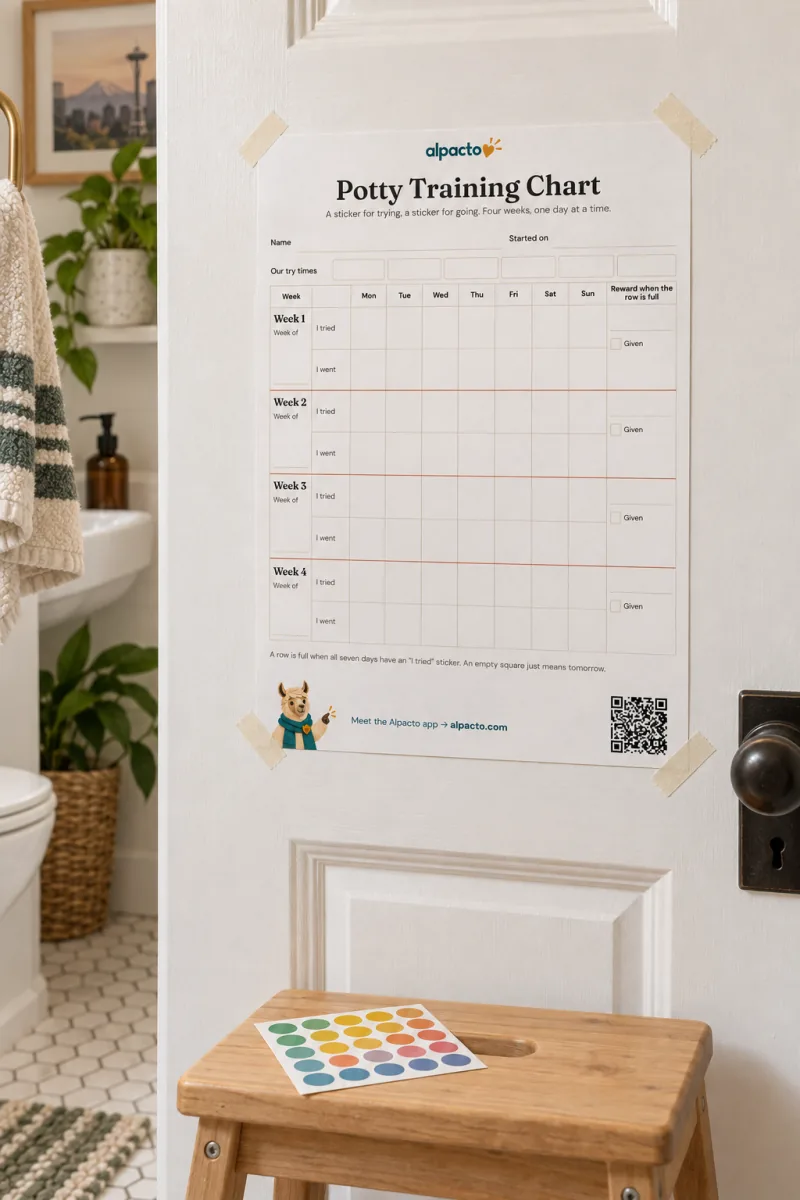
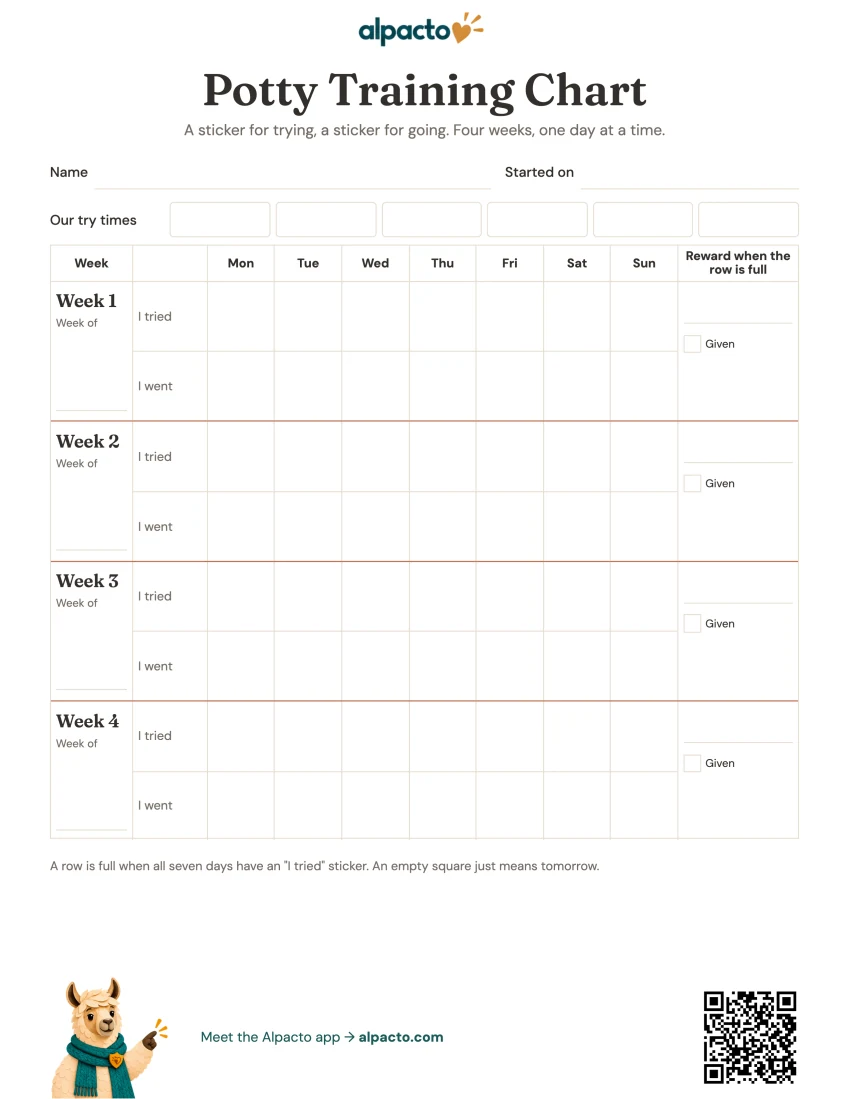
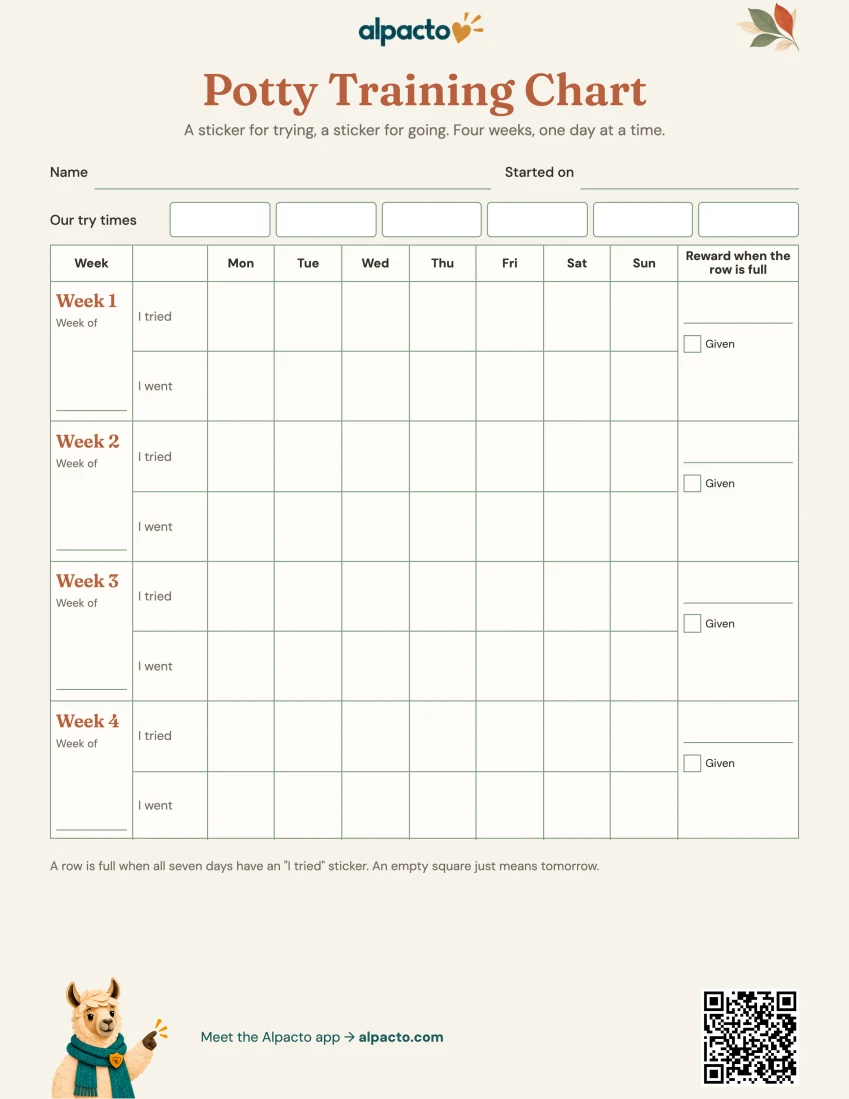
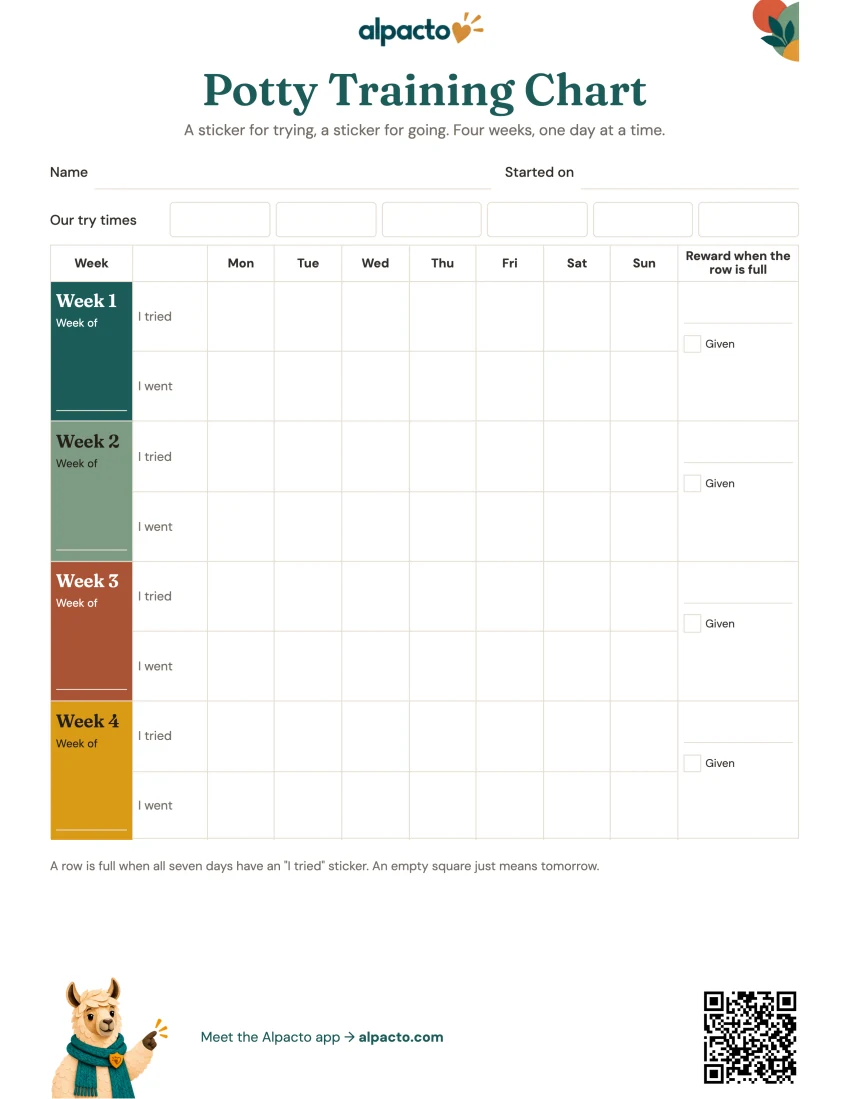
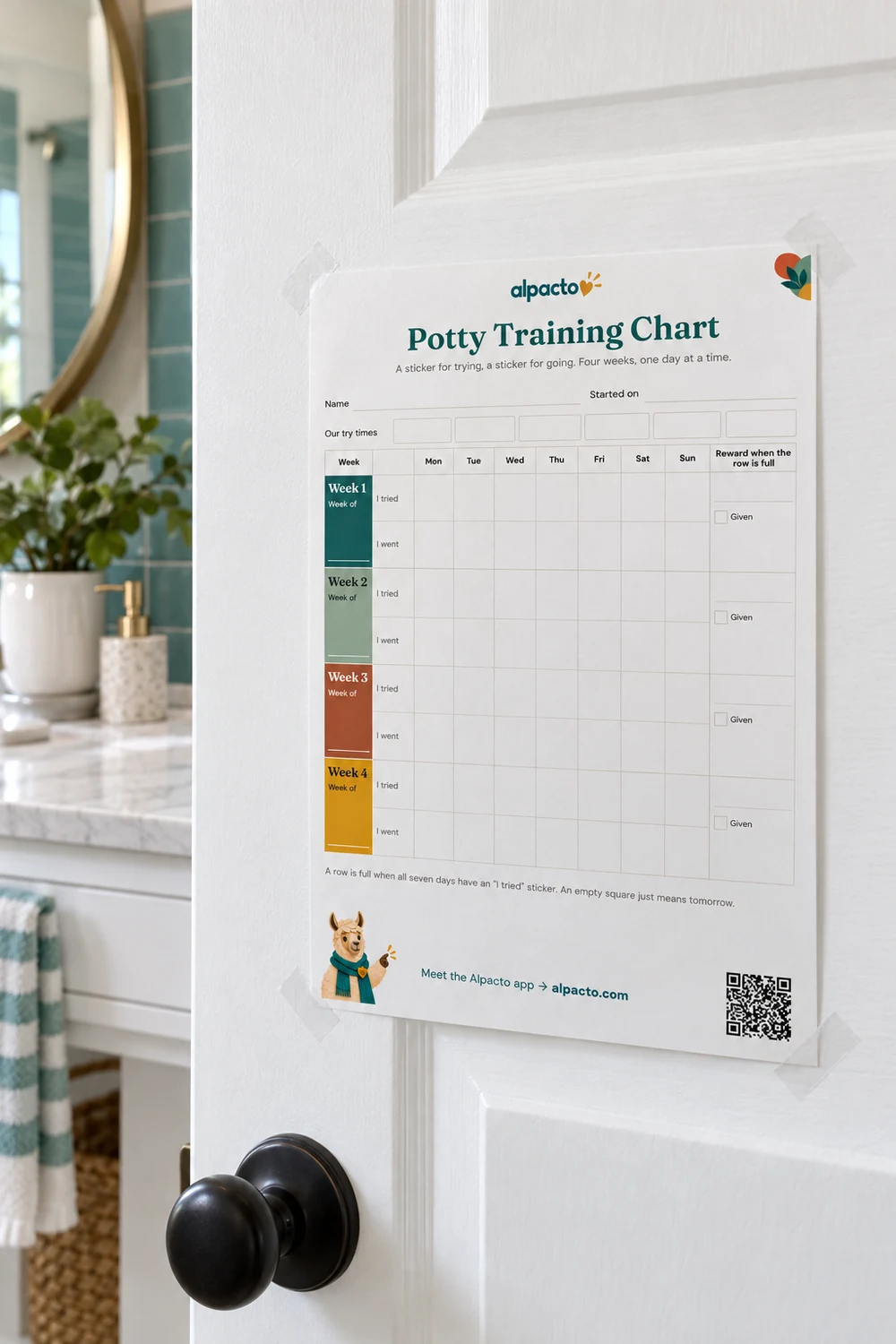
Four weeks, seven days each, two squares a day: one for I tried and one for I went. The week’s reward is written in before the week starts, and the row counts as full when all seven days have a trying sticker. A square left empty costs nothing, and the sheet prints that rule.
- Pages
- One, both on US Letter and on A4
- Weeks
- Four, with an I tried row and an I went row for each
- Squares
- 0.675 by 0.7 inches, sized for a round sticker up to 0.6 inches
- Versions
- Blank, a handwritten example, and a fillable PDF
- Designs
- Minimal, warm and color
What is on the potty training chart printable
Two squares a day
Every day has a square in the I tried row and a square in the I went row. Both take a sticker, and they are counted separately, because only one of them is inside a child’s control.
The reward column
One ruled line at the end of each week for what it earns, and a checkbox marked Given. Fill the line in before the week starts; tick the box when the reward has been handed over.
Our try times
Six empty boxes at the top of the sheet for the times you plan to try. The schedule lives on the fridge with the chart rather than in an adult’s head.
One printed rule
Under the table, in one line: a row is full when all seven days have an I tried sticker, and an empty square just means tomorrow. That is the only rule printed on the sheet.
The sticker is for sitting down, not for the result
A toddler can decide to sit on the potty. Whether anything happens next is not a decision, and a chart that only rewards the result quietly asks a two-year-old to control something they cannot. On this sheet the week is earned by seven I tried stickers.
That is the one real difference from the charts above us in the search results. Pampers, whose page ranks on this query, describes its chart in its own words: “Every successful attempt—like asking to go or staying dry—earns a sticker or gold star, making little steps feel like big wins.” We looked at two of the nine pages ranking here closely enough to quote them, so this is a comparison with one named chart rather than with all of them.
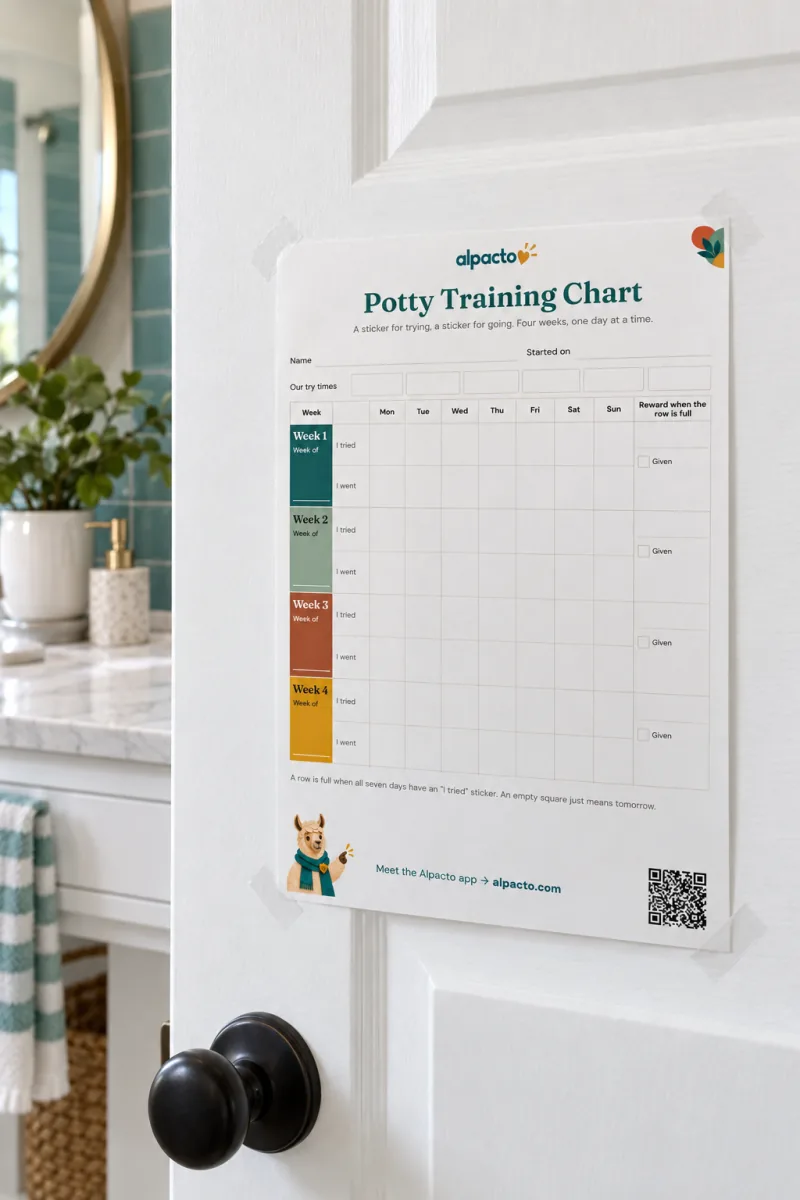
Four weeks on the wall, one sticker square per try.
Written before the week, ticked when it is handed over
Paper charts usually die for a dull reason: the adult stops counting and the reward never arrives. There is nothing to count here: a full row is visible at a glance, and its reward is already written on the same line.
The Given checkbox exists for the last step, the one everybody forgets. A reward that was promised on Monday and never handed over on Sunday teaches the opposite of what the chart is for, and one tick is enough to keep that honest.
The row of boxes at the top does the same job for the schedule: whatever times you decide on get written down once and stay visible.
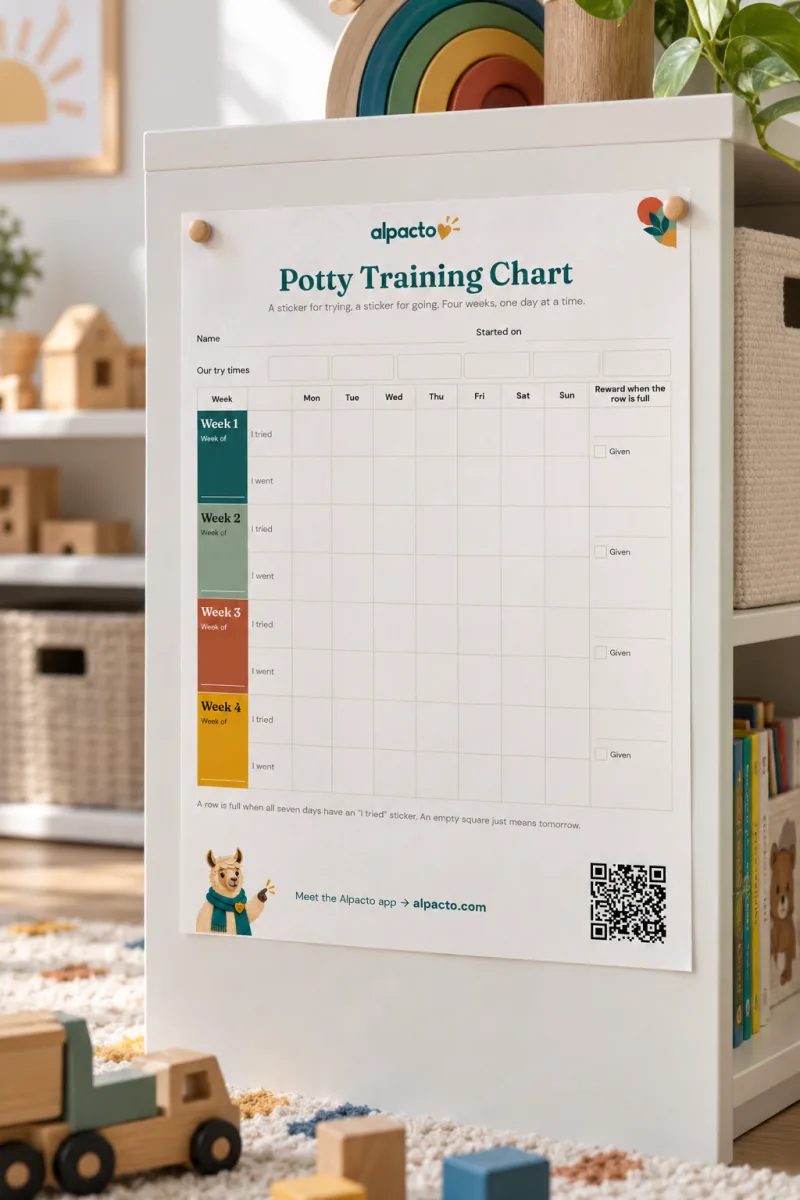
In the room where it happens, at the height of the person using it.
Download the free printable potty training chart
Three designs, the same four-week table in each. Every file is free, with no email, no account and no watermark.
Whether to start at all is not our question to answer
We make a sheet, not a method, and we are not going to tell you when a child is ready. The American Academy of Pediatrics publishes that on HealthyChildren.org, and its page is worth reading before any chart goes on the fridge. Its own numbers are quoted in the questions below, in its words rather than ours.
Among the signs it lists that a child may be developmentally ready: dry for at least two hours at a time or after naps; showing when they are about to go; following simple instructions. Also walking to the bathroom and helping undress; disliking a wet diaper; asking for the toilet, or for big-kid underwear. It ends that list with one line we will repeat rather than paraphrase: “If you have any questions or concerns, talk with your child’s doctor.”
Two more lines from the same source belong here, because a chart on a wall can push you the other way. Major changes at home are a reason to put training on hold, and negative words about the child are to be avoided entirely. Nothing on our sheet is red, nothing is crossed out, and the word accident does not appear on it.
What to change when the potty chart stops working
Most paper charts go quiet in the second or third week. The novelty wears off, the stickers stop being interesting, and the sheet becomes wallpaper. Before you decide the child is not ready, check the chart itself.
Start with the reward line. If the week’s reward is the same thing every Sunday, swap it for something else you can hand over that day: a walk to the playground, a new bath toy from the dollar aisle, ten minutes of a favorite game. The line is blank each week precisely so it can change.
Next, look at the I tried row. A row with five stickers out of seven is a good week, but the sheet counts it as not full.
If your child is stuck at five, write the next week’s reward on the line with a note beside it, and tell them the new rule out loud: this week, five stickers are enough. You are the one printing the rule, so you can reprint it.
If a week passes with almost no stickers at all, stop the chart for a few days and take the sheet off the wall. Nothing on it expires. Print a fresh copy, start again on a Monday, and use the Our try times boxes to cut the plan down to the two or three times that already work in your house, such as right after waking and before the bath.
Stickers can also be too much. A child who loves peeling and sticking may ask for squares to fill when there is nothing to record. Put the roll away and let them add the sticker only when they sit down.
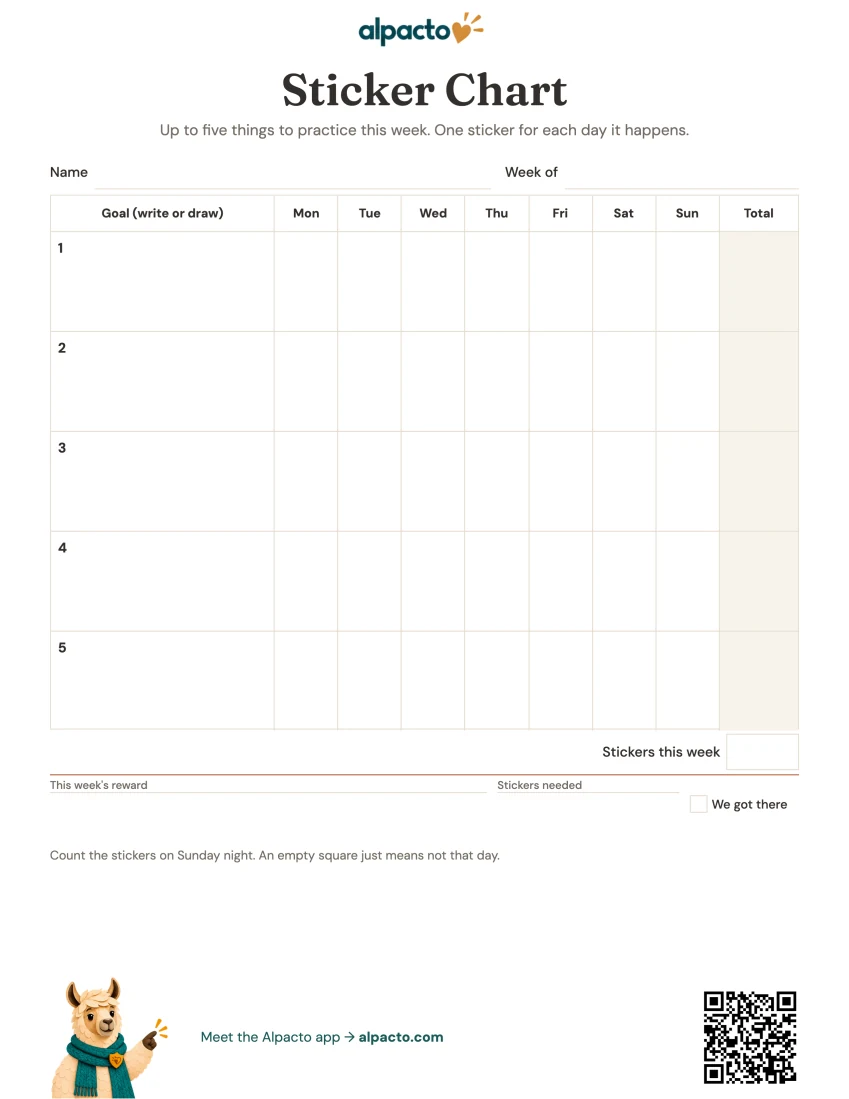
For more ways to run a sticker routine in general, see the sticker chart, and for how rewards behave over months rather than weeks, token economy at home.
Questions people ask
Do potty charts really work?
A potty chart does one thing well: it makes a week visible to a small child and to the adult at the same time. What it cannot do is decide anything for a body, which is why this one rewards sitting down rather than the result. If the chart stops being fun, that is information about the chart, not about the child, and taking it off the fridge for a while costs nothing.
At what age should a normal child be potty trained?
That is a question for a pediatrician rather than for us. The American Academy of Pediatrics answers it plainly on HealthyChildren.org: signs of bladder and bowel control usually appear between 18 and 24 months, and most children in the United States are trained by four. The same page says training can begin whenever parent and child want to start, that questions belong with your child’s doctor, and our sheet has no ages printed on it at all.
What is the 10, 10, 10 rule for potty training?
We are not going to describe a rule we cannot source: the American Academy of Pediatrics page we quote for everything else here does not mention it once. Whatever schedule you do choose goes in the six Our try times boxes at the top, and the table underneath records days rather than minutes.
Is it better to try every 15 or 30 minutes?
That is a question about a method, and the sheet works with either. Write the times you decide on into the six boxes once, and the plan stops being re-argued every afternoon.
Other free printable sheets
Save this chart to Pinterest
Pin it now and the chart is one tap away on the day you decide to start. Four weeks, a row of squares for each one, and a reward at the end of every row — US Letter and A4.
When the stickers run out
Paper works while the sheet is on the fridge. In Alpacto the same week becomes a routine both adults see: one marks the day, the other confirms, and the coins add up to the agreed reward. The app counts, so nobody has to remember what was promised.