
Alpacto › Kids & Rewards › Token economy at home
Token economy at home: set it up so your child trusts the bank
A token economy is a deal: a child earns small tokens for a named behavior and trades them for rewards at prices agreed in advance. At home it works when three things are settled before the first token: what earns one, when tokens can be spent, and what each reward costs.
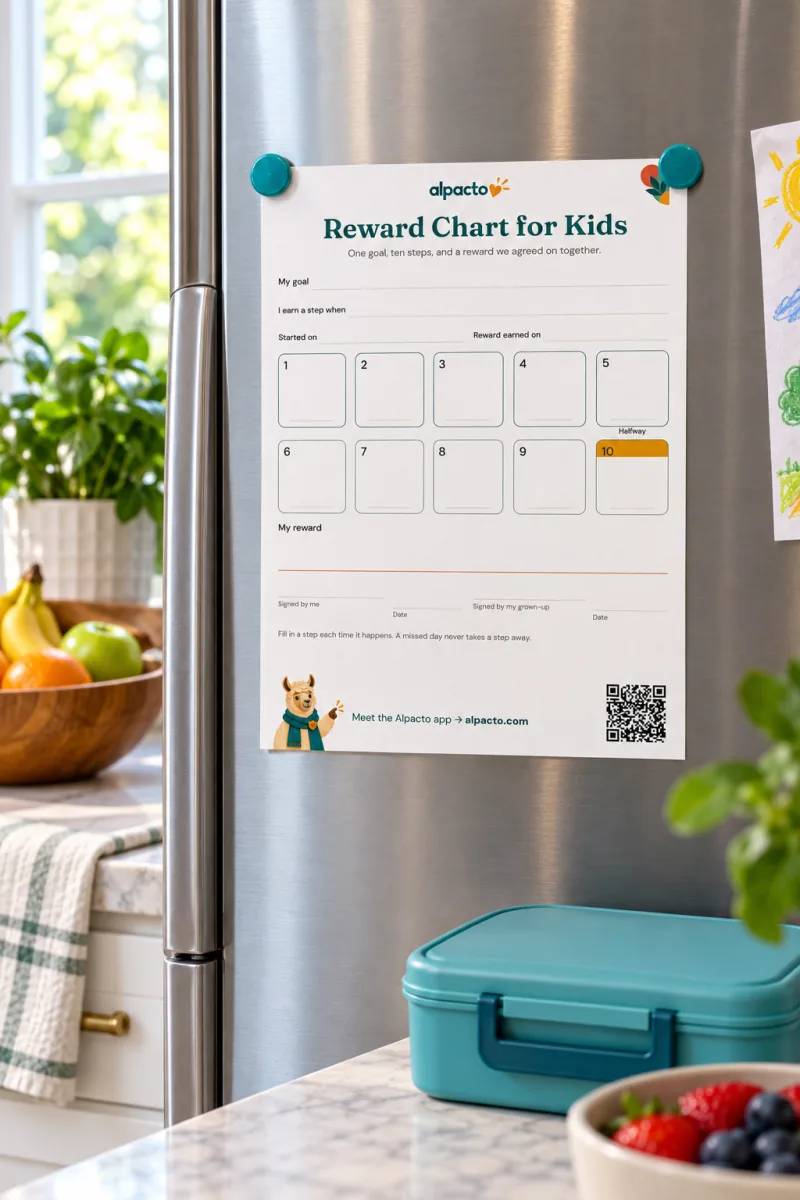
Ten numbered steps, one goal, and a line for the reward, signed before step one.
In short
Tokens turn a goal a child cannot see into something they can count. Pick one or two behaviors and describe them the way a camera would see them. Write a menu of rewards with prices, and make the cheapest one reachable on day one.
Give the token the moment the behavior happens, together with one sentence of specific praise. Never take an earned token back, and plan from the start how the tokens will fade out. The two printables at the end have these rules printed on the sheet.
What a token economy is, in three decisions
Behavior researchers describe every token system as three linked schedules: how behavior produces tokens, when an exchange opens, and how many tokens buy the reward. Parents who run a token economy system at home usually decide only the first one. The other two are where kitchen charts quietly fail.
| Name in the research | What to decide at home | A worked answer |
|---|---|---|
| Token-production schedule | Which behavior earns a token | Dressed before sitting down to eat on a school morning: one step on the chart |
| Exchange-production schedule | The hour the shop opens | Every evening after dinner; Saturday morning for the bigger items |
| Token-exchange schedule | The price of each reward | Two tokens to pick the bedtime story, twenty-five to choose the family movie |
Write the three answers down before the first token changes hands. A child who knows the shop opens after dinner stops asking at four o’clock, and a price on paper is hard to renegotiate at bedtime.
The method is old and well tested. The same review calls token systems “among the most successful behaviorally-based applications in the history of psychology.” Most of that record comes from classrooms and clinics, so the home version below keeps only the parts a family can run without a therapist.
Token system examples you can copy, by age
Each row is an example of a token economy small enough to start tonight. The choice of token follows Raising Children Network: “Star stickers work well for younger children, whereas older children might like points or other markers.”
| Age | What earns a token | The token | Shop and prices |
|---|---|---|---|
| 4 | Shoes on and by the door when the timer rings | A button dropped in a clear jar | After dinner: 2 buttons for the bedtime story, 10 for the playground |
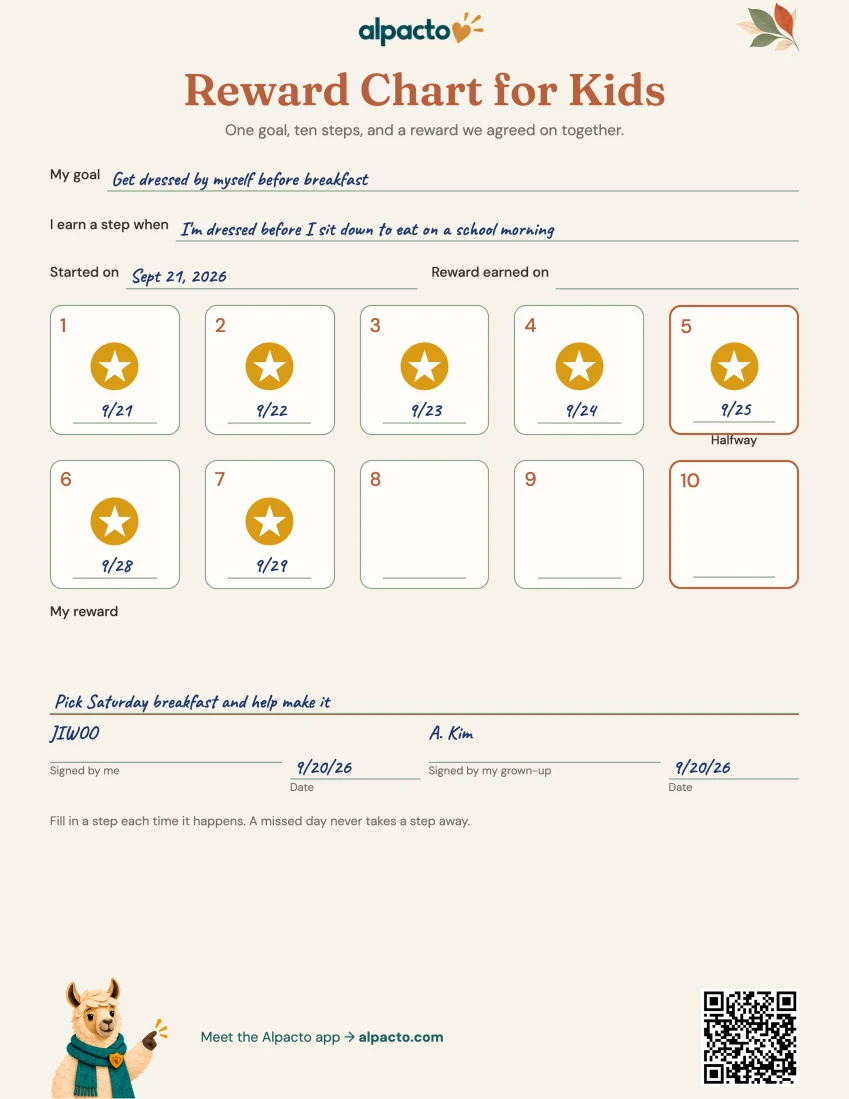
| 7 | Dressed before sitting down to eat on a school morning | A dated step on a ten-step chart | One reward, written in at step zero: pick Saturday breakfast and help make it |
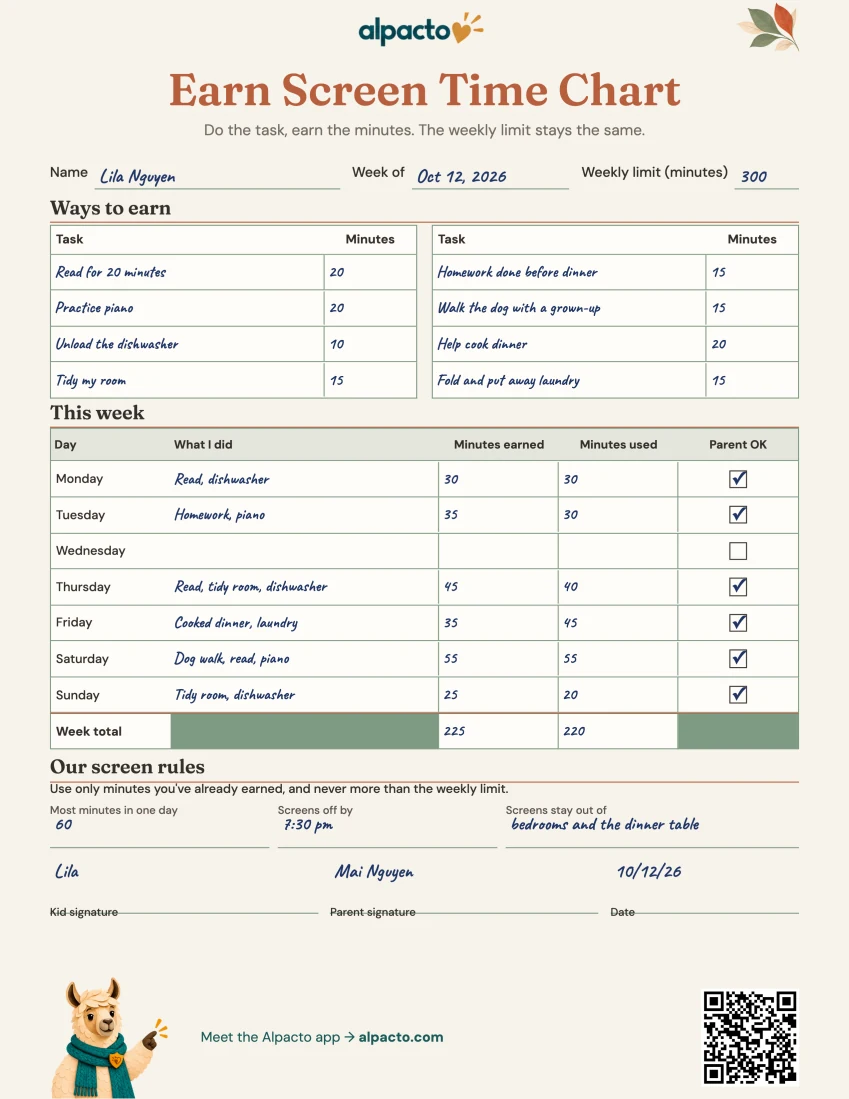
| 10 | Reading, piano practice, unloading the dishwasher | Minutes of screen time, logged on a weekly sheet | Minutes spent one for one, never past a weekly limit of 300 |
| 13 and up | Homework done before dinner, practice without a reminder | Points in a notebook, or coins in an app | Weekend privileges priced in points that the teen helped set |
What to use as token economy tokens
Anything a child can see and count, and cannot easily add to alone:
- Stickers or stamps on a chart, for children of three to six.
- Buttons, marbles or pom-poms in a clear jar, so the level shows from across the room.
- Numbered steps with a date in each box, where every box is one token.
- Tally points or minutes on a sheet, for children who can add them up.
- Coins in Alpacto, for a teenager of 13 or over. They are records between two people, never money.
Why this system never takes tokens back
Some clinical programs also remove tokens after misbehavior, a procedure the literature calls response cost. Hackenberg’s review studies it as “conditioned punishment via token loss”. We leave it out of a home system: two sources you can check advise against it, and one reason is our own.
- Raising Children Network advises parents to “avoid punishing your child by saying, ‘I’ll take a star away’”.
- The AAP says physical punishment does not correct behavior well, and adds: “The same holds true for yelling at or shaming a child.” Taking a token back in front of a sibling comes close to that.
- A bank that can seize deposits is a bank nobody saves in.
“A jar of earned tokens provides a physical reminder that nothing can take away the good we’ve already done.”A parent writing about their son’s token jar, ADHD Homestead
Our reward chart prints the rule under the track: “Fill in a step each time it happens. A missed day never takes a step away.” A hard day earns nothing, and tomorrow starts from the same number.
Token economy for ADHD: what the sources actually say
Many families first hear the term after an ADHD diagnosis, when an adhd token system is suggested by a school or a clinic. The AAP’s 2019 clinical guideline lists “point systems” among school supports that help a student meet age-appropriate expectations, next to daily report cards.
For younger children, CDC sums up the AAP position. “For children with ADHD younger than 6 years of age, the American Academy of Pediatrics (AAP) recommends parent training in behavior management as the first line of treatment, before medication is tried.” CDC describes that training as teaching parents skills built on positive reinforcement, structure and consistent discipline.
What a chart on the fridge is not
A token jar is a parenting tool, not a treatment, and we make no promise about ADHD symptoms. If your child has a diagnosis, bring the chart to the clinician or the parent training program, and set the targets and prices with them.
How to fade a token economy out
Kazdin and Bootzin’s 1972 review found token economies “successful while in operation” and flagged the open question: what happens to behavior when the tokens stop. So plan the ending on day one.
A meta-analysis of 128 studies adds a reason. Tangible rewards “tended to be more detrimental for children than college students” to their interest in an activity, while positive feedback raised interest. Pair every token with a sentence that names the behavior, like HealthyChildren’s “Good job listening the first time!”
- Keep one token per behavior until it happens most days without a reminder.
- Space the tokens out: every second day, then every fifth, with praise every time.
- Swap the small menu items for one bigger goal at a higher price.
- Stop when the goal is reached, and pause before the next chart.
The last step is Raising Children Network’s own advice: “Once you have finished a reward chart, take a break before starting another.”
Tokens a week while fading one behavior
Two printable charts that already work as a token board
Both are free, one page, US Letter and A4, with a fillable PDF. No email, no account.
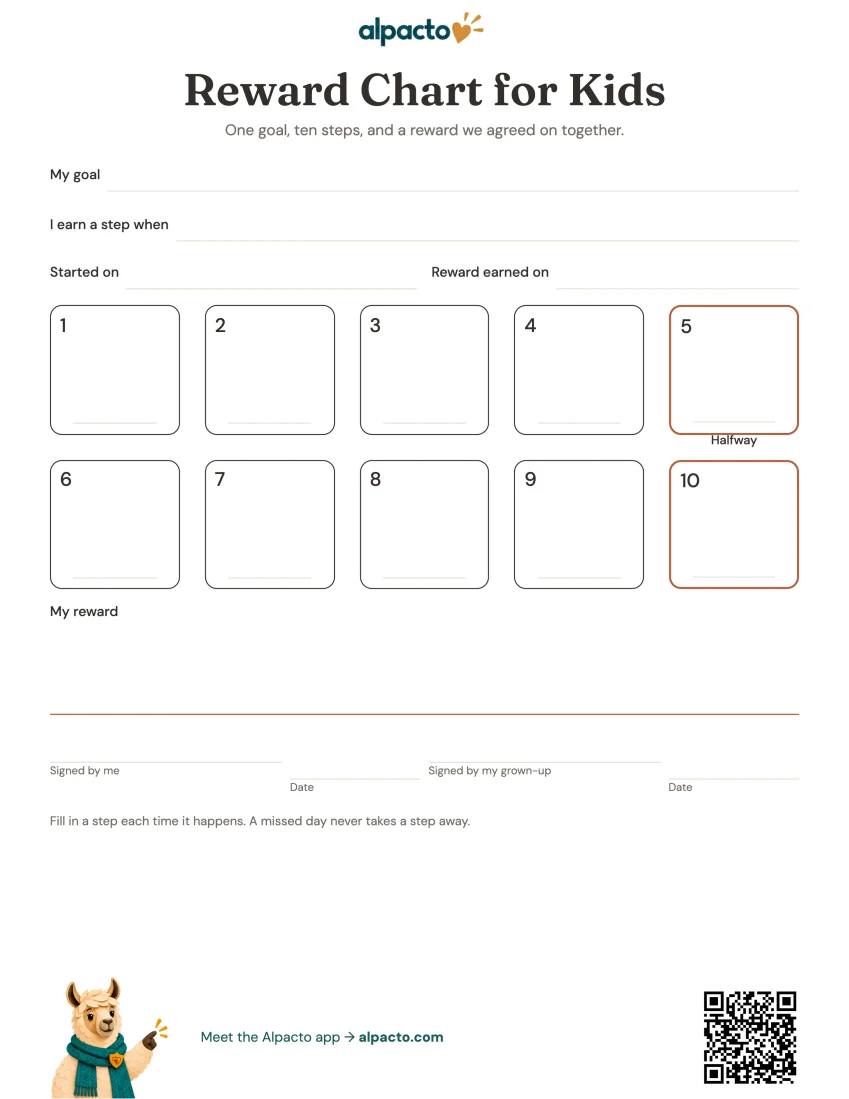
The reward chart is a token board with one item on the menu. Each numbered step is a token, and My reward is signed by the child and the grown-up before step one, so the price is fixed in ink.
The earn screen time chart uses minutes as tokens. Ways to earn holds eight tasks with a price in minutes, and the rule is printed under the log: “Use only minutes you’ve already earned, and never more than the weekly limit.” In the filled example, 225 minutes are earned and 220 used, and Wednesday stays blank.
Questions people ask
What is an example of a token economy?
A four-year-old earns a button in a jar each time their shoes are on by the door before the timer rings, and trades two buttons for picking the bedtime story after dinner. Stickers on a chart, dated steps and logged screen minutes work the same way.
What are the three main components of a token economy?
The behaviors that earn tokens, the tokens themselves, and the rewards the tokens buy. Research adds the timing: when tokens are earned, when the shop opens, and how many tokens each reward costs.
What are the drawbacks of using a token economy?
Gains can fade once the tokens stop, a gap Kazdin and Bootzin pointed out in 1972. Tangible rewards can also lower a child’s interest in something they already enjoyed. Keep tokens for dull jobs, pair each with praise, and plan the fade from the start.
Do token systems work for children with ADHD?
We have no source that promises results from a home chart, so we will not promise any. The AAP guideline lists point systems among school supports for ADHD and recommends parent training in behavior management first for children under 6. Ask your child’s clinician how a chart fits into that plan.
Do token charts work for teenagers?
Yes, with points and privileges the teen helps price, rather than stickers. Raising Children Network notes that older children might prefer the chart in their bedroom or somewhere else private.
Is there a token economy app for kids?
Alpacto works for a parent and a teenager of 13 or over, the age in our terms of use: a routine or task carries coins and a reward you both chose. Younger children use a paper chart, or a parent’s screen. Coins stay inside the app and are never money.
Other apps that run points for children are compared by what the child earns in our reward chart app review.
When the jar moves to two phones
In Alpacto, a pact between a parent and a teenager of 13 or over (our terms) holds the job, the coins it earns and a reward you chose together. One of you marks it done, the other confirms. Younger children keep the paper chart, or share a parent’s screen.