
Alpacto › Free printables › Kids › Sticker chart
A printable sticker chart with the reward written down before the week starts
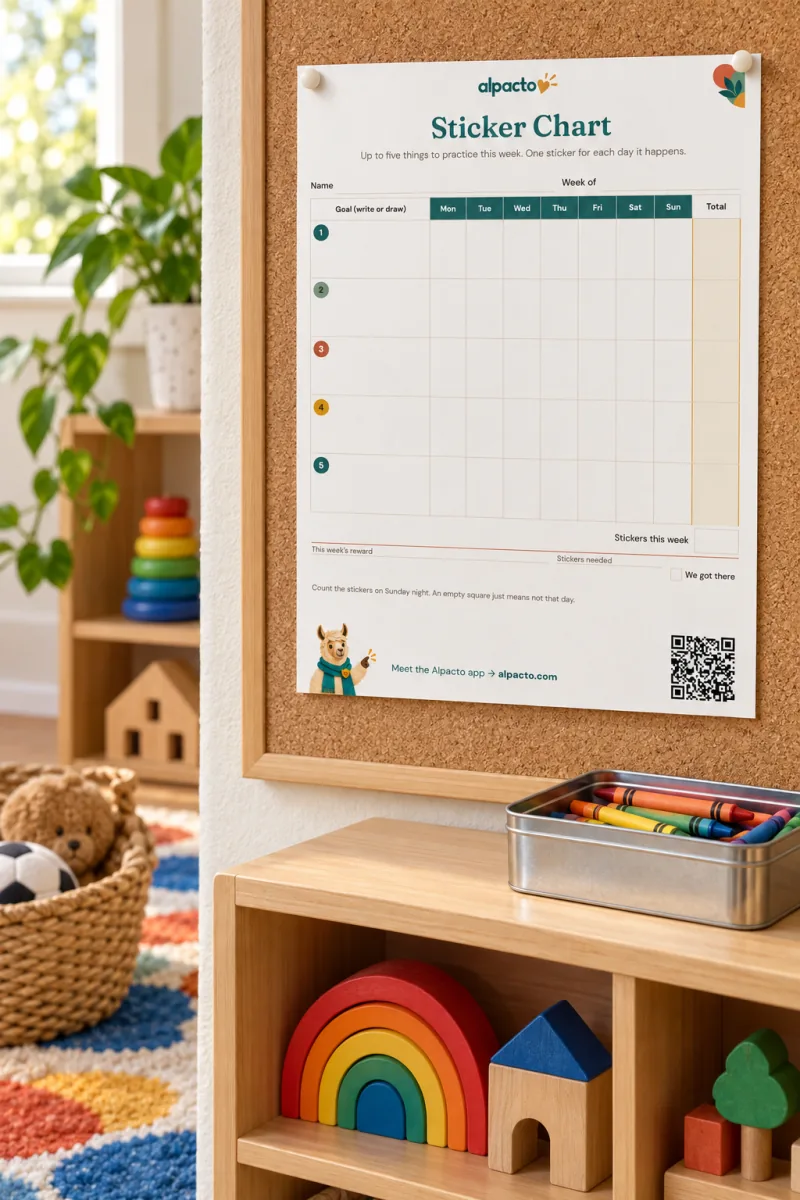
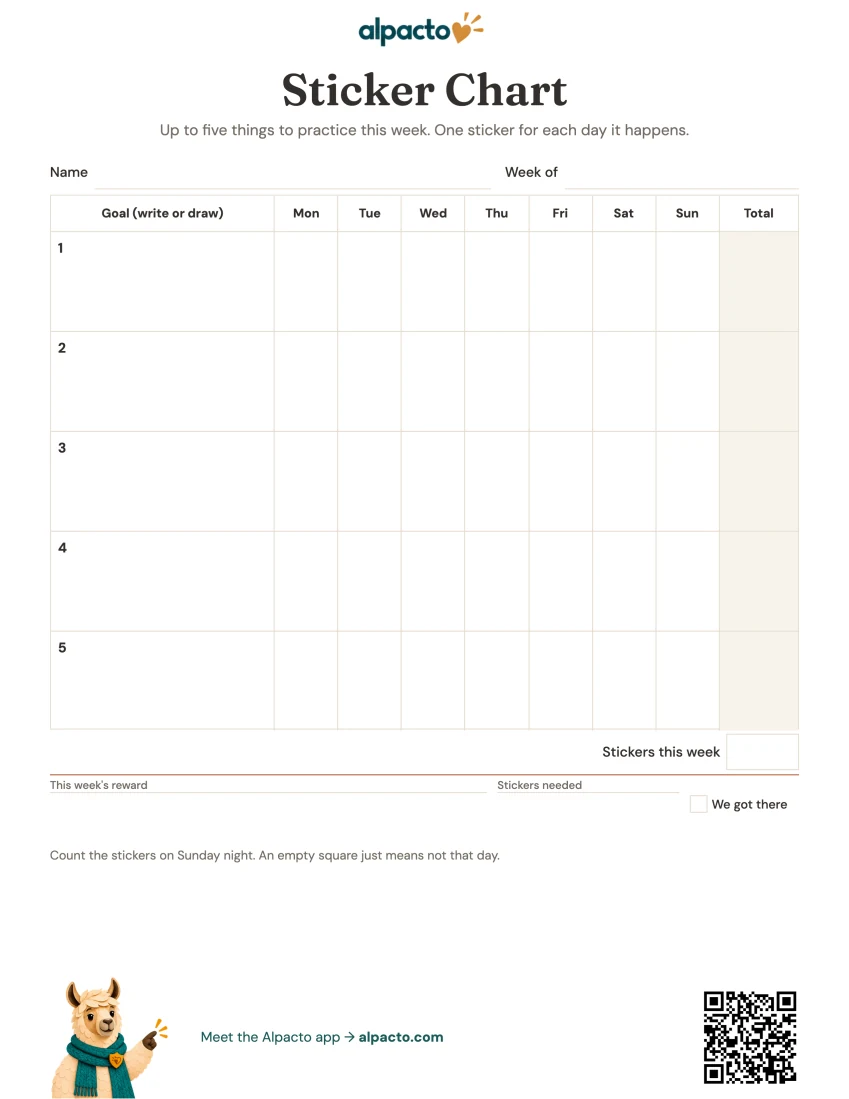
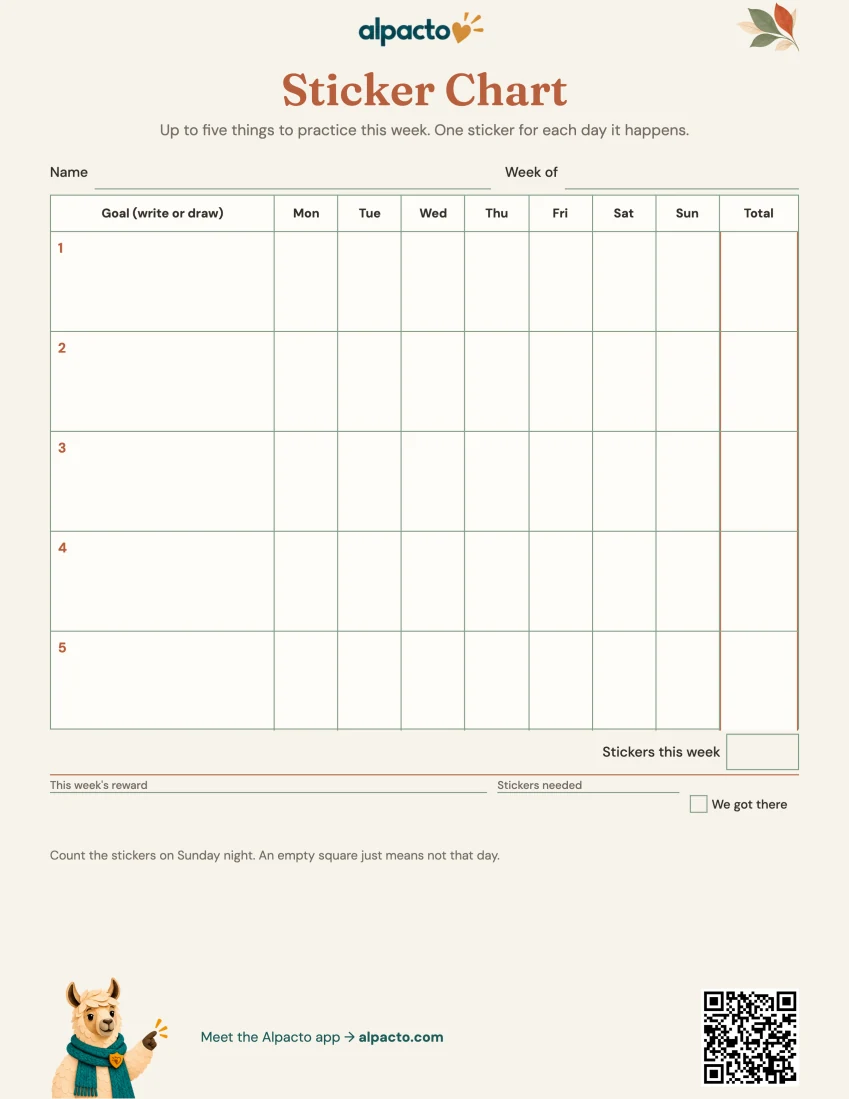
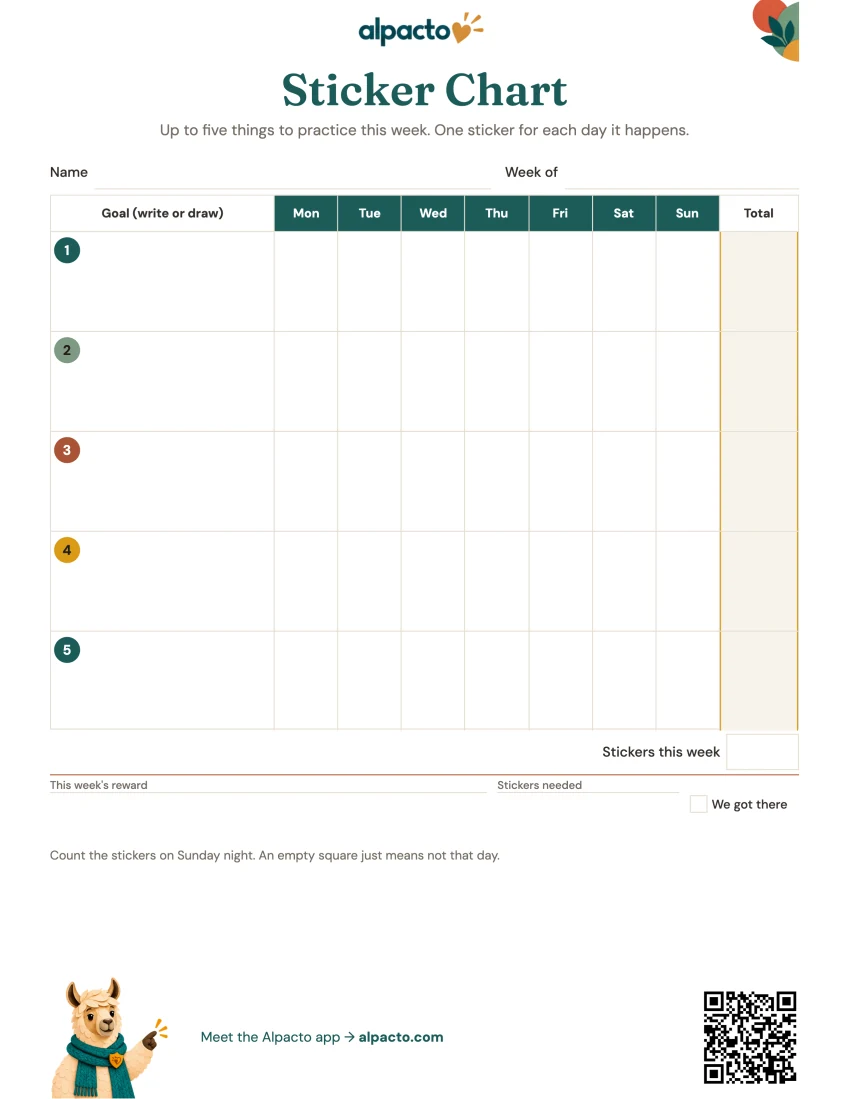
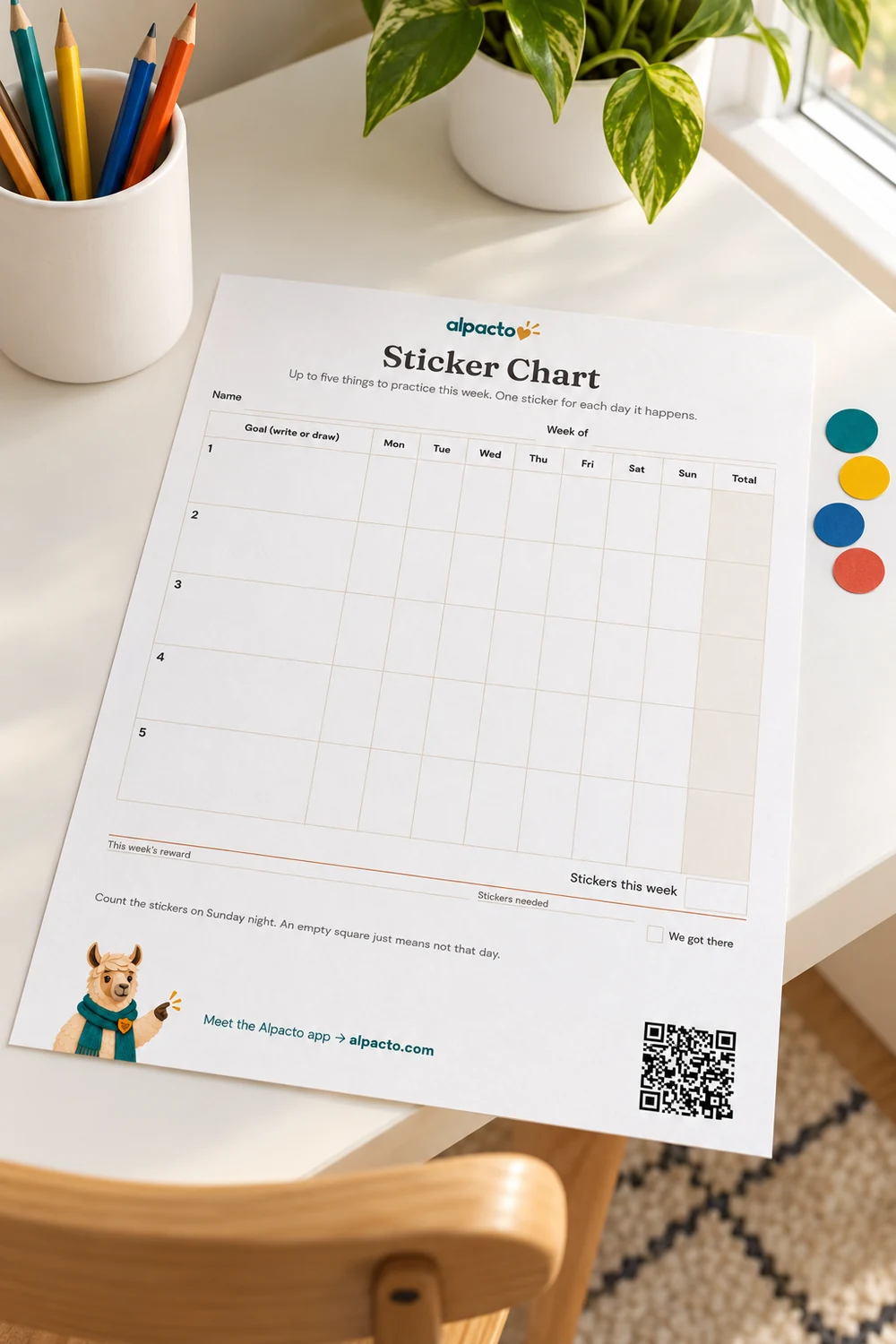
This printable sticker chart holds one week and up to five goals, with a square for every day. At the bottom is a box for the reward and the stickers it takes. An empty square takes nothing away, and the sheet says so in print.
- Pages
- One week on one page, Letter and A4
- Goals
- Up to five, each with seven day squares and a Total
- Reward
- Named in advance, with the number of stickers it takes
- Versions
- Blank, filled-in example, fillable PDF
- Designs
- Minimal, warm and color
What is on the sticker chart printable
The week grid
Five rows for goals, seven squares across for Monday to Sunday. Each square is 0.64 by 1.0 inches, drawn for one sticker up to 0.6 inches across.
Goal: write or draw
An empty box with the row number and no ruling inside: a drawing of a toothbrush for a three-year-old, the words for a seven-year-old.
The strip that makes it a sticker reward chart
A Total column and a Stickers this week box, counted on Sunday night; under them This week’s reward, Stickers needed and a We got there checkbox, filled in before Monday.
A day without a sticker takes nothing away
Most charts on the fridge die the same way. A child misses two days, someone takes a sticker back or marks the gap in red, and the page becomes a record of failure. This sheet prints one line under the grid instead: count on Sunday night, and an empty square just means not that day.
That rule is not ours. The CDC, in its guidance for parents of toddlers and preschoolers, puts it in one sentence: “Never take away rewards your child has earned. Rewards that your child has earned are theirs and should not be removed for misbehaviors.”
So nothing on the sheet is red, and there are no crosses. Rows hold whatever you agree on: teeth brushed on a bedtime sticker chart, the plate carried to the sink on a chore sticker chart, and a whole morning of steps has its own routine chart for ages 3 to 12. The same CDC page calls the refrigerator a good place for it, for the plain reason that the child walks past it.
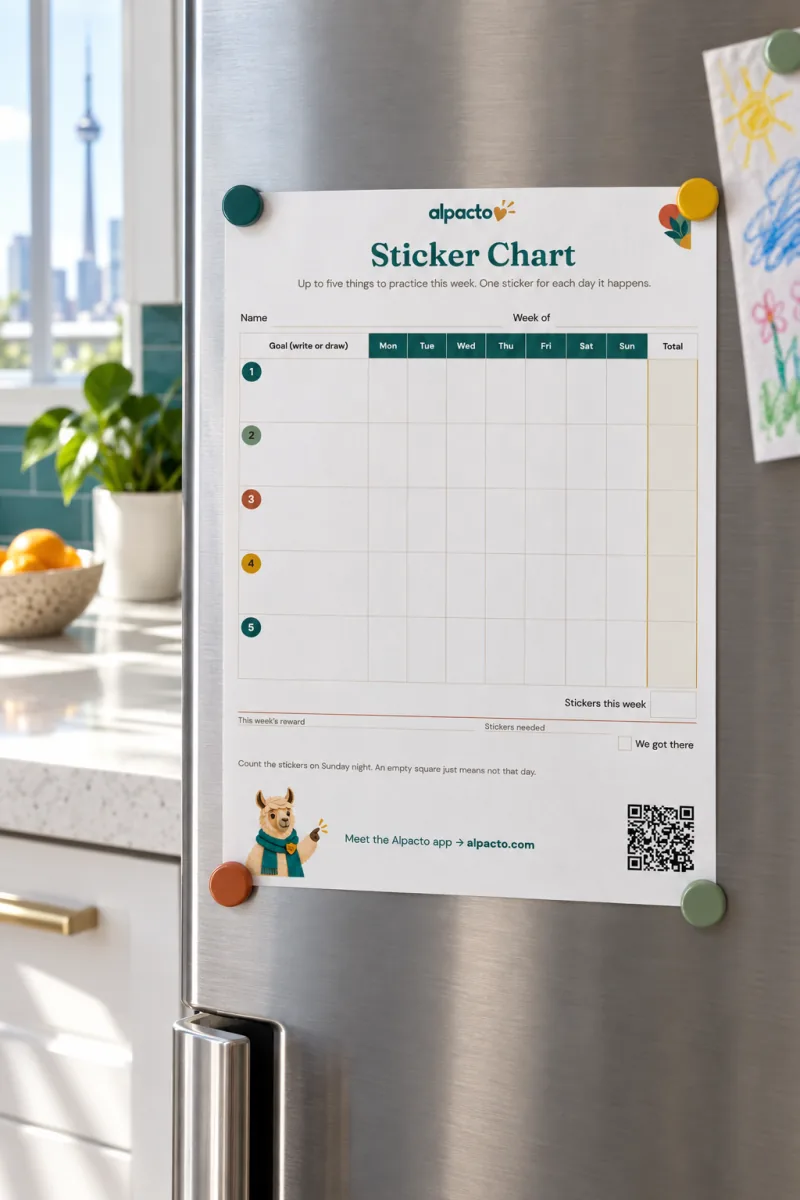
One week, five goals, up before the first sticker goes on.
Name the reward on Monday, not on Sunday night
This week’s reward and Stickers needed are filled in with the child on Monday. The count goes in the Total column on Sunday, and the We got there box is ticked or not. A reward agreed in advance survives a bad Wednesday; one invented on Sunday night is a negotiation, and children win those.
The American Academy of Pediatrics adds two things. The reward should be “meaningful to your child” and picked with the child; the chart is a measure of success, because penalties and demerits “can be humiliating or discourage your child from even trying”. Both are built into the layout, which has a blank reward line and no column for anything lost.
We read the four free printable collections in these results end to end on September 18, 2026. Between them, the words phase out, fade, lose interest, take away and stickers needed appear zero times. They hand you the drawing; the sticker chart reward system around it stays your job.
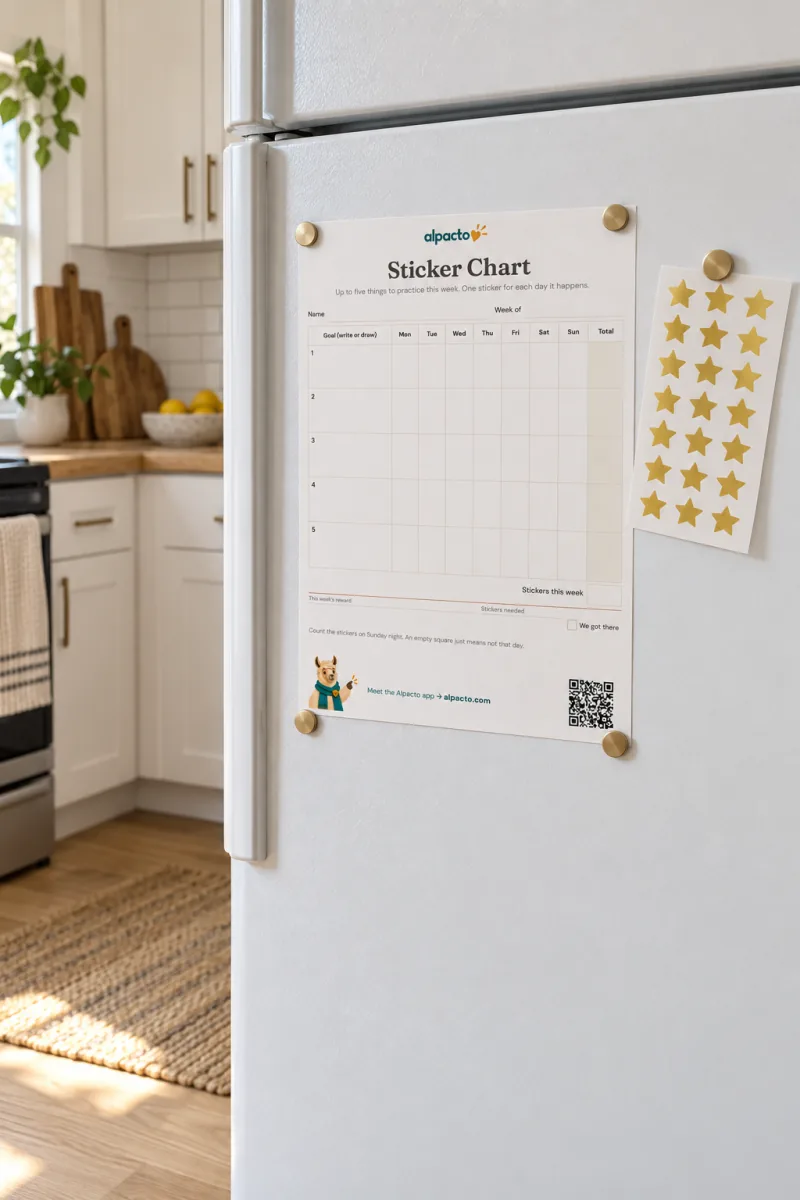
The chart and the stickers in the same place, at a height the child can reach.
Download the free printable sticker chart
Three designs, the same grid in each. Every free printable sticker chart here comes with no email.
The sign that the chart has done its job
The sheet is meant to run out, and the American Academy of Pediatrics describes the moment to look for: “Gradually phase out this program as your child internalizes their behavior. Usually, you can tell they’ve reached this point when they lose interest or forget to ask for their points.” A child who stops asking about the stickers has not got bored with the chart; that is the result.
The same source sets the age range: paper stars “tend to work better for early school-age children; points and contract systems work better for older children”. So this childrens sticker chart runs a week at a time, while the grown-up version, our monthly habit tracker, counts streaks. For a preschool sticker chart, use one or two rows rather than five.
When a week goes wrong, the CDC gives three questions. Can the child do what you ask, is the behavior clear enough to see, and is the reward still wanted. Children, it adds, “become tired of some rewards and develop new likes and interests”, which is why the reward line is rewritten every Monday.
Questions people ask
Where can I find free sticker charts?
Here, with no email and no account: blank, a filled-in example and a fillable PDF, in Letter and A4. The other collections in these results have more themed designs; none of them prints a reward box with the stickers it takes.
At what age do sticker charts work?
The American Academy of Pediatrics puts paper stars with early school-age children and points or written contracts with older ones. This sheet is drawn for roughly three to eight: a preschooler needs the goal drawn rather than written.
How can I create my own sticker chart?
Rule five rows for goals, seven columns for the days, a narrow total column, and a strip at the bottom for the reward and the stickers it takes. That strip turns a grid into a printable reward sticker chart, and it is the part people leave out.
Do sticker charts work for ADHD?
A chart is not a treatment, and no printable sheet should be sold as one. What the CDC says is that for children with ADHD under six, the American Academy of Pediatrics recommends parent training in behavior management before medication is tried, and reward programs are part of that training. Ask your clinician what it should look like for your family.
Do sticker charts work for potty training?
That job has its own sheet, the potty training chart, because its day squares hold several tries rather than one. Use this weekly sheet for goals that happen once a day.
Is there an A4 version, and can I type into it?
Both. Every design comes in US Letter and A4, the same one-page layout on each. The fillable PDF has 15 text fields for the name, the week, the goals, the totals and the reward, plus 36 checkboxes.
Other free printable sheets
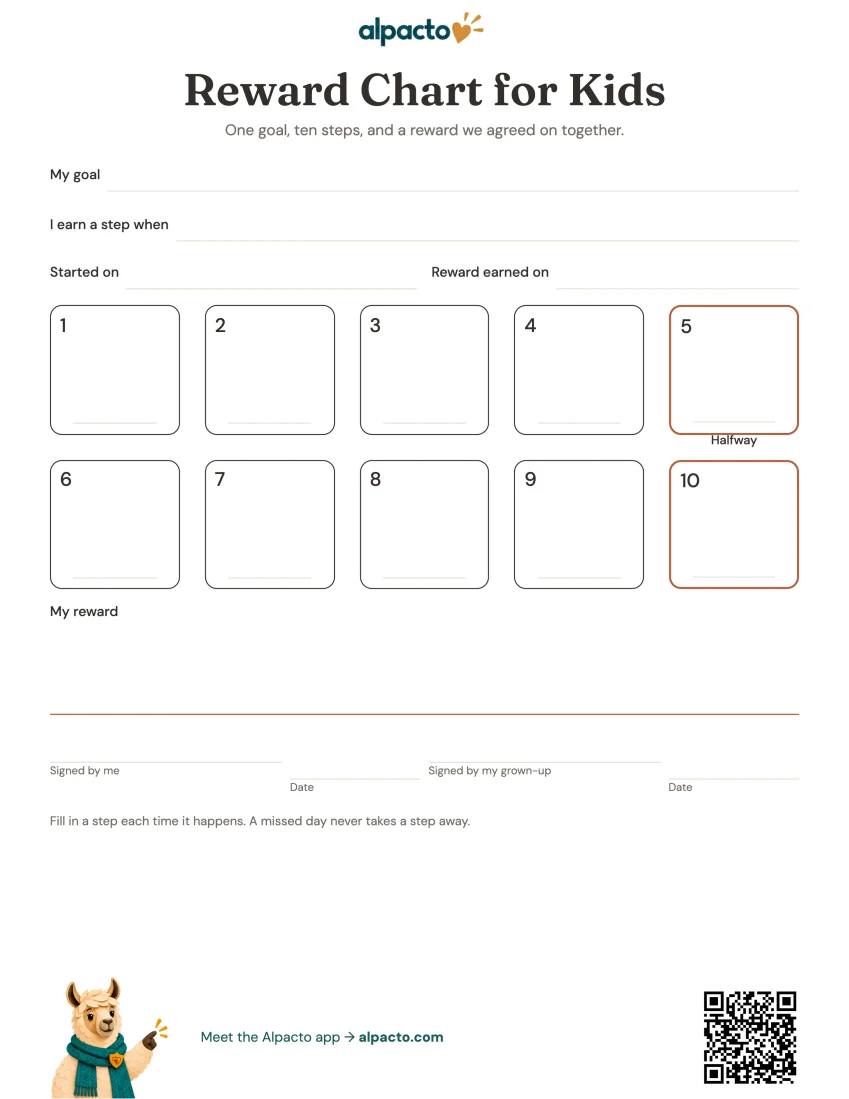
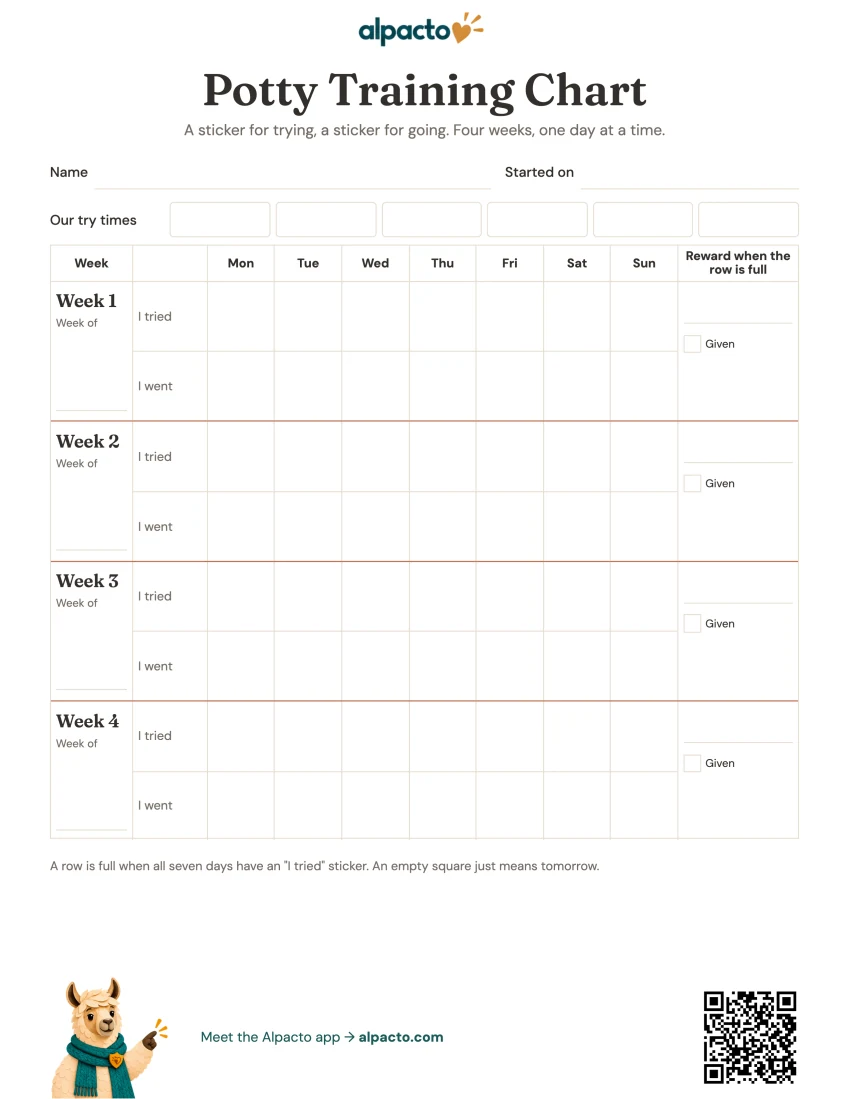
Save this chart to Pinterest
Pin it now and the chart is on your board the next time you buy stickers. A clean grid of squares, a reward line at the bottom, and room for their name — blank, US Letter and A4.
The same week, counted for you
Paper is honest, but the adult is the one who has to remember. In Alpacto each row of this sheet is a routine: the child marks the day, the adult confirms it, and the coins count themselves. Accounts start at 13; younger children use the sheet, or the grown-up’s screen.