
Alpacto › Challenges & games › Questions to ask before moving in together
Questions to ask before moving in together: 63 of them, and an agenda for the ones you disagree on
The questions to ask before moving in together cover money, chores, space, guests, routines, pets and the lease. Below are 63 of them in seven groups. Mark each one, and the page turns the open ones into a printable agenda, with a moving in together checklist as a second sheet.
Mark the answers, print the open ones, talk before you sign.
In short
Ask about money, chores, space, guests, sleep, pets and the lease before you sign. Mark every question as agreed, to talk about, or a deal-breaker.
Settle the deal-breakers first, because they decide whether to keep looking at apartments together. Then work through the “need to talk” list in short sittings and write down what you decide.
Questions to ask before moving in together: mark each one, then print what is left to discuss
Each of you reads the question and gives your own answer, then you mark the one that fits you both.
Use We agree when your answers match. Use Need to talk when they do not, or when you have not thought about it. Use Deal-breaker when the answer decides whether you move in at all.
Money and rent
- How will we split rent: equally, or in proportion to what each of us earns?
- Who pays the landlord, and by what date each month?
- Will we keep separate accounts, open a joint one for the home, or mix the two?
- Which bills and subscriptions are shared, and which stay with one person?
- How do we split groceries and household supplies?
- What size of purchase for the home needs a yes from both of us?
- What happens if one of us loses income for two or three months?
- How much does each of us owe in debt, and does it change what we can pay toward the home?
- Who is responsible for the deposit now, and who gets it back later?
- How often will we check the numbers together, and where do we keep the record?
Chores and housework
- What does clean mean to each of us, room by room?
- Which chores does each of us dislike most, and which do we not mind?
- Do we split chores by task, by day or by time spent?
- Who notices and plans, such as buying supplies and booking repairs, not only who does?
- How long can a dirty dish, a full bin or a laundry pile sit before it counts as a problem?
- Will we hire help with anything, and who pays for it?
- Who cooks, who shops, and what happens on nights neither of us wants to?
- How do we ask for a chore to be done without it sounding like a reminder?
- When the split stops feeling fair, how will we say so?
Space and stuff
- Whose furniture and belongings come, and what do we sell or store?
- Who decides how the home looks: colors, art, the couch?
- Does each of us get a spot that is only ours, such as a desk, a shelf or a closet side?
- If one of us works from home, where do they work and what are the quiet hours?
- What do we do with items that carry old relationships or strong memories?
- How do we feel about borrowing each other’s things without asking?
- How much clutter is fine, and where does it live?
- What happens to what we buy together if we split?
- Is there a room or corner either of us can close the door on?
Guests and family
- How much notice does the other need before a friend comes over?
- Can friends or family stay the night, and for how many nights?
- How often do we want evenings at home alone, just the two of us?
- How do we feel about family dropping in, or having a key?
- Which holidays and weekends do we spend with whose family?
- Do we host, and who does the work when we do?
- What is our rule for a friend who needs somewhere to stay for a while?
- How do we say no to a visitor without it becoming an argument?
- How do we feel about the other person’s friends and exes?
Routines and sleep
- What time does each of us go to bed and get up, and who is the lighter sleeper?
- Do we share a bed every night, and what do we do about snoring or room temperature?
- How much alone time does each of us need after a long day?
- How do we feel about screens, TV and noise in the evening?
- Who showers first, and how long do we have in the bathroom on workday mornings?
- What do mealtimes look like: together, apart or whenever?
- How do we feel about quiet mornings versus talking mornings?
- What does a normal weekend look like for each of us?
- How do we behave when we are stressed, and what helps?
Pets
- Does either of us have a pet, or want one?
- Who feeds, walks and cleans up, and who pays the vet?
- Do pets sleep in the bedroom or in the bed?
- Does the lease allow pets, and is there a pet deposit or monthly pet fee?
- What do we do if one of us is allergic or comes to dislike the pet?
- Who looks after the pet when we travel?
- How do we handle a pet that damages something?
- If we split, who keeps the pet?
If we break up: lease and deposit
- Whose names are on the lease, and what does that mean if one of us leaves?
- If one of us moves out, who keeps the home, and who pays the rest of the lease?
- How much notice do we give each other?
- How do we split the deposit, and who requests it back?
- What happens to furniture and things we bought together?
- Who is responsible for the utilities and the internet contract after one leaves?
- Where does the person who leaves stay in the meantime?
- Do we agree to put this in writing now, while we are happy?
- Who tells the landlord?
Your agenda
Mark a few questions to see your agenda.
Print opens your browser’s print window. Choose “Save as PDF” there if you would rather keep a file.
Moving in together checklist: lease, deposit, utilities, insurance
These are the practical jobs behind the questions. Pick an owner for each, then print the sheet. The owner does the job; the other person does not remind.
Lease
- Read the whole lease together before either of you signs
- Decide whose names go on the lease, and why
- Put the lease end date and the notice deadline in a shared calendar
- Check what the lease says about guests, pets and subletting
- Save a copy of the signed lease where you both can reach it
Deposit and move-in day
- Agree who pays the deposit, and how it is split, in writing
- Photograph every room and every damage on move-in day
- Return the move-in condition form to the landlord
- Note what each of you gets back when the lease ends
Utilities and accounts
- Decide whose name each account is in: power, gas, water, internet
- Set the start or transfer dates before the first night
- Choose which account pays the bills automatically
- Agree how the bills are split and where the record lives
Renters insurance
- Check whether the lease requires renters insurance
- Decide whether both of you are named on one policy
- List the valuables each of you owns, with photos
Moving day and stuff
- Divide the packing and decide who books the truck or movers
- Agree who keeps which furniture, and how it is marked
- Copy the keys and decide who holds the spare
- Set up one place for the house paperwork
Why to ask these questions before you move in together
Most fights in a new shared home are about things nobody said out loud. One of you pictures quiet mornings, the other pictures separate routines. The Gottman Institute opens its own list of questions to ask before moving in together with exactly this kind of mismatch, and argues that the talk is easier before the boxes arrive.
The things to discuss before moving in together cost an evening, while a broken lease costs money. If one of you wants this as a step toward marriage and the other wants to test it, that is worth knowing before you share a bank transfer. If you are already past this step and thinking about marriage, 100 questions to ask before marriage picks up where this list stops.
How to go through the list without it turning into a fight
Do not try to finish all 63 in one night. Take one group per sitting and stop when your timer ends. The groups are short, so a weekend covers them.
- Answer alone first. Each of you reads the question and decides your own answer before you say it. That stops the first person from setting the answer for the second.
- Mark honestly. “We agree” means the answers match, not that one of you gave in. If you gave in, it is “need to talk”.
- Start with the deal-breakers. If a deal-breaker does not match, say so plainly and stop looking at apartments until it is settled.
- Then take the “need to talk” items. Print the agenda, work through three or four at a time and write the decision on the line.
- Review it after a month. Put a date on the sheet. Most answers look different once you live with them.
Moving in with your partner: what you decide about the lease, deposit and insurance
The checklist above covers the paperwork. The decisions behind it are the ones couples skip, because they feel like a formality. They are not, because they decide who is responsible if something goes wrong.
Whose names are on the lease
Read your own lease before you decide. In many leases every named tenant is responsible for the whole rent, not half of it, but the wording differs, so check yours or ask the landlord. If only one of you is on the lease, the other has no written claim on the home or the deposit, and that is worth a conversation.
The deposit
Write down who paid it and how it is split when you leave. Rules on deposits differ by state, so look up your state’s rules for when it must be returned. Photos on move-in day settle most later arguments.
Utilities and renters insurance
Pick one name per account and say who pays it. Ask whether your lease requires renters insurance and whether both of you can be named on one policy. A landlord’s own insurance usually covers the building, not your belongings, so ask your insurer what yours would cover.
For a written version of these decisions, the living together agreement is a two-page template for money, chores and space. Use this page to find out what you disagree on, and that one to record what you decide. The rent split calculator compares three ways to divide the rent.
The last group: what if we break up
It feels cold to ask. It is also the group that protects the friendship if the relationship ends, because the lease does not end when you do. Settle three things: who may stay, how the deposit is divided, and how much notice each of you gives.
If this group is the one you both want to skip, mark it “need to talk” and take it last. Skipping it entirely is the only wrong answer.
Questions people ask
What are 25 things a couple should discuss before moving in together?
Start with one question from each of the seven groups above. Ask how you split rent, what clean means and whose furniture comes. Add sleep, pets and the lease after that.
The tool above holds 63, so you can mark the ones that matter to you and print them.
How long should you date before moving in together?
There is no research-backed number that we found, and a calendar answer misses the point. A better test is whether you have had the money, chores and lease conversations above and still agree on the deal-breakers. If you have not, the month count does not matter.
What is the 3-6-9 rule in dating?
You will find no authoritative source or research for it. The versions online treat three, six and nine months as milestones in a new relationship, not as a rule about moving in together.
What is the 7-7-7 rule for couples?
It is a popular schedule, not a research finding: a date every week, a getaway about every seven weeks and a romantic trip about every seven months, per Personal Psychology. It is about time together, so it works alongside the talk about moving in.
What are the moving in with partner questions that matter most?
For moving in with boyfriend or girlfriend alike, ask the same questions. The three that decide the most are how the rent is split, what a clean home means to each of you, and who is on the lease. Mark them first in the tool above.
What if you disagree on a question?
Mark it “need to talk” and take it into the printed agenda. Set a short sitting, hear each answer without replying, then agree a trial you can review in a month. If it is a deal-breaker for one of you, settle it before you sign anything.
Where can I find more questions?
For getting to know each other, see 120 questions to ask your partner. To make a regular talk out of it after you move in, see relationship check in questions.
Write the decision down, then keep it where you both see it
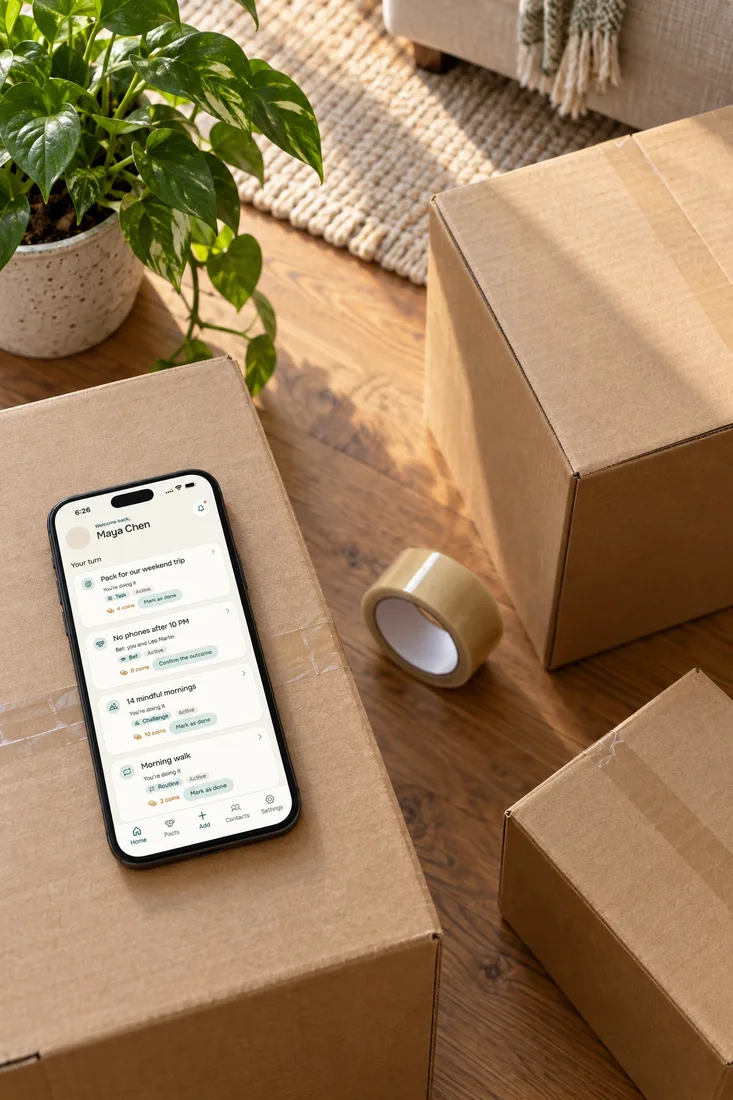
Every item you marked “need to talk” ends in a decision, and a paper sheet on the fridge is the plain way to hold it. In Alpacto one of you proposes the agreement as a pact, the other accepts, and both see what was agreed and what is still owed. It is on iPhone and Android.